Solo Mining
ASIC Tariffs in 2026: Find Your Real Cost
US tariffs can add close to 47% to an ASIC miner's price in 2026. Here is a step-by-step way to calculate what a machine actually costs you.
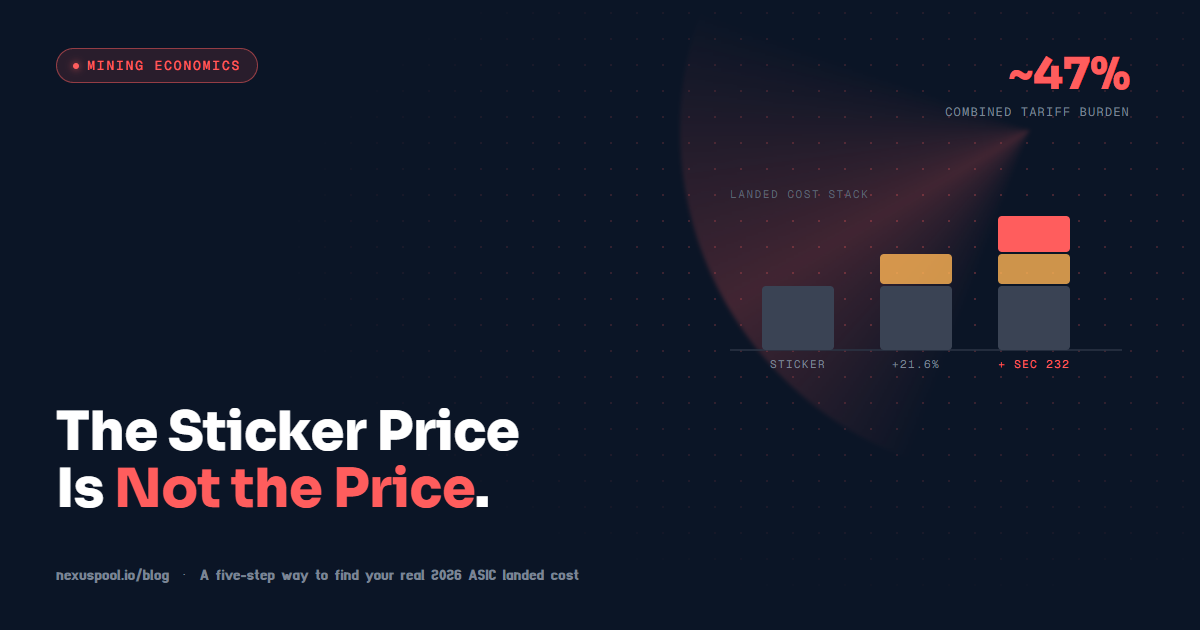
If you are pricing out a new ASIC in 2026, the number on a retailer's checkout page is not what the machine actually costs you. ASIC tariffs 2026 have become a real, sometimes overlooked line item that can add tens of percent to a home miner's hardware budget, and unlike a difficulty change or a price swing, it is a cost you can calculate exactly before you buy. Here is a step-by-step way to work out your own real landed cost, using the actual tariff categories currently in effect.
Step 1: Start With the Sticker Price, Not the Landed Cost
Begin with the advertised price of the machine you are considering, whatever a retailer or manufacturer lists before shipping and duties. This number is your baseline, and it is the number most price comparisons and profitability calculators online still use by default, which is exactly why it understates what you will actually pay if the unit ships from outside the country you live in.
Step 2: Add the Reciprocal Tariff
Most ASIC miners sold into the United States are manufactured in China or assembled in Southeast Asian factories. Reciprocal tariffs finalized in early 2025 raised the import levy on ASIC miners from Southeast Asian factories to 21.6%, up from 2.6% before the increase, while machines imported directly from China face a substantially higher rate under Section 301. Multiply your sticker price by the applicable percentage for your machine's country of assembly, not its brand's headquarters, since assembly location is generally what determines which tariff schedule applies.
Step 3: Add Section 232 Metals Tariffs If They Apply
A second, separate tariff category applies to the steel, aluminum, and copper used in an ASIC's casing, heatsinks, and internal wiring. These Section 232 metals tariffs stack on top of the reciprocal tariff rather than replacing it. Reporting on a flagship Antminer S21 XP found roughly $1,600 in Section 232 metals duties added on top of the existing 21.6% reciprocal tariff, pushing the combined tariff burden on that specific machine to approximately 47% above its base price. Whether your own machine carries a similar metals-tariff exposure depends on its specific materials and declared value, information a retailer's customs paperwork or a customs broker can confirm before you commit to a purchase.
Step 4: Compare Your Landed Cost to Current Breakeven Figures
Once you have a real landed cost, the number that matters is not the tariff percentage itself but what it does to your breakeven point, the price per bitcoin your operation needs to reach profitability given your specific electricity rate and hardware efficiency. Reporting from early 2026 put breakeven production costs for publicly listed American miners at around $74,600 to $85,000 per bitcoin after accounting for tariff-inflated hardware costs, up from levels that made mining comfortably profitable before the tariff increases took effect. Your own number will differ based on your electricity cost and the specific machine's efficiency, but the exercise is the same: landed hardware cost plus power cost, compared honestly against current network difficulty and block value.
Step 5: Decide What Your ASIC Tariffs 2026 Math Actually Means for You
A higher landed cost does not change your odds of finding a block once the machine is running: those odds are set entirely by your hashrate relative to the network's total hashrate, identical for every miner on the chain, and no tariff, discount, or purchase price changes that ratio. What tariffs change is how long it takes your hardware investment to make sense against your own electricity costs and mining goals, a straightforward payback calculation rather than a probability question. If your calculation from Steps 1 through 4 pushes your landed cost meaningfully above what comparable used or domestically assembled hardware would cost, that is a real input worth weighing before you buy, separate from anything about future bitcoin price, which this post makes no claim about.
Recap: Calculating Your ASIC Tariffs 2026 Landed Cost
- Start with the sticker price.
- Add the reciprocal tariff for your machine's country of assembly.
- Add Section 232 metals tariffs if your machine's materials and declared value trigger them.
- Compare the resulting landed cost to current breakeven figures for your own power cost.
- Decide based on payback time and budget, not on any claim about odds or future price.
None of this changes what NexusPool controls once your hardware is running. Solo mining through NexusPool, with the payout design documented on how NexusPool documents its protocol and payout design, charges 0% pool fee and pays 100% of a found block's reward, subsidy plus fees, directly to your own address across Bitcoin, Litecoin, Dogecoin, and Bitcoin Cash, regardless of what your hardware cost to land. You can review the pool's terms before relying on any of this for your own planning, and NexusPool's Payout Preflight tool lets you check how a found block's coinbase transaction would be constructed before you have found one, independent of what you paid for the machine that might find it.
This post is not investment advice, makes no claim about future bitcoin price, and does not claim that any tariff status, hardware purchase, or pool choice changes your odds of finding a block, which are set purely by difficulty relative to your own hashrate. It is also not a claim that NexusPool's core software is open source. Tariff rates and classifications change and vary by machine and importer; confirm current rates with a customs broker or official U.S. Customs and Border Protection guidance before relying on any specific percentage. For the reporting behind the cost figures used above, see crypto.news's coverage of the 47% tariff-driven cost increase.
Trust nothing. Verify your own machine's actual landed cost before you compare it to anyone else's breakeven number.