Glass Ledger
Should You Upgrade to the Bitaxe Naja Duo? A Self-Check
The Bitaxe Naja Duo is the first Bitaxe on a 3nm ASIC. Run this checklist to decide if upgrading your home solo miner actually makes sense.
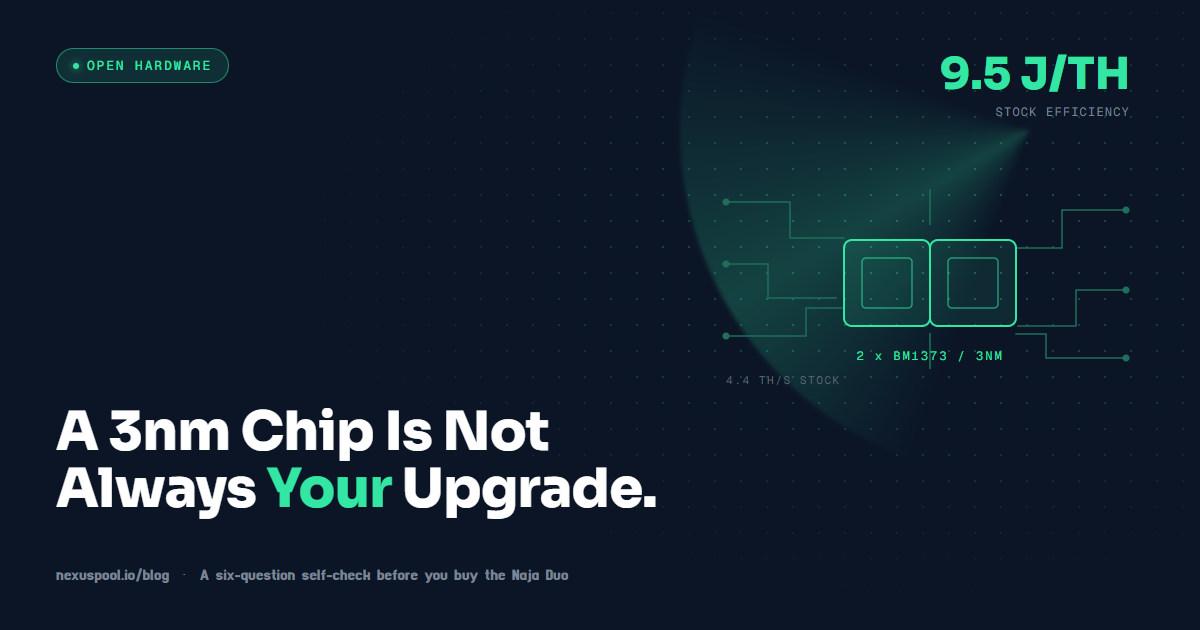
The Bitaxe Naja Duo, released in August 2026, is the first Bitaxe built on Bitmain's 3nm BM1373 ASIC, and it is the first Bitaxe model to break the single-digit joules-per-terahash efficiency barrier at stock settings. If you already run an older Bitaxe or NerdQAxe model, or you are choosing your first open-source solo mining device, the Bitaxe Naja Duo upgrade question is less about whether the hardware is genuinely better, which on paper it is, and more about whether that improvement actually matters for your specific setup. Run through the checklist below honestly before deciding.
What the Bitaxe Naja Duo Actually Changes
The Naja Duo pairs two BM1373 ASIC chips, the same 3-nanometer SHA-256 chip family Bitmain uses in its Antminer S23 generation, on a single open-source board running AxeOS, the community-maintained firmware that powers every Bitaxe. At stock settings it produces about 4.4 TH/s at roughly 9.5 to 9.8 joules per terahash, and overclocked configurations push output to around 8 TH/s at about 11.5 J/TH. That stock efficiency figure is a real jump from earlier models. For comparison, the original Bitaxe Gamma 602 from 2024 produced about 1.2 TH/s per board, meaning the Naja Duo's per-board hashrate has grown roughly fourfold in under three years on similar open-source firmware. One independent review flagged a real caveat worth weighing before you overclock: pushed to maximum overclock, the same BM1373 chip's efficiency degrades back toward roughly 15 J/TH, erasing most of that efficiency jump and effectively costing you a premium for the newer chip while only matching the efficiency of an older one at that specific setting.
The Bitaxe Naja Duo Upgrade Self-Check
Answer each question honestly about your own setup, not about the hardware in the abstract. A specification sheet describes what a chip can do in a controlled test, not what your particular unit will do in your particular room, on your particular power circuit, next to whatever else you already have running.
- Is your current miner more than one hardware generation old, meaning its stock efficiency sits meaningfully above 10 J/TH?
- Does your electricity cost make efficiency gains, rather than raw hashrate, the bigger lever for your own economics?
- Do you plan to run the new hardware at or near stock settings, rather than pushing maximum overclock where the efficiency gain shrinks?
- Are you comfortable flashing and maintaining open-source firmware, AxeOS and esp-miner, yourself, including updates as the project evolves?
- Does the unit's price fit your budget as a hobby or research expense, not as something you are counting on to pay for itself on a fixed timeline?
- Is your current pool or node setup already compatible with a new device without reconfiguration, or are you prepared to handle that setup step?
If You Answered Yes to Most of These
A Bitaxe Naja Duo upgrade likely makes sense for you: the efficiency gain is real at stock settings, and your setup, budget, and expectations are aligned with what the hardware actually delivers rather than with whatever grabbed your attention about a 3-nanometer chip as a headline number.
If You Answered No to Several of These
Hold off, or treat this specifically as a hobby purchase rather than an upgrade decision. An older, fully paid-off miner running at a higher J/TH figure can still be the more rational choice if your electricity is cheap, your current hardware works, or you are not prepared to run and maintain new firmware yourself. None of that makes older hardware a worse choice in every case; it makes the decision dependent on your specific numbers, not on which chip is newest. A machine that already covers its own power cost and keeps running without attention has already done its job, regardless of how it compares to a chip released this year.
What This Checklist Does Not Tell You
No efficiency gain, chip generation, or hashrate figure changes your odds of finding a block on any chain. Your probability of finding a block is set by your own hashrate relative to the network's total hashrate at the time you are mining, identical for every miner regardless of which device produced that hashrate. A more efficient machine can lower your cost per unit of hashrate, which is a real economic benefit, but it does not shift the underlying odds ratio in your favor beyond whatever hashrate increase it actually delivers.
Whichever Bitaxe model or ASIC you run, NexusPool's native support for both Stratum V1 and Stratum V2, with same-port protocol auto-detection, means older and newer firmware both connect without manual configuration. You can review the protocol details NexusPool publishes, check the pool's current uptime on NexusPool's status page, and see what protocol and feature support has shipped over time on NexusPool's changelog. None of this is a recommendation to buy any specific miner, an endorsement of any hardware vendor, or a claim that upgrading hardware improves your solo mining odds beyond the hashrate it actually adds; it is also not a claim that NexusPool's own core software is open source, unlike the Bitaxe firmware discussed above. For the underlying firmware and chip-support details, see the official ESP-Miner firmware release history on GitHub.
If you answered the checklist honestly and the upgrade still makes sense for your setup, confirm your firmware is current, run it at or near stock settings first, and verify your actual efficiency and hashrate on your own dashboard before assuming the specification sheet number applies to your unit.
Trust nothing. Verify your own miner's real efficiency and hashrate against its spec sheet before deciding it was worth the upgrade.