Bitcoin block
Bitcoin Block Submission Process Guide Explained
This Bitcoin block submission process guide explains how a solo-mined block moves from your rig to nodes, and how to check where its reward goes first.
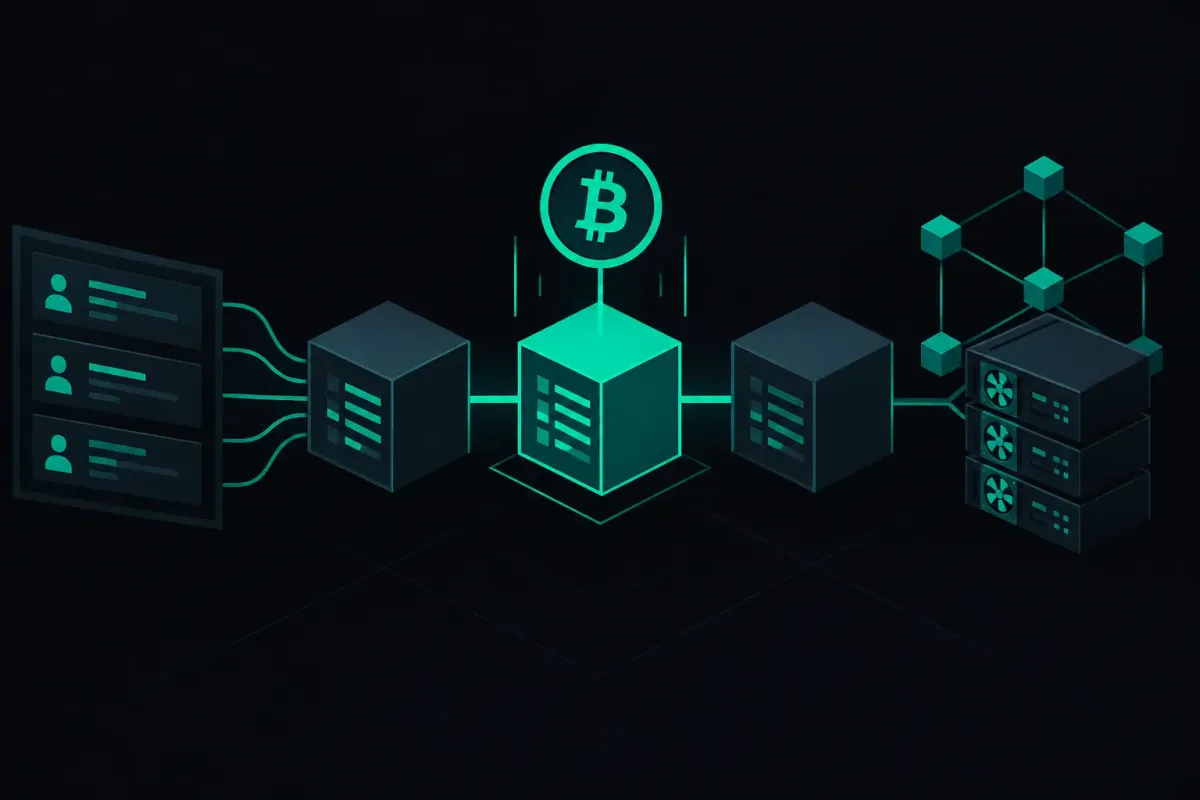
A found block is not a payout request. It is a valid Bitcoin block that must reach the network before another valid block replaces it. This Bitcoin block submission process guide follows that path from your miner's share submission to a block on the network, including the checks that matter when you mine solo.
The odds come first. Network difficulty sets your chance of finding a Bitcoin block. It is the same at every pool. Solo mining is a lottery, and an expected wait is not a schedule. The pool cannot add luck. Its job starts after your rig has done the hash work: give it current work, recognize a winning result, and submit that result without losing time or changing where the reward goes.
Before submission: the pool builds work
Your rig does not usually construct a full Bitcoin block from scratch. It connects to a Stratum endpoint and receives a job. For Bitcoin at NexusPool (nexuspool.io), that endpoint is solo.nexuspool.io:3350. You connect with your own Bitcoin address and no account.
The job gives the rig enough information to construct headers and try hashes. Your payout address is placed in the coinbase transaction for the block template. If your rig finds a valid block, the subsidy and transaction fees are paid to that address in the block itself. There is no balance held for you to withdraw later.
A block template changes when the network changes. A competing block may arrive, the transaction set may change, or the pool may create a newer job for another reason. Old work is not necessarily invalid at the instant a new job arrives, but it becomes less useful. If the network has already moved to a new tip, a valid header built on the old block will not become the next main-chain block.
That is why the time between a new network header and fresh work matters. On NexusPool's Frankfurt server, measured on September 10 and 11, 2026, the median time from a new header to work was 0.49 ms across 162 mainnet blocks. The work was available 205 ms before the node finished validating the new block. That first job contains no transactions. It gets the rig hashing on the new parent while full validation completes. A later job can include transactions.
This is not a claim about odds. It is a claim about avoiding unnecessary work on an old block.
Shares are tests, not block submissions
Most messages your rig sends are shares. A share proves that the rig found a hash below the difficulty target assigned to it. It is almost never below Bitcoin's network target.
The pool reads a share in the form the firmware submitted it. It checks the submitted fields, reconstructs what the rig was trying to hash, and tests the result. A rejected share should have a reason, such as stale work, a duplicate, an invalid nonce, or a result that misses the assigned target. A low-difficulty or malformed share is not close to being a block. It simply does not meet the relevant target.
This distinction matters when diagnosing a miner. A run of rejected stale shares can point to a slow connection or work that arrived late. Invalid shares can point to configuration, firmware behavior, or bad data. The message is evidence about a specific submission, not a judgment about the rig.
If a rig goes quiet for a few minutes, its assigned difficulty can remain in place rather than changing immediately. That avoids making a returning rig solve a moving configuration problem just because it was briefly offline.
When a share is a Bitcoin block
Very rarely, a submitted share also meets Bitcoin's current network target. That is the event miners mean by finding a block.
The pool must treat it differently from an ordinary share. First, it verifies that the header and block data are internally consistent with the job. The previous-block reference must still be usable. The coinbase transaction must carry the payout construction for the job. The merkle root, timestamp, version, nonce, and proof of work must all match what Bitcoin requires.
If the candidate is valid, delay becomes the enemy. Another miner elsewhere may find and propagate a competing block. Neither miner did anything wrong. Bitcoin accepts one chain tip, and competing blocks can occur naturally.
The important question is therefore not whether a dashboard says "found." It is what happens to the complete block candidate next, and whether the reward destination can be inspected before a win.
Check the reward before your rig finds anything
A solo pool can show the payout construction for the current template. NexusPool's Payout Preflight shows the reward built for your Bitcoin address on the current block: the subsidy and the transaction fees in that template.
That check has a limit. Transaction fees can change when the template changes, and a new network block replaces the current opportunity. Preflight is not a promise that the same template will still exist later. It is a way to inspect where a current winning block would pay before your hardware finds one.
For a home miner, this is the useful custody check. Look at the destination address. It should be yours. If you find a block under that template, the payout is part of the block's coinbase transaction rather than an entry in a pool ledger.
Bitcoin block submission process guide: from disk to nodes
Once a valid block candidate is found through Los Angeles, Chicago, or Frankfurt, NexusPool writes it to disk before submitting it to Bitcoin nodes in all three of those cities. Each submission is retried for up to five minutes. If the pool restarts with a block still pending, it submits that pending block again.
Writing first gives the candidate a durable record before network submission. Retrying addresses ordinary delivery failures. It does not force Bitcoin to accept a block that conflicts with a block the network has already accepted.
Singapore has a different path. A block found through Singapore is sent to its own Bitcoin node, not to nodes in all three other cities. That difference is worth stating because "four regions" does not mean every found block follows the same fan-out route.
A node that receives the candidate performs its own validation. It checks the proof of work, transactions, coinbase rules, block weight, scripts, and connection to the chain it knows. If the block is valid and extends the active chain, the node relays it to peers. Other nodes independently repeat the checks.
A submission is therefore not the same thing as a confirmation. Submission means the candidate was handed to a node for validation. Network acceptance means nodes have accepted and relayed it. A confirmation comes when a later block is built on top of it. The distinction is dull but useful. It prevents a local event from being mistaken for a final result.
What to check when the path matters
Start with the connection path. Configure your miner with solo.nexuspool.io:3350, your Bitcoin address, and the worker name your firmware expects. Stratum V1 and encrypted Stratum V2 use the same port, although many home miners still use V1.
Then check the thing that is available before luck enters the picture: Payout Preflight for your address and the current block. Confirm that the destination is yours and that the displayed reward includes both the subsidy and current transaction fees.
If you operate more hardware, watch share reasons as well as accepted-share counts. A sudden cluster of stale shares often has a network or timing cause. A repeated invalid reason calls for checking firmware settings and submitted data. A pool cannot make the lottery predictable, but it should make the path from a rejected share to a reason legible.
Your distance from a server can lengthen the round trip for new work and status updates. That can matter for stale work. It does not change your probability of finding a block. Your hashrate and Bitcoin's network difficulty set that probability.
The useful standard is plain: a pool should let you inspect the payout destination before a find, explain what it accepted or rejected from your rig, and document what it does after a winning submission. Trust nothing. Verify your payout address in the current block template.