Mining Difficulty
Bitcoin's Difficulty Is About to Drop. Here's the Math
Bitcoin's next difficulty adjustment lands around November 12-13, 2026. A step-by-step walkthrough of what a drop actually changes for your solo odds.
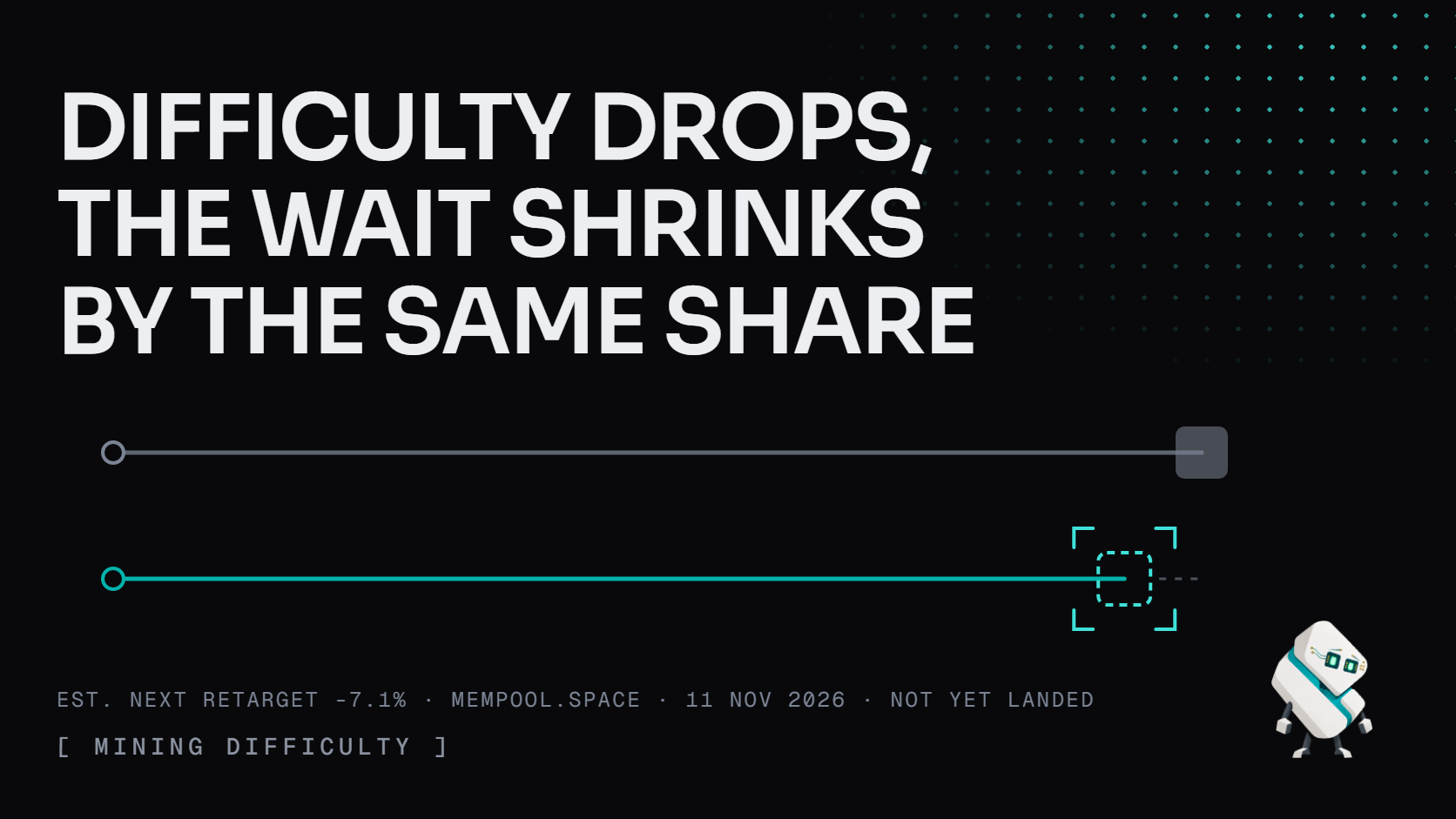
Bitcoin's mining difficulty adjusts automatically every 2,016 blocks, roughly every two weeks, to keep blocks arriving close to once every ten minutes no matter how much hashing power is pointed at the network. The last adjustment, on October 29, 2026, pushed difficulty up 5.54% to 148.36 trillion. The next one is due around block 975,744, which several trackers place around November 12 or 13, 2026, and early estimates from industry sources, including a November 2026 mining-data roundup, put the move anywhere from about 1.5% down to as much as 6.5% down, with the most recent readings clustering nearer 3.7% to 3.85% lower. The live estimate on mempool.space read about 7.1% lower on November 11, with 294 blocks still to go, so the number keeps moving until the retarget lands. None of that is confirmed until the adjustment actually lands, but the direction gives us something concrete to walk through: what does a difficulty drop of a few percent actually do to a solo miner's odds, and what does it not do?
Here's the walkthrough, one step at a time.
Step 1: Know what difficulty actually measures
Difficulty is a number the Bitcoin protocol sets so that, given the total hashing power currently pointed at the network, blocks keep landing about every ten minutes on average. When more hashing power joins the network, difficulty rises to keep the pace the same. When hashing power drops off, difficulty falls for the same reason. It is not a dial anyone turns by hand, and no pool, company, or piece of hardware sets it. It is a mechanical response to how much total hashing power showed up over the prior 2,016 blocks.
Step 2: Turn the difficulty adjustment into an odds change
A miner's odds of finding a block in any given attempt is, in practice, their hashrate divided by the total hashing power competing against the current difficulty target. If difficulty falls by a given percentage and a miner's own hashrate stays exactly the same, their odds of clearing that lower target rise by roughly that same percentage, to a first approximation. Take the clustering estimate of a 3.7% lower difficulty. For a fixed hashrate, a 3.7% easier target makes the per-attempt odds of success about 1 ÷ (1 − 0.037), or roughly 1.0384 times better, meaning about 3.8% more likely per attempt than before the adjustment.
Step 3: Run that percentage through an actual example
Let's use the same kind of home-scale rig a solo miner might actually run: 3 TH/s. At today's difficulty of 148.36 trillion, the network needs about 637 sextillion hashes (148.36 trillion times 2^32) on average to find one block. A rig trying 3 trillion hashes a second would need about 212 billion seconds for one expected block, a little over 6,730 years. Per ten-minute block, that is roughly a 1 in 354 million chance.
Apply the 3.7% easier difficulty from Step 2. The expected wait scales directly with difficulty, so it shrinks to 6,730 times 0.963, or about 6,480 years. That is a real change, roughly 250 years off the expected average, and it is also, in practical terms, no change at all to what that miner should actually expect to happen this year, this decade, or most likely this lifetime. Even the 7.1% live estimate only brings the wait to about 6,250 years.
Step 4: Separate what moved from what didn't
What moved: the mechanical probability of finding a block on any single attempt, by whatever percentage the retarget actually lands at. What didn't move: everything else. Difficulty sets the odds of finding a block, and it sets them the same way for every miner at every pool, NexusPool included; nothing about a protocol, a pool, or a device changes that math beyond the hashrate a miner actually points at the network. A few percentage points of difficulty, up or down, does not turn a multi-millennium expected wait into a realistic monthly or yearly one for a home-scale rig. It only nudges the same long odds by the same small amount in one direction.
Step 5: Check the mechanism you're actually relying on
A difficulty retarget is also a reminder of how much happens between a rig finding a plausible hash and that hash actually counting. NexusPool sends a rig work on a new block before its own node finishes checking that block; on its Frankfurt server across 162 mainnet blocks in September 2026, that first job was ready a median of 0.49 milliseconds after the header arrived, carrying no transactions yet. A breakdown of how NexusPool's stratum setup handles this covers the mechanics in more detail. The pool also tests a submitted share against the network itself before applying its own difficulty, credit, and rate-limit rules over Stratum V1, so a rig that is over its own limit still gets a potential block submitted rather than silently dropped. None of that changes the odds math above; it only changes how much of what happens to a rig's work during a retarget cycle a miner can actually see, through the pool's coinbase-preview tool and its signed hourly receipts.
A note for Litecoin, Dogecoin, and Bitcoin Cash miners
Everything above is written around Bitcoin's roughly ten-minute block pace and 2,016-block retarget window, but the same mechanical relationship holds on every proof-of-work chain NexusPool supports for solo mining, including Bitcoin Cash and the AuxPoW merged-mining pairing of Litecoin and Dogecoin. Each of those networks runs its own difficulty and its own retarget schedule, so a percentage move on Bitcoin's chain says nothing about what Litecoin's or Bitcoin Cash's own next adjustment will do. The same first step applies regardless of chain: find that chain's current difficulty and your own hashrate before reading anything into someone else's number.
Recap: the five steps, compressed
Difficulty resets every 2,016 blocks to keep the ten-minute block pace steady. A percentage move in difficulty produces roughly the same percentage move in a fixed-hashrate miner's odds. Run your own hashrate against the current network hashrate before trusting any headline number. A few percent either way barely dents a wait measured in centuries or millennia for most home rigs. Check what a retarget does to your own math, not to the headline.
This walkthrough is not a prediction of when any specific miner will find a block, and it is not investment guidance. The adjustment estimates above are industry projections, not confirmed figures, and will be superseded once the retarget actually lands.
Trust nothing. Verify the next retarget's real number against your own hashrate once it lands, not against the projection in this post.