Bitcoin Mining
Bitcoin Hashrate Drops: What It Means for Solo Miners
Bitcoin's hashrate hit a three-week low as big miners pivot to AI. Here's the actual math on what a smaller network means, and doesn't mean, for solo mining.
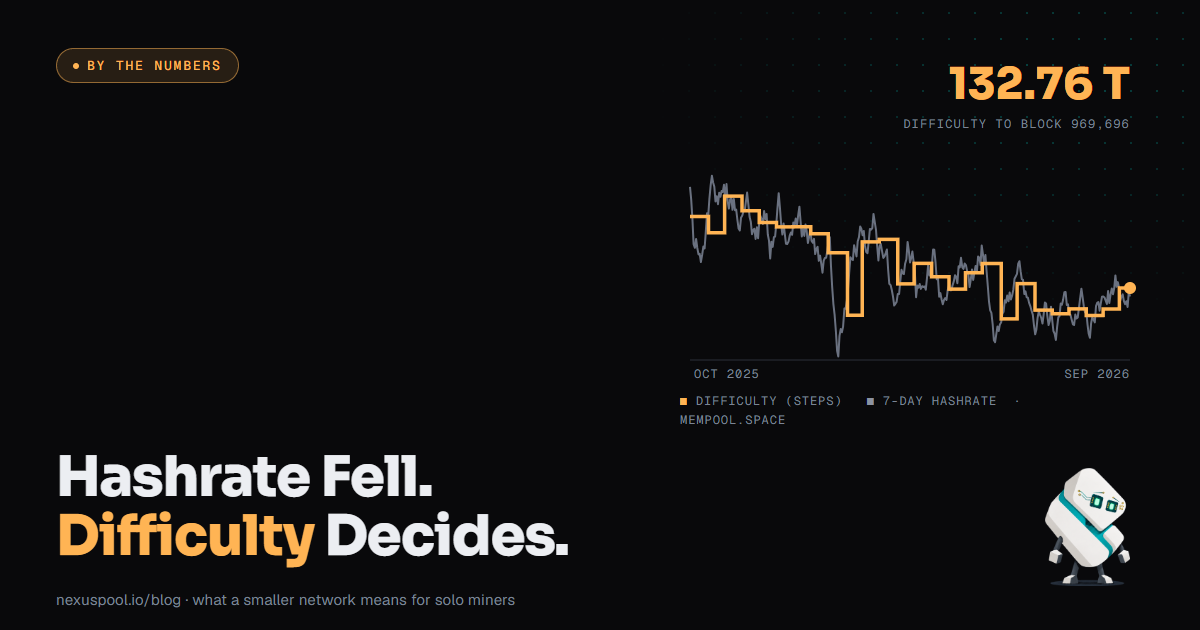
The latest Bitcoin hashrate drop pushed the network's seven-day average down to 915.8 EH/s on September 26, 2026, its lowest reading in three weeks, while miner reserves fell by 1,530 BTC over the same seven days. The headline reads like bad news for network security. For a solo miner running a rig at home, the useful question is narrower: does a smaller network change the expected wait for a given rig, and by how much? The answer is yes, but by less than the headlines suggest, and only through one number. Big operators are switching machines off Bitcoin mining and pointing the power at AI contracts instead, and the protocol only reacts to that at the next difficulty adjustment.
The number setting the pace: 915.8 EH/s
According to a Digital Asset report cited by crypto.news, the seven-day average stood at 915,844,520 TH/s on September 26, about 34.86 EH/s lower than a week earlier and the lowest since around September 3. For scale, the same seven-day average peaked near 1,153 EH/s on October 19, 2025, according to mempool.space's mining data, with single days printing above 1,300 EH/s. Measured seven-day average against seven-day average, today's figure sits roughly 21% below that peak. Gizmodo reported that the network is now running about 50% below its longer-term growth trend. Twenty One Capital CEO Raphael Zagury called the stretch Bitcoin's first "hashrate bear market" in a keynote at Bitcoin Asia 2026 in Hong Kong on August 27, putting the drawdown from the all-time high at roughly 22% to 24%.
The reading is also noisy. By September 28 the same seven-day average had climbed back to 934.7 EH/s. Hashrate is never measured directly; it is estimated from how fast blocks arrive, so a few slow or fast days move it.
The figures, side by side
| Metric | Value | Source period |
|---|---|---|
| Network hashrate, 7-day average | 915.8 EH/s | September 26, 2026 |
| Same average at its peak | ~1,153 EH/s | October 19, 2025 |
| Pullback, like for like | ~21% | peak to September 26 |
| Miner BTC reserves | 1,192,766 BTC, down 1,530 in a week | week to September 26 |
| IREN installed mining capacity | ~23.2 EH/s | June 30, 2026 |
| Keel (formerly Bitfarms) US mining | shut down, zero mining revenue expected in Q3 | since June 29, 2026 |
The pattern spans several companies. IREN's annual report puts its installed mining capacity at about 23.2 EH/s as of June 30, 2026, and says the move from mining to AI cloud services should be substantially complete by the end of this year. Keel, the company formerly known as Bitfarms, stopped mining at its three Pennsylvania sites on June 29 after closing its Washington site in April, and CoinShares expects it to book no mining revenue at all this quarter, the first listed miner to reach zero. Hyperscale Data cut power to the Bitcoin rigs at its Dowagiac, Michigan facility on September 1 to make room for an AI tenant.
Why this Bitcoin hashrate drop is happening
No ban or price crash drove this. Operators made a capacity call. CoinShares estimates that AI data centers earn around $1.5 million a year in profit per megawatt, against roughly $0.5 million for Bitcoin mining on the same power. For a public company whose scarce resource is megawatts, that gap settles the question, and it says nothing either way about Bitcoin itself. CoinShares also counted at least 35 EH/s scheduled to leave the listed miner group this quarter as IREN and Cipher finish their exits, roughly 4% of the network.
What the Bitcoin hashrate drop does to solo mining odds
A rig's chance of finding a block does not depend on the network's hashrate directly. It depends on difficulty, the target every block hash has to beat. Difficulty moves only once every 2,016 blocks, when the protocol compares how fast the last 2,016 blocks arrived against the ten-minute target. Between adjustments, the odds for each hash your rig computes stay exactly where the last adjustment put them, whatever the hashrate charts do in the meantime.
The expected time for a rig to find a block is difficulty multiplied by 2^32, divided by the rig's hashrate. Take an illustrative 1 TH/s rig, a realistic size for a small home setup:
| Difficulty | When it applied | Hashrate it implies | Expected wait at 1 TH/s |
|---|---|---|---|
| 155.97 T | From October 29, 2025 (all-time high) | ~1,117 EH/s | ~21,200 years |
| 132.76 T | Since September 19, 2026 | ~950 EH/s | ~18,100 years |
| ~131.94 T (projected, -0.62%) | Next adjustment, around October 3, 2026 | ~944 EH/s | ~18,000 years |
So the same rig's expected wait is about 15% shorter than at the difficulty peak, not 21% and not 30%. Two details explain the gap. Difficulty never climbed all the way up to the best hashrate days, and the last adjustment, on September 19 at block 967,680, raised difficulty by 4.16%. This week's dip only reaches solo miners at block 969,696, and mempool.space currently projects that adjustment at about 0.62% lower. Projections like that swing as the epoch fills, so treat it as an estimate, not a fact.
Nothing about the rig changed, and nothing about any pool changed either. Difficulty sets the odds for every hash identically at every pool, NexusPool included. An expected wait is also only an average, not a schedule. It describes the middle of a very wide spread of outcomes, not a countdown clock, and a block can arrive far sooner or never arrive at all for a given rig.
What the number doesn't do
A falling network hashrate is not a sign that any particular pool, protocol, or piece of hardware improves anyone's chances beyond what the shared math already allows. It is not investment advice, and mining Bitcoin, Litecoin, Dogecoin, or Bitcoin Cash is not a way to guarantee a return; a shorter expected wait is not a promise that a block is coming on any particular day. Industrial operators leaving for AI contracts is a business decision made at megawatt scale, unrelated to whether solo mining at a kitchen-table scale makes sense for a given person's own goals and budget.
Checking the math yourself
None of the figures above require trusting this post. Difficulty, block times and hashrate estimates are public, and anyone can pull the current difficulty from a block explorer and redo the division above with their own rig's real hashrate. For the parts that touch NexusPool directly, the same principle applies: NexusPool takes 0% of the block reward, and the coinbase transaction pays a miner's own address, not a pool balance, so no custodial step exists where you would need to trust the pool. NexusPool's Payout Preflight tool shows the exact coinbase transaction that would pay a given address on the current block, before any block is found, and the Glass Ledger publishes a signed, hourly receipt of the shares and difficulty the pool counted for each connected rig, checkable against a key NexusPool publishes. Details on how shares are read and tested, and how Stratum V1 and V2 both connect without extra configuration, are on NexusPool's technology page.
The numbers that matter to a solo rig come down to two: its own hashrate and the current difficulty. Headlines about the network hashrate only reach that rig when the next adjustment turns them into a new difficulty. Check the math before you mine, not after.
Trust nothing. Verify the difficulty behind this week's hashrate headlines yourself.