Self-Custody
Bitcoin Whale Wallet Moves $378M After 6 Years
A wallet that received 4,582 BTC nine days before the March 2020 crash just moved $378 million. Here is what the on-chain record actually shows.
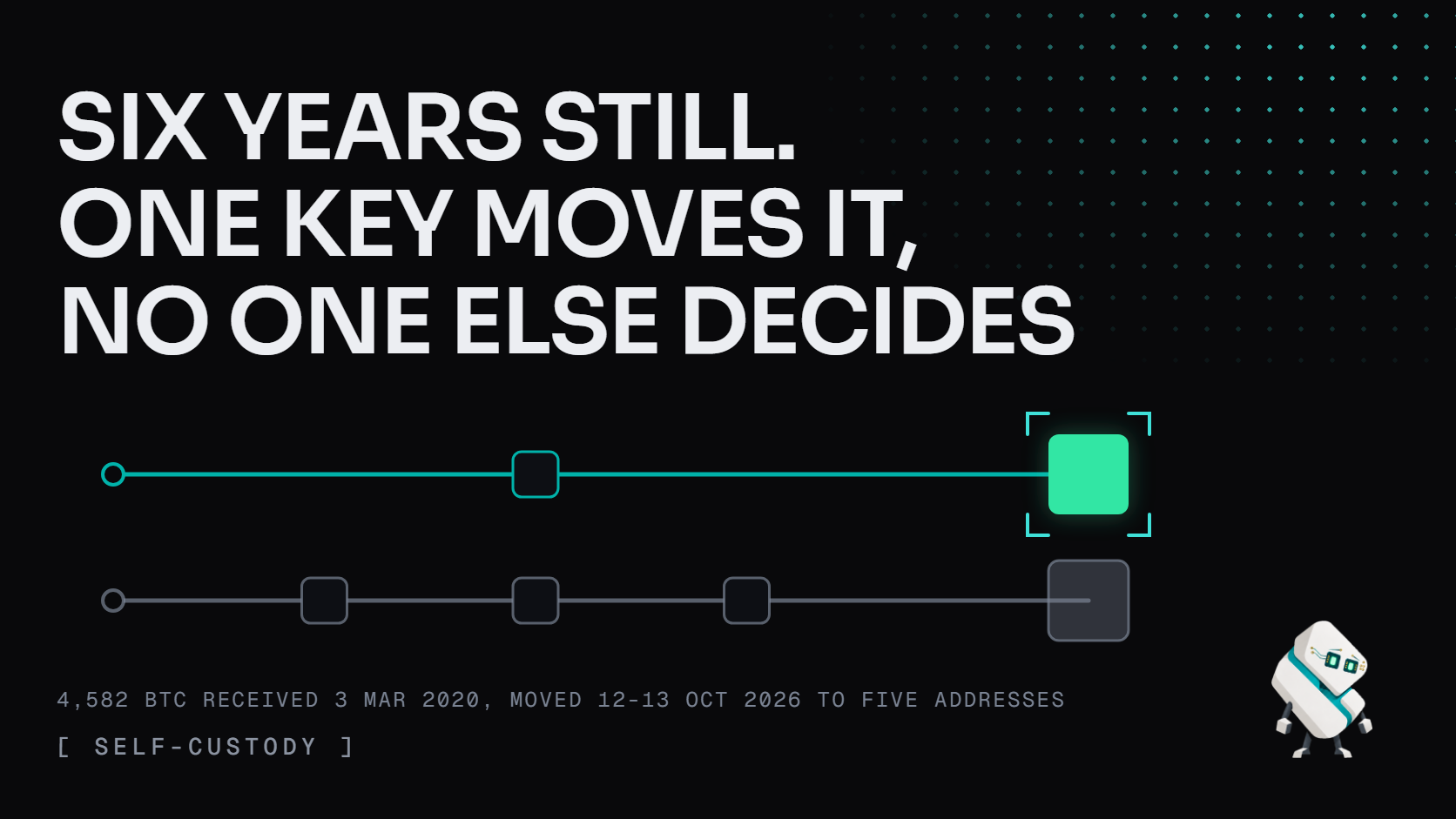
On March 3, 2020, a bitcoin wallet received 4,582 BTC, worth about $40.8 million at the time. Nine days later, the price of bitcoin fell more than 40 percent in a single day as COVID-19 panic hit every market at once. The bulk of the position did not move. It sat through that crash, through the 2024 halving, through two bull runs and the drawdowns that followed each one, for more than six years. Then, on October 12 and 13, 2026, it moved. This bitcoin whale wallet moved its entire position, now worth roughly $378 million, to five new addresses, and the record shows plainly that nobody but the person holding the keys made that call.
This is not a story about where bitcoin's price is headed. It is a story about what six years of silence, followed by one decision, actually proves about who controls a coin.
What the on-chain record actually shows
The transfer itself is not in dispute. The wallet sent 4,582 BTC to five destinations: four addresses received 1,000 BTC each, and the fifth received the remaining roughly 582 BTC. As of this writing, none of the five new addresses has sent any of that bitcoin onward. CoinDesk's reporting on the transfer ties the original deposit to March 3, 2020, the same week bitcoin's price began the slide that would bottom out below $4,000 later that month.
Beyond that, outlets covering the move do not fully agree with each other, and that disagreement is itself worth sitting with rather than smoothing over. Some reports describe the wallet as dormant for four years; others put the holding period at more than six, noting a single outgoing payment of roughly 0.009 BTC in August 2024 that barely registers against the size of the position. Even the transfer date splits across sources, October 12 in some write-ups and October 13 in others. A story built entirely on public blockchain data still arrives through several different lenses, each rounding the details slightly differently.
Why this bitcoin whale wallet moving $378 million does not mean it sold
A transfer between addresses is not a sale. None of the five recipient addresses has interacted with an exchange, and analysts covering the move are split on what it signals. One CryptoQuant analyst pointed to a negative Coinbase premium around the same window, read by some as a sign of selling pressure from US-based participants. Other commentary described the move as the wallet owner reorganizing a position, not a precursor to panic. Nobody outside the wallet's owner knows which read is correct, and the honest description of what happened is "moved," not "sold."
That distinction matters more than it sounds like it should, because it is the same distinction that separates custody from control everywhere in bitcoin. A coin can sit in an address for six years and mean nothing about intent until the owner decides otherwise, on their own schedule, answerable to no one.
The lesson underneath the move: who actually decided
Compare this to a different kind of bitcoin that moves after years of sitting still: funds held by a government seizure, an exchange, or a custodial service. In those cases, a court, a company, or a bankruptcy process decides the timing, and the original owner has no say in when, or whether, the coins ever move again. This wallet is the opposite case. Whoever controlled the private key in March 2020 still controlled it in October 2026, through every market condition in between, and the move happened the moment they chose to make it. No custodian authorized it. No pool or exchange had a vote.
That is the entire argument for self-custody, stated in its plainest form: control is not about what a balance says, it is about who holds the key that can move it. NexusPool's own design follows the same logic on a smaller, verifiable scale. The block pays your address. There is no balance for us to hold. 0% pool fee. Payout Preflight shows the exact coinbase before you find a block. A miner can see that exact coinbase transaction, the one their own address would receive, before any block is found, using NexusPool's Payout Preflight tool, the same way this wallet's owner could, at any point over six years, have checked that the keys controlling those 4,582 BTC were still theirs alone.
NexusPool also builds in a second check on the same instinct. Each hour, a signed receipt for the work we counted. BIP340, against a key we publish. Check it on our home page or in your own code. That hourly receipt, called the Glass Ledger, covers the shares counted from every connected rig, the difficulty they were served at, and the window they landed in. The instinct behind both that receipt and this wallet's six-year silence is the same one: don't take a balance's word for who controls it, check the mechanism yourself. NexusPool's Glass Ledger page shows how that check works, and NexusPool's technology page describes how it applies across the Bitcoin, Litecoin, Dogecoin, and Bitcoin Cash solo mining the pool supports.
None of this is a claim about where bitcoin's price goes next, and it is not a claim that this specific wallet's owner is about to sell, buy, or do anything else. This post does not claim to know that owner's intent, does not treat the transfer as a trading signal, and does not claim NexusPool tracked or verified this wallet beyond the public reporting and on-chain data cited above.
Back to March 2020
Go back to that week in 2020. Markets were falling everywhere, and 4,582 BTC had just landed in an address worth a fraction of what it is worth today. Whoever held that key could have panicked, could have sold into the crash like plenty of others did, or could have done nothing. They did nothing, for six years, through every cycle that followed. The only thing that changed on October 12 and 13, 2026, is that the same person who could have moved those coins at any point finally chose to. That is not a prediction about what happens next. It is a demonstration, playing out in public on a blockchain anyone can read, of what it actually means to be the only one who can move a coin.
Trust nothing. Verify who holds the key before you read a signal into where the coins went.