Payout Preflight
BTCB2's 45-Day Coinbase Lock, By The Numbers
BTCB2 just locked mined coins for 45 days starting today. Here's the math behind that rule, and what it actually means for BTC, LTC, DOGE, and BCH miners.
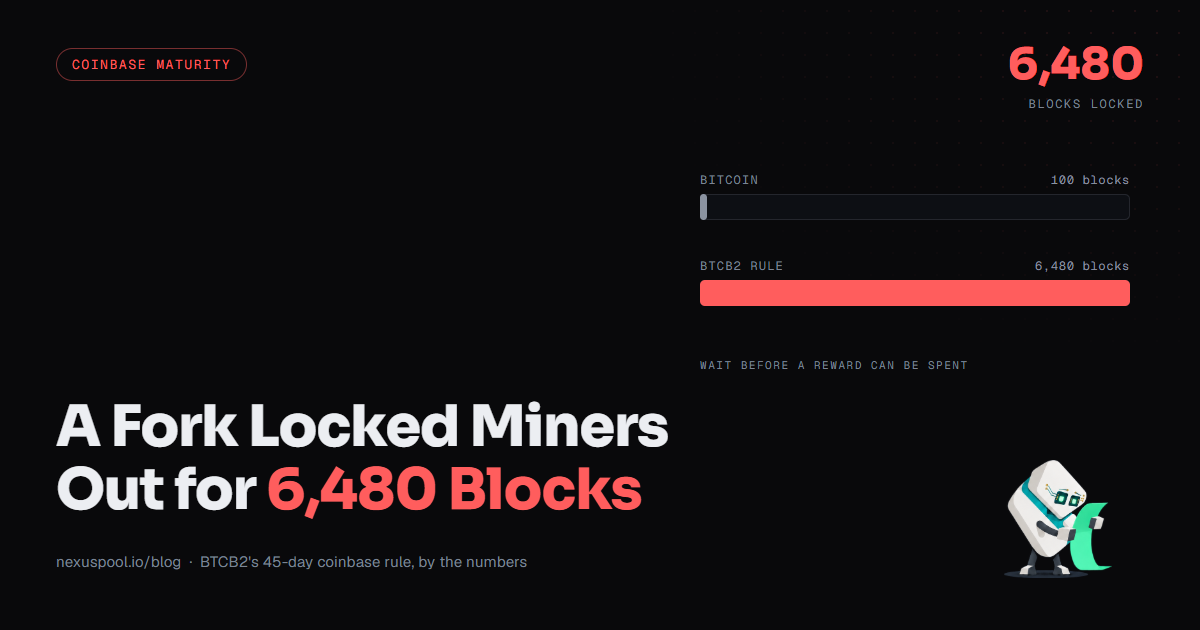
Starting today, September 22, 2026, at block height 973,440, the Bitcoin fork known as BTCB2 (Bitcoin BLAKE2b) begins holding every newly mined coinbase reward for 45 days before a miner can spend it. The rule was merged into the Bitcoin Knots repository as pull request 419 and runs until block 979,920. That is not how Bitcoin itself works, and the gap between the two numbers is the most useful part of this story for anyone who mines on a real chain rather than a two-month-old fork.
BTCB2's Coinbase Maturity, By The Numbers
| Rule | Wait Before Spending | In Blocks |
|---|---|---|
| Bitcoin's standard coinbase maturity | about 16 hours 40 minutes | 100 blocks |
| BTCB2's temporary rule (block 973,440 to 979,920) | 45 days | 6,480 blocks |
| Difference | roughly 65 times more blocks | 6,380 additional blocks |
Bitcoin's normal coinbase maturity requires 100 confirmations before a block reward can be spent. At Bitcoin's roughly 10-minute average block time, 100 blocks works out to about 1,000 minutes, or 16 hours and 40 minutes. BTCB2's new rule stretches that same concept across 6,480 blocks, from 973,440 to 979,920, which is roughly 65 times the block count a Bitcoin miner waits through. The developers describe that window as 45 days.
Why 45 Days
BTCB2 forked away from Bitcoin on August 8, 2026, at block 961,632, and the chain immediately stalled: it inherited Bitcoin's difficulty and managed only about eight blocks in its first 22 days. It was revived by switching the proof-of-work function to BLAKE2b, shrinking the maximum block size, and resetting the difficulty. The switch matters mechanically, because SHA-256d mining hardware, the Antminers and Bitaxes that secure Bitcoin, cannot mine BLAKE2b at all, while Goldshell's BLAKE2b ASICs, originally built for Siacoin, suddenly became relevant hardware for an entirely different chain.
BTCB2 hit $1,799 in early September as thin-liquidity trading pushed it around, then fell roughly 84% to a recent range of $270 to $315. According to Bitcoin.com News's coverage of the lock-up rule, the pull request was opened by Luke Dashjr, and the release-note language accuses incumbent BLAKE2b miners of "blind hashing instead of mining," meaning hashrate that chases a price spike, mines a batch of coins, and sells immediately without validating the transactions it is supposedly securing. Locking new coinbase rewards for 45 days is meant to give miners who stay committed to the chain an edge over hashrate that shows up only when the price is hot.
Whether that works is a separate question. The number that matters is simpler: a fork can, and in this case did, write a rule that holds a miner's own mined coins out of reach for thousands of blocks, on top of however long it takes to find a block in the first place.
The Odds Underneath Never Change
None of this changes the probability of finding a block on any chain, including BTCB2. That probability is set entirely by a miner's own hashrate divided by the network's total hashrate, and nothing about a maturity rule, a protocol fork, or a pool's policies changes that division. Using a single Bitaxe-class device at roughly 1.2 TH/s against a Bitcoin network hashrate of about 934 EH/s, the three-day average reported by mempool.space at the time of writing, the per-block probability works out to about 1 in 779 million. At Bitcoin's pace of roughly 52,560 blocks a year, that is an expected wait of somewhere around 14,800 years for that single device. Nothing in this post, and nothing the BTCB2 developers wrote into pull request 419, changes that math for anyone, on any chain.
NexusPool does not support mining BTCB2 at all. Its solo mining support covers Bitcoin (SHA-256), Litecoin and Dogecoin through Scrypt and AuxPoW merged mining, and Bitcoin Cash, which is the same math above applied to four real chains rather than one thinly traded fork.
What NexusPool Does With The Reward Once It Matures
Coinbase maturity, on any chain, is a protocol-level rule enforced by the network itself, not something a pool imposes or waives. What a pool controls is what happens to that reward once it does mature, and that is where the real difference between BTCB2's 45-day lock and an ordinary non-custodial payout shows up. On NexusPool, a found block's coinbase transaction pays the block reward directly to the miner's own address, at 0% pool fee, with nothing routed through a pool-held balance first. There is no separate withdrawal step and nothing for the pool to hold onto during or after whatever maturity window the underlying chain enforces.
NexusPool's technology page covers how Stratum V1 and Stratum V2 connections are auto-detected on the same port so this applies whether a miner's firmware is old or new, and the Payout Preflight tool reconstructs and checks a coinbase transaction byte for byte before a block is even found, catching construction errors ahead of time rather than after. The Glass Ledger system documents the signed, offline-checkable work and custody receipts behind that process, for anyone who wants to check the claim rather than take it on faith.
This post does not claim that any of this improves the odds of finding a block, that mining is an investment with a guaranteed return, or that NexusPool's own core software is open source or publicly auditable. It is not; only the license, README, and version file are public. Solo mining is a lottery set by difficulty and a miner's own hashrate, identical for every miner on a given chain, and no pool, protocol, or maturity rule changes that.
What The Numbers Mean For You
If you mine Bitcoin, Litecoin, Dogecoin, or Bitcoin Cash, the 6,480 blocks in BTCB2's rule change nothing about your own payout timeline. Your coinbase still matures in about 100 blocks, same as it always has. What the comparison is useful for is the question it puts in front of you: on whatever chain and whatever pool you use, who controls your reward between the moment a block is found and the moment it is actually spendable? On a fork that just wrote a 45-day hold into its own rules, the answer is the protocol's developers. On a pool that pays directly to your own address with nothing held in between, the answer is nobody but you.
That is the question worth checking against your own setup, not the specific number 45.
Trust nothing. Verify who actually controls your coinbase until it matures.