Job Declaration
Can ASICs Negotiate Jobs? What Miners Control
Can ASICs negotiate jobs? Learn what your miner, firmware, and pool control in Stratum V1 and V2, and how to verify where block-template authority sits.
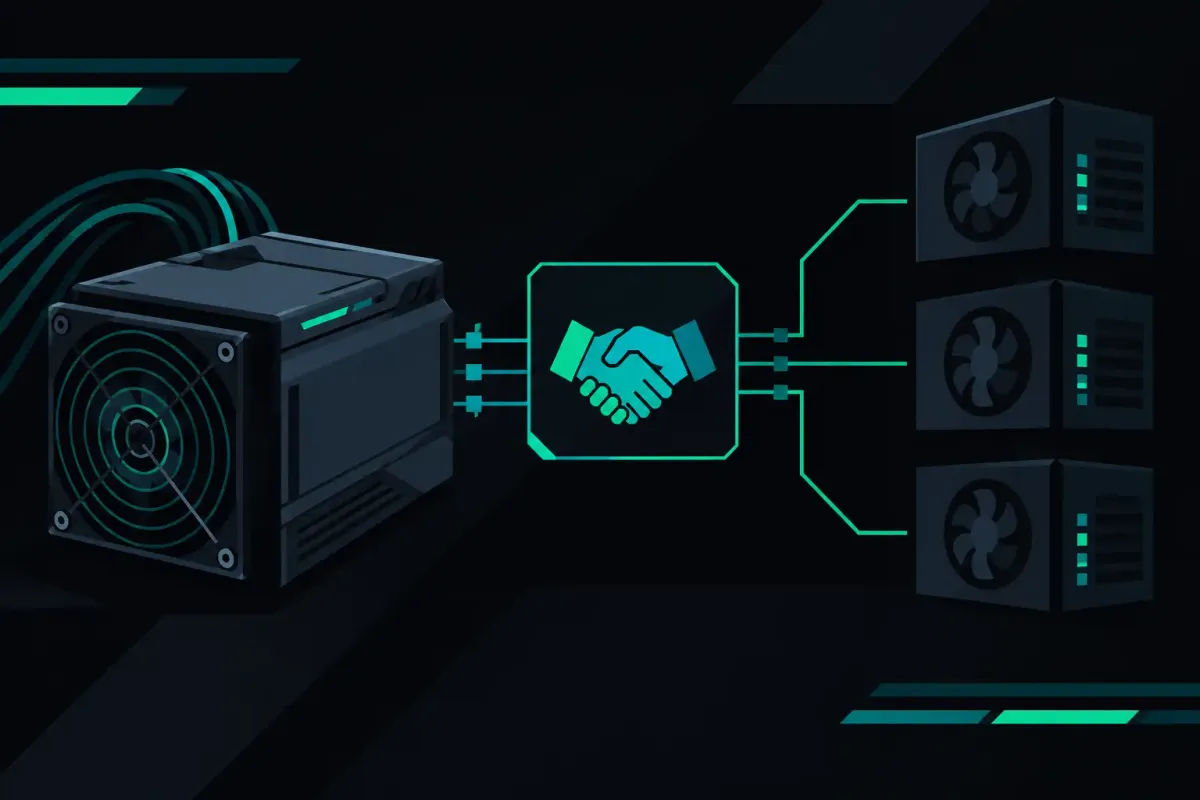
Your ASIC does not bargain with Bitcoin. It hashes the work it receives. So, can ASICs negotiate jobs? Usually, no. The ASIC chips inside a miner test header values at extreme speed. The miner controller, its firmware, or a proxy may speak Stratum and make decisions around that work. Those are different jobs.
That distinction matters because a mining job is not just a target and a header. It can carry authority over the block template. Whoever controls the template decides which transactions are considered for the block, where the coinbase reward is paid, and which previous block the work builds on. A miner can only claim sovereignty over that process when the protocol and the connected software actually give it that authority.
What a Mining Job Contains
A mining job is a package of data that lets a miner construct candidate Bitcoin block headers. The exact format depends on the protocol, but the purpose is consistent. The miner needs a previous block reference, a Merkle root or the information needed to create one, a target, and values it can vary while hashing.
The ASIC chip takes those inputs and searches. It changes the nonce, and the surrounding miner software may also change values such as extranonce space, timestamp, or version bits when the assigned rules allow it. When a resulting hash meets the share target, the miner submits a share. If the hash also meets Bitcoin's network target, it is a block candidate.
The ASIC does not inspect the mempool. It does not decide whether a transaction belongs in a block. It does not negotiate a fee policy with the Bitcoin network. A chip designed to calculate hashes is not a block-template policy engine.
That is not a weakness. It is a division of labor. The question is whether the system around the chip lets the miner participate in choosing the work before the hash search starts.
Stratum V1: The Server Assigns the Job
With Stratum V1, the usual flow is direct. The miner connects to a server, subscribes, authorizes with its configured worker name, and receives mining notifications. The server constructs the job. The miner hashes it and returns shares.
A standard Stratum V1 ASIC can vary the fields its assigned job permits. It can use its extranonce allocation and roll permitted header values. That creates many valid headers for the same block template. It does not mean the miner selected the transaction set or the payout output.
The pool-side template authority remains upstream in that arrangement. The configured payout address still matters because it identifies where a reward should go if a block is found. But the miner is not independently composing the block template through standard V1 job delivery.
For a home miner, this means the connection path can stay simple. Point the machine at a Stratum endpoint. Use the required payout address format as the worker identity. Start hashing. That is enough to receive work.
It is not enough to claim job negotiation. Receiving a job is not negotiating one.
Can ASICs Negotiate Jobs in Stratum V2?
Stratum V2 separates several functions that Stratum V1 commonly bundles together. It can use encrypted connections, clear authority boundaries, and a Job Negotiation protocol for miners that want to construct their own templates.
The important word is “can.” Stratum V2 support alone does not guarantee that an ASIC is negotiating jobs. A miner may use Stratum V2 only to receive assigned work through a channel. In that case, the protocol is different, but the upstream party still selects the block template.
Job Negotiation is a separate capability. It lets an authorized mining participant propose a block template to a template provider. The participant chooses transactions according to its own policy, builds the template data, and requests a template identifier. The pool can then distribute work based on that declared template when it provides a current previous-hash reference.
This gives the miner a meaningful role in transaction selection. It does not let a miner negotiate Bitcoin's consensus rules. Every proposed block must still be valid under the rules enforced by nodes. The current chain tip still determines what can be built on. The network target still determines whether a hash is a valid block.
In practice, the party doing Job Negotiation may be a mining controller, a local proxy, or fleet management software. It may not be the ASIC's hashboard firmware. Calling all of that an “ASIC” is common shorthand. It hides where the authority actually lives.
The Hardware Is Only One Layer
A typical miner has at least three relevant layers. The ASIC chips hash. A controller runs firmware and communicates over the network. A pool or template provider coordinates job distribution and, depending on the setup, template creation.
For an ESP32-class open-source miner, the controller may have limited memory, processor time, and firmware features. It may speak Stratum V1 well while lacking native Stratum V2 support. A standard rack ASIC can have the same limitation. Its hash rate does not answer the protocol question.
If the firmware only supports Stratum V1, the machine cannot perform native Stratum V2 Job Negotiation on its own. A local translator or proxy could potentially handle a different protocol upstream, but then the proxy is the negotiating participant. That may be a sensible design. It should be described accurately.
Ask a plain question: which device constructs or approves the transaction list? If the answer is “the server,” your miner is receiving jobs. If the answer is “your controller or proxy, using Job Negotiation,” then your mining operation has template-selection authority within the protocol's limits.
What Job Control Does Not Change
Template authority is not an odds multiplier. A miner with 1 TH/s has the same probability of finding a valid Bitcoin block per hash regardless of who selected the transactions, assuming it is hashing valid work at the same network difficulty. Network difficulty sets the threshold. Hashrate determines how many attempts a miner makes over time.
Transaction selection can change the transaction fees included in a valid block. It cannot make a low-difficulty hash satisfy Bitcoin's network target. A pool cannot negotiate that target down for its connected miners. A valid block is valid because Bitcoin nodes accept it, not because a server labels it a winner.
Job control also does not remove variance. Solo mining remains a high-variance process. A miner can run for a long time without finding a block, or find one earlier than an average-based estimate would suggest. Neither result proves that the job source changed the underlying odds.
Verify the Authority You Actually Have
Do not infer job control from a dashboard label or a protocol acronym. Check the connection mode, the firmware documentation, and the messages your miner or proxy can observe.
With encrypted Stratum V2, verify the authority key your software pins or accepts. Encryption protects the connection only when the miner knows which authority it is connecting to. A secure tunnel to an unverified key still leaves a trust decision unresolved.
With any setup, inspect what identifies your payout destination before you hash. A non-custodial design should show where a reward would land before a block is found. The payout output is a concrete fact. It should not be a promise buried behind an account balance.
Then inspect how submitted shares are handled. A rejected share should come back with a reason. A found block should have a durable record before submission attempts begin. Those details do not change block odds. They show whether the infrastructure can account for the work it received and the result it reports.
NexusPool accepts Stratum V1 and native encrypted Stratum V2 on the same port. That makes connection simpler for miners whose current firmware speaks V1 while leaving a native V2 path available for hardware and software that support it. Whether a connected miner uses Job Negotiation still depends on its configured capability and the protocol role it actually takes.
Choose the Claim That Matches the Setup
“ASIC job negotiation” is useful shorthand only when everyone agrees on what it means. For most miners, the accurate statement is simpler: the ASIC hashes assigned work. The controller handles Stratum. The template provider decides the transaction set unless Job Negotiation gives that decision to the miner's side.
If you run a small home miner, start by confirming the basics. Confirm the endpoint. Confirm the payout address. Confirm the protocol your firmware speaks. Then ask whether you need transaction-selection authority or whether reliable, visible assignment of work is the actual requirement.
A protocol feature is real only at the layer where it is enabled. Trust nothing. Verify who controls the block template.