Mining Payouts
Custodial Mining Payouts and Who Holds Your Block
Custodial mining payouts put a pool between your winning block and your wallet. Learn what the pool holds, what it can alter, and how direct payout works.
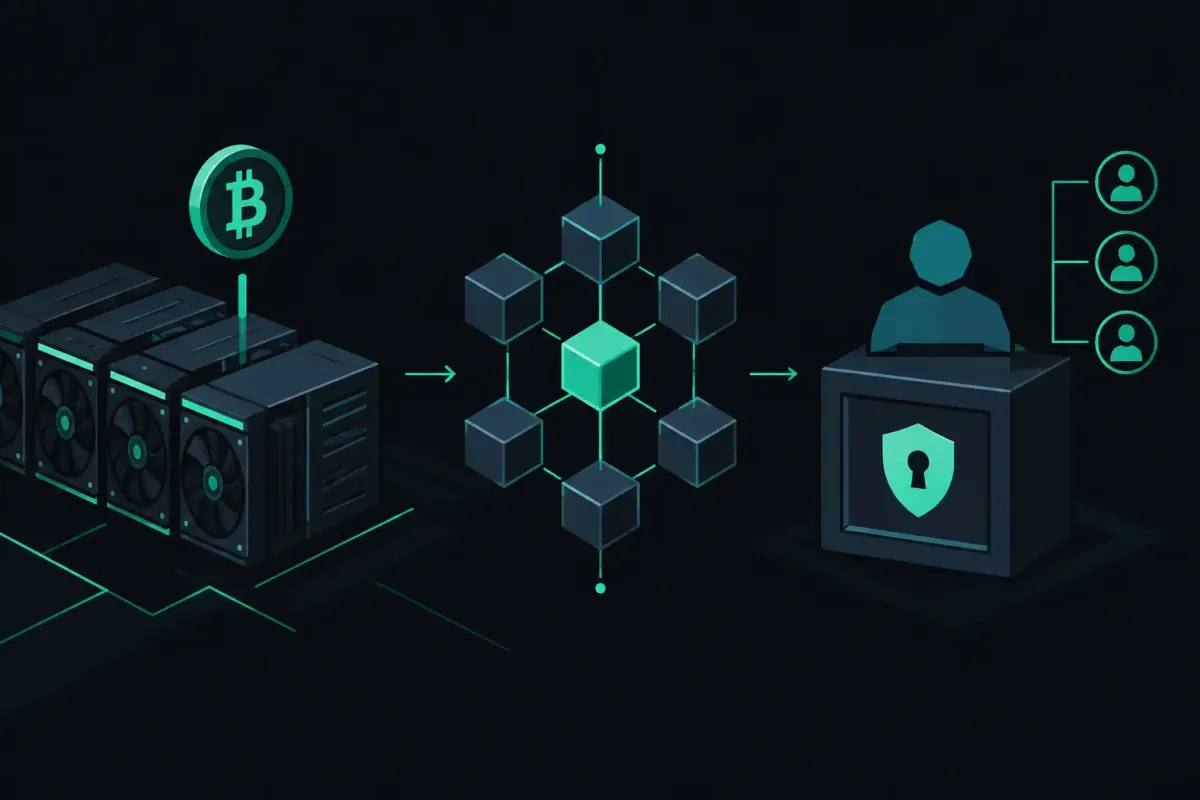
A solo miner can wait a long time for one valid block. If that block arrives, custodial mining payouts decide whether the reward first belongs to your address or first lands under the pool's control. That distinction is not cosmetic. It determines who builds the payment transaction, who holds the funds before you receive them, and what you can verify at the moment the block is found.
Solo mining is a lottery. An average wait is not a schedule. Network difficulty sets your odds at every pool, and a pool cannot add luck. But the payout path starts only after your rig has already done the rare thing: found a block. That path is worth inspecting.
What custodial mining payouts mean
A custodial payout model sends the block reward to an address controlled by the pool or its payment system. The pool later sends a separate transaction to the miner. It may pay after confirmations, on a scheduled cycle, after a balance threshold, or when an operator approves the payment.
That can be a reasonable accounting arrangement for a shared-reward pool. Many miners submit work, the pool calculates each miner's share, and one payout system distributes many smaller payments. The pool needs control of the reward before it can divide it.
For solo mining, the question changes. One miner found one block. There is no group balance to calculate. If the block reward enters a pool-controlled address first, the miner depends on the pool to create the next transaction correctly and on time.
That dependency is custody. It exists even if the pool has good intentions, publishes a payment history, or usually pays within minutes. The funds are not in the miner's wallet until the pool's transaction confirms.
The pool controls the second transaction
When a pool receives the block reward, it controls the transaction that sends funds onward. It chooses when to broadcast it. It chooses the transaction fee. It constructs the outputs. It can place operational rules between the found block and the miner's wallet.
Those rules may be visible or buried in terms. A miner should know whether a payment minimum applies, whether transaction fees come out of the payout, and what happens if the payment address was entered incorrectly. A pool can also change its payment process later. The chain records what happened, but it cannot force the pool to send a later payout.
A custodial balance creates a second risk that has nothing to do with mining odds. The rig may have produced a valid block, but the miner still has counterparty risk until the withdrawal reaches an address they control.
A direct block payout removes the waiting balance
Bitcoin permits the coinbase transaction in a mined block to pay an address chosen before the block is found. The coinbase transaction creates the block subsidy and collects that block's transaction fees. If the miner's own address is in that transaction, both amounts go there directly.
The reward still has Bitcoin's coinbase maturity rule. It cannot be spent until 100 more blocks are mined after the winning block. That is a network rule, not a pool withdrawal delay. The important difference is ownership: the output is already assigned to the miner's address in the block itself.
There is no pool balance to request. There is no second payment transaction for the pool to prepare. There is no payout threshold. The miner can inspect the found block and see the destination output on-chain.
This is not a claim that direct payout changes the chance of a win. It does not. Hashrate and network difficulty determine that chance. Direct payout changes what happens after a winning share becomes a valid block.
Subsidy and fees belong in the same check
A common shortcut is to describe a solo reward as the subsidy alone. That leaves out the transaction fees included in the block. The complete reward is the subsidy plus the fees from the transactions the block contains.
The exact amount varies by block. Fees are not fixed, and a pool may prepare initial work before it has finished validating a new block. That first job can carry no transactions, so its candidate block has no transaction fees. Later work can include transactions once validation is complete.
A useful preflight check therefore shows more than a generic reward estimate. It should show the payout built for your address on the current block, including the actual subsidy and the fees available in that candidate. It also needs to make clear that a new network block can replace the current candidate at any moment.
How to inspect the custody boundary before mining
Do not wait for a winning block to learn where it would pay. Start with the address field or worker name your rig sends when it connects. For a direct solo payout, the address used to identify the miner should be the address embedded in the candidate block's coinbase payout.
Then ask a precise question: if this rig finds a valid block on the current job, what address appears in that block's reward transaction? A dashboard total, an estimated daily return, or a promise of automatic payout does not answer it.
The check should expose the payout destination and the current amount. It should distinguish confirmed on-chain ownership from a pool's internal balance. An internal balance is a record the pool maintains. An output in a Bitcoin block is a record the network maintains.
There are practical limits. A preflight display is a view of the current candidate, not a guarantee that the next job will contain identical fees. Blocks change. Transactions enter and leave the mempool. Another miner can find a block first. But the address rule should not be ambiguous: your address is either in the payout output or it is not.
The found-block path still matters
Direct payout removes custody of the reward. It does not remove the need for the pool to handle a winning submission correctly.
Your rig sends a share. Most shares are below the target needed for a Bitcoin block, so they only show that the rig is working. A rare share meets the network target. The pool must read it as the firmware sent it, test it, and submit the resulting block to Bitcoin nodes.
A pool can lose useful time by sending work for an old tip after a new block is available. It can reject a valid-looking share because it parsed a field differently from the rig. It can also fail to rebroadcast a found block after a local interruption. None of these errors changes the mathematical odds. They can affect whether the luck your rig already had reaches the network.
For a home miner, the simple part comes first: confirm the endpoint, confirm the payout address, and look at the result the current job would produce. For an operator with several machines, the next questions are more operational. Which region receives the connection? Does a quiet rig keep its assigned difficulty for a short absence? Does the pool return a reason when it rejects a share? What happens to a pending found block after a restart?
Those are separate checks from custody, but they meet at the same moment. A direct address in a candidate block is useful only if the pool can carry a valid found block from the rig to the Bitcoin network.
A concrete Bitcoin example
NexusPool (nexuspool.io) accepts a Bitcoin address with no account at solo.nexuspool.io:3350. Its Payout Preflight shows the current candidate payout for that address before the rig finds anything. When a rig finds a block, the subsidy and the transaction fees pay that address in the block's coinbase transaction. The pool does not hold a balance for later withdrawal.
The pool supports Stratum V1 and encrypted Stratum V2 on that same port. Most home rigs use the first option. The connection path is still simple: set the server, use a valid Bitcoin payout address, and let the rig begin submitting shares.
A miner far from the pool's regions may see a longer round trip for work and status updates. That distance does not change the odds of finding a block. It can affect how quickly a rig receives new work, which is why timing the path from your own network is more useful than assuming a server location tells the whole story.
The question to ask before you point a rig
Custodial mining payouts are not automatically fraudulent. They are a design choice with a clear consequence: a pool receives the block reward before the miner does. That may fit a shared payout system. It is harder to justify when one solo miner's address can be written into the block from the start.
Before connecting, inspect where a winning block pays, whether the displayed amount includes the current block's fees, and whether the result can be checked on-chain. Then point a rig at solo.nexuspool.io:3350 only if the payout path says what you think it says.
Trust nothing. Verify where your block would pay.