Glass Ledger
Dashjr's Bitcoin Subsidy Proposal: A Miner's Self-Check
Luke Dashjr floated a month with no Bitcoin block subsidy. Headlines missed which chain he means. A five-minute self-check shows if it touches your mining.
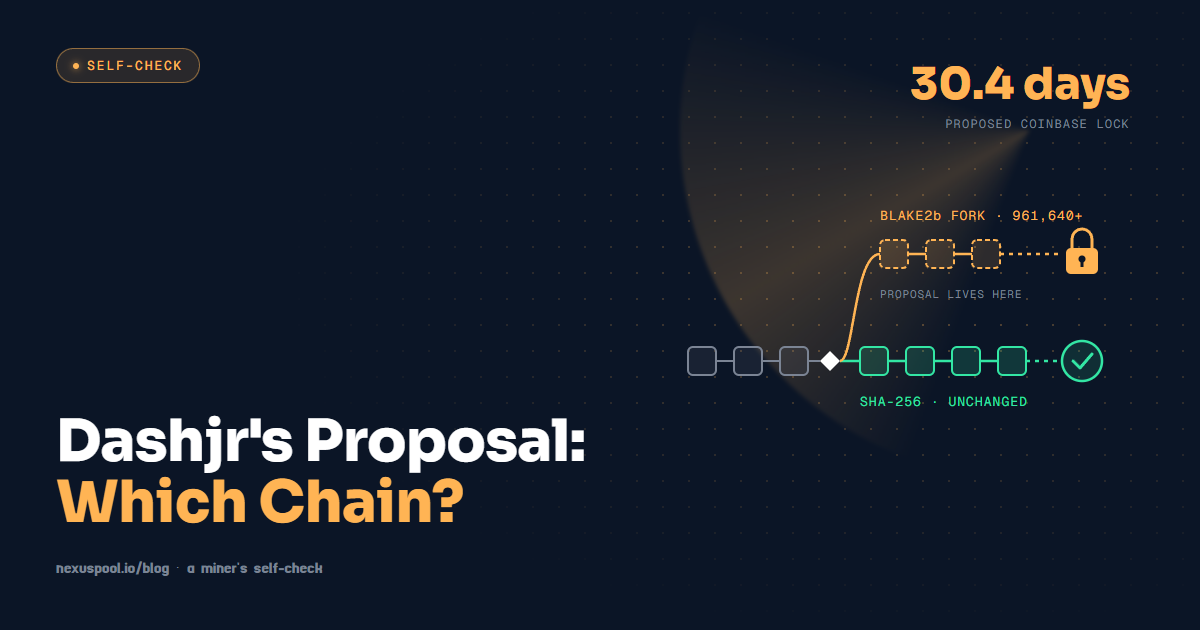
On September 10, 2026, Luke Dashjr posted two temporary rule ideas and asked for opinions. One would stretch the wait before newly mined coins can be spent from 100 blocks to 4,375. The other would set the block subsidy to zero for about a month, so miners earn fees and nothing else. He aimed both at what he called "a large batch of hashers who appear to only have profit as their motive." Within hours, outlets were summarizing the Dashjr Bitcoin subsidy proposal as a plan to cut the reward on the network your SHA-256 miner works on, complete with that network's 3.125 BTC subsidy and 2028 halving date. Dashjr's post never names a chain, and once you know which one he means, most of the headline version falls apart. The checks further down take about five minutes and tell you whether any of this reaches your own setup.
What the Dashjr Bitcoin Subsidy Proposal Says
Bitcoin already locks every block reward for 100 blocks. Full nodes reject any spend of a coinbase output until 100 more blocks sit on top of it, which at the 10-minute target is about 16 hours and 40 minutes, so a short chain reorganization cannot erase coins someone already spent. Dashjr's first idea stretches that lock to 4,375 blocks: 43,750 minutes, or about 30.4 days. Miners would still collect the full reward and wait a month to move it.
His second idea leaves the lock alone and zeroes the subsidy for about a month. At the 10-minute target, a month is about 4,320 blocks, and 4,320 blocks at 3.125 coins each comes to 13,500 coins that the chain would not pay on its normal schedule. That figure is arithmetic from the current subsidy, not a number Dashjr published. Whether those coins arrive later or never exist depends on how someone writes the rule, and nobody has. The first idea changes when miners can spend. The second changes what they get paid.
Neither idea comes with code, a Bitcoin Improvement Proposal number, a client to ship it, or an activation method. Dashjr followed up 27 minutes later to say both ideas are temporary and no decision is final, then sent readers to a Discord server to weigh in. CryptoTimes, which logged both posts with timestamps, noted that he gave no way to measure a month when blocks run fast or slow.
Which Chain Is Dashjr's Proposal For?
Most coverage skipped the context. Since the September 1 fork, Dashjr treats the forked chain as the real Bitcoin and calls the SHA-256 chain "Spamcoin." That fork's last SHA-256 block was 961,639. From block 961,640 on, it accepts BLAKE2b work only. The miner guide on the fork's own reference site lists the hardware: Sia-family BLAKE2b machines such as the Antminer A3, Goldshell SC5 Pro and Goldshell SC Lite, pointed at a gateway from CONVOY Mining, the company Dashjr now runs. CONVOY's gateway serves BLAKE2b jobs and cannot hand out SHA-256 work at all.
Read the proposal again with that in mind. The fork pays 3.125 coins per block and launched with a small global stock of compatible machines, so rental markets for BLAKE2b hashrate filled with buyers chasing its early block rewards. A renter who shows up for a new chain's emissions, sells what the machines mine and moves on is as close a match for Dashjr's description as you will find. The replies under his post read it the same way. One described the targets as BLAKE2b machines that had sat on shelves for years. Another warned that zeroing the subsidy could stall the network until the proof of work changed again. The first supportive reply CryptoTimes quoted came from a solo miner running two Goldshell HS Box units, which are not SHA-256 hardware.
The SHA-256 chain was never in reach anyway. BIP editors removed Dashjr from the BIP repository on August 10, and BIP-110, the Reduced Data Temporary Softfork his camp championed, peaked at about 2.53% of signaling against the 55% it needed. Dashjr did not name the chain, so take this section as a reading of the evidence rather than his stated position. It fits the facts far better than the headline version does.
The Self-Check for NexusPool and Home Miners
- Which proof of work does your machine run? A Bitaxe, a NerdAxe, an Antminer S19 or an S21 hashes SHA-256. The fork chain cannot use that work, so the hashers this proposal aims at do not include you. If your machine is a Sia-family BLAKE2b unit, keep reading the next two checks.
- Which chain does your node follow? A node running Bitcoin Core follows the SHA-256 chain. If you run Bitcoin Knots, look before you assume: the fork's own guides tell miners to run Knots 29.4.1 with the BLAKE2b consensus change. Compare your node's tip height and block hash against a block explorer for the SHA-256 chain, and you will know in a minute which network your node treats as Bitcoin.
- Did you rent BLAKE2b hashrate or point Sia hardware at the fork? Then you sit in the group Dashjr is describing. A 30-day maturity lock would tie up a month of rewards as working capital, and a zero-subsidy month would leave you mining for fees alone, if either idea ever ships on that chain.
- Where does your block reward land? At NexusPool, the coinbase output of a block you find pays straight to the address you mine with, so the 100-block maturity clock you wait on belongs to Bitcoin, and no pool balance sits in between. NexusPool's Payout Preflight reconstructs that coinbase transaction and checks it byte for byte against your address before any block is found, and the signed, offline-checkable receipts behind the design are covered on NexusPool's Glass Ledger page.
- Who builds your block template? Template control is the fight Dashjr's camp keeps returning to, and it is a fair question to ask of any pool. NexusPool's technology page documents native Stratum V1 and Stratum V2 support, including encrypted V2 connections pinned to the pool's authority key.
- Did any of this change your odds? No. Your hashrate relative to the chain's difficulty sets your odds of finding a block, and they come out identical at every pool, under every protocol and under any subsidy rule.
If Your Answers Came Back SHA-256
SHA-256 hardware, a node on the SHA-256 tip and a coinbase paying your own address means the proposal asks nothing of you. On that chain the 21 million ceiling, the 100-block maturity rule and the 2028 halving at block 1,050,000 stand where they stood on September 9. This post does not predict whether the proposal advances on any chain, it is not investment advice, and it does not claim NexusPool's own core software is open source today. For the posts, timestamps and replies, see CryptoTimes' account of the Dashjr proposal. For the fork chain's hardware and gateway, see the BIP-110 chain's own miner guide.
Trust nothing. Verify which chain a headline is about before you decide it touches your rewards.