Solo Mining
Does Solo Mining Include Fees? What You Actually Get
Does solo mining include fees? See where Bitcoin transaction fees go, how pool fees differ, and how to check your block payout before your rig finds it.
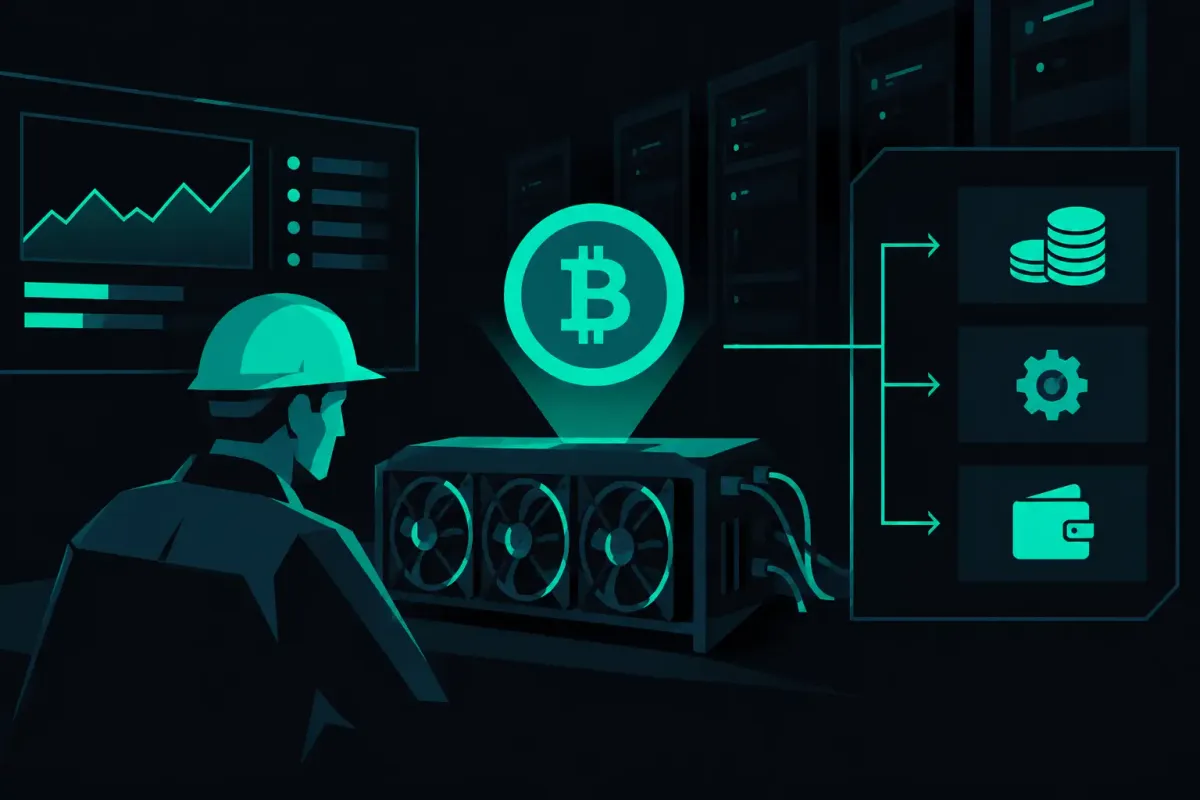
A Bitcoin block reward is not just the subsidy. So, does solo mining include fees? Usually, yes: if your rig finds a valid block containing transactions, the block's coinbase transaction can pay your address the subsidy plus the fees from those transactions. The word “usually” matters. A block with no transactions has no transaction fees to collect.
That is the short answer. The useful answer is about where the money appears, what a pool fee can remove, and what you can check before your miner ever finds a block.
Does solo mining include fees in the block reward?
Bitcoin gives a block finder two sources of value. The first is the block subsidy, which consensus creates in the block's coinbase transaction. The second is the total fee paid by the transactions included in that block.
The miner who finds a valid block does not receive transaction fees as a later bonus. The fees are part of the block reward from the start. They appear in the coinbase transaction because the outputs created by that transaction may total the subsidy plus the included transaction fees.
For a solo miner, the intended payout is simple: a block your rig finds pays the reward to your Bitcoin address. If the block contains transactions, that reward includes their fees. If the block is empty, it includes the subsidy only.
This is separate from the 100-block coinbase maturity rule. Seeing your address in a found block proves where the reward was assigned. Spending that coinbase output must wait until it has matured under Bitcoin's rules.
Transaction fees and pool fees are different things
The names are close enough to cause bad answers.
Transaction fees are paid by people sending Bitcoin. A sender offers a fee to make their transaction worth including in a block. The total of those fees is available to the miner of the block, provided those transactions are actually in it.
A pool fee is a charge imposed by the pool. In a shared pool, that charge is commonly taken before or during distribution to participants. In a solo pool, the relevant question is whether the pool takes any part of a block your rig finds.
A pool can advertise a 0% pool fee and still leave a separate question: where does the full coinbase reward go? The answer should be visible in the candidate payout transaction, not buried in a slogan.
At NexusPool (nexuspool.io), a Bitcoin block found by your rig pays the subsidy and included transaction fees to your own Bitcoin address inside that block. The pool states a 0% pool fee. There is no account balance to withdraw because the found block's coinbase transaction pays the address your miner used to connect.
That does not make solo mining an income schedule. Solo mining is a lottery. Network difficulty sets the odds at every pool. A lower network difficulty means a shorter expected wait for a given hashrate, not a promise of a win or more value from any one pool.
Why an early block job may have no fees
A Bitcoin pool must decide when to give miners work for a new block. Waiting for full transaction validation can leave miners working on the previous block for longer. Sending work early reduces that stale period, but there is a trade-off.
The first job sent for a new block can carry no transactions. It is a valid candidate block shape, but there are no transaction fees in it because there are no transactions beyond the coinbase transaction.
NexusPool's Frankfurt server measured a median 0.49 milliseconds from receiving a new block header to making new work ready on September 10 and 11, 2026, across 162 mainnet blocks. That work was ready 205 milliseconds before the node finished validation. The first job carried no transactions.
This is the part that gets lost when someone says, “solo mining includes fees.” It includes fees from transactions in the block you actually find. It cannot include fees from transactions that were not in that block template.
Once the pool has a validated new block and builds work with transactions, the candidate reward can include the selected transaction fees. The transaction set and its total fees change as the mempool changes and as another miner finds the next block. A number shown before a find is a statement about the current candidate block, not a permanent quote.
What to inspect before pointing a rig
You do not need to read Bitcoin source code to check the payout path. You need to establish three facts.
First, confirm the payout address. Your miner connects using a Bitcoin address, and that address should be the one you control. A typo does not create a support problem. It creates a different destination for a winning block.
Second, inspect the current candidate payout. NexusPool's Payout Preflight shows the payout built for your address on the current block before your rig finds anything. It lets you see the coinbase destination and the candidate total, including whatever transaction fees are in that current template.
Third, know what can change. A candidate block is replaced when the network finds a new block. Its transactions can change before then. If a current job is the early no-transaction job, its displayed reward should reflect that fact. The check is useful precisely because it does not pretend every job has the same fee total.
If your rig finds a block, inspect the found block itself. The coinbase transaction is the record that matters. Its output should name your address. Its value should equal the permitted subsidy plus the fees from the transactions included in that exact block.
The pool's job is not to create fees
No pool creates Bitcoin transaction fees. Users create them by attaching fees to transactions, and miners or pool infrastructure select which valid transactions make the next candidate block.
The pool does control the route between your hash and a submitted block. That route matters after luck has already done its rare work. A winning share must be read correctly. The candidate block must be built correctly. A found block must be submitted quickly enough to compete with other valid blocks.
For Bitcoin, NexusPool accepts connections at solo.nexuspool.io:3350. A miner can use Stratum V1 or encrypted Stratum V2 on that same port. The endpoint steers a miner to a nearby healthy region. Distance can make new work and statistics take longer to reach a rig, especially for miners far from the pool's four regions. It does not change the odds of finding a block.
A found Bitcoin block through Los Angeles, Chicago, or Frankfurt is written to disk before submission, then sent to Bitcoin nodes in all three cities. Each submission is retried for up to five minutes. A found block through Singapore is sent to its local node. After a restart, a pending block is submitted again. Those are operational details, not a claim that a pool can change network difficulty or manufacture luck.
The practical answer for a home miner
If by “fees” you mean Bitcoin transaction fees, solo mining can include them. They are part of the reward only when your found block includes fee-paying transactions.
If by “fees” you mean a pool charge, that depends on the pool's published policy and, more importantly, on the payout transaction you can inspect. A 0% pool fee means the pool says it takes no cut. A block whose coinbase output pays your address is the direct check.
Do not confuse an expected average with a date on a calendar. Your Bitaxe, Avalon Nano, or full-size ASIC can run for a long time without finding a block. The same rig can also find one on a day that has nothing special about it. Network difficulty sets those odds everywhere.
Before you mine, use Payout Preflight to see the current candidate payout for your address. If your rig ever hits, check the coinbase output in the found block. Trust nothing. Verify your payout.