Non-Custodial Mining
Dogecoin on Solana: Myth vs Reality of the Bridge
Dogecoin now trades natively on Solana through a new bridge. Here is what actually changes about trust and custody, myth versus reality.
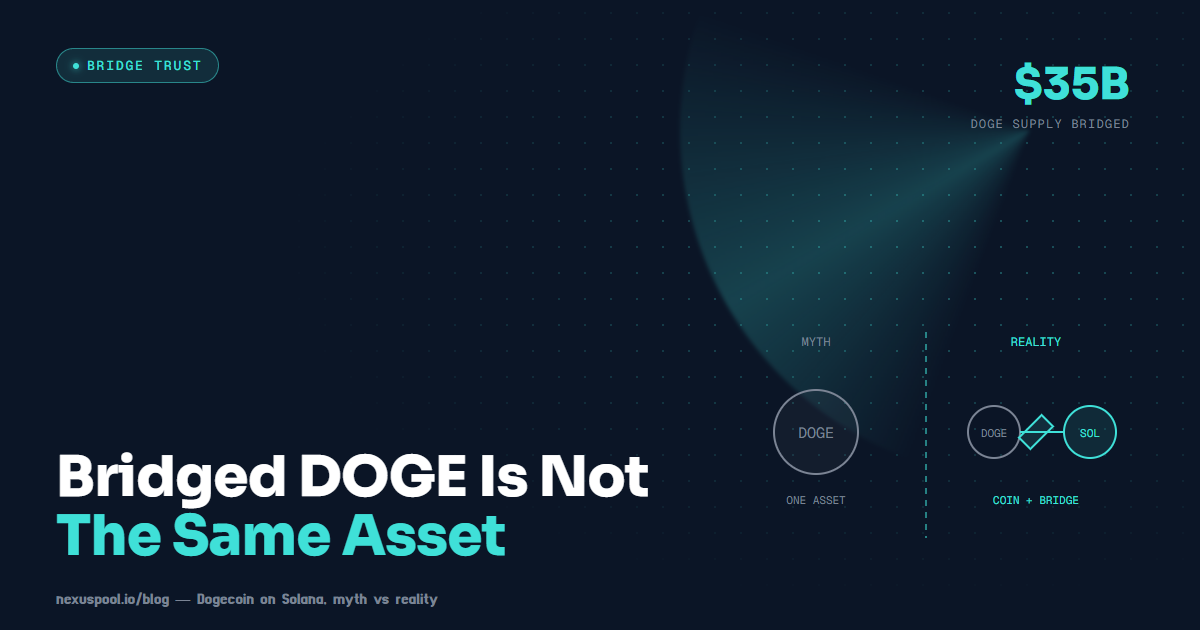
On September 7, 2026, Solana's own account confirmed that Dogecoin is now live on the network through a new Dogecoin Solana bridge called Sunrise, built on Wormhole's Native Token Transfers framework. The rollout covers Dogecoin's entire circulating supply, worth roughly $35 billion, one of the largest single-asset cross-chain integrations to date, and early trading volume reportedly reached about $19 million in the first stretch after launch. Coverage of the move has leaned heavily on the word "native," which is doing more work than most readers will notice. Separating the marketing framing from the actual trust model is worth doing before treating DOGE on Solana as functionally identical to DOGE on its own chain.
Myth: Bridged DOGE Is Exactly the Same Asset as Real DOGE
The pitch behind Wormhole's NTT framework is that it avoids the old model of a single custodian holding a pile of DOGE and issuing a generic wrapped IOU against it. Instead, NTT is described as a canonical, burn-and-mint design, meaning the representation on Solana, a token some coverage refers to as QDOGE, is treated as the canonical cross-chain form of the same asset rather than a separate synthetic wrapper issued by one company. That framing is a real technical improvement over the older wrapped-token model, and it is fair to call it more decentralized than a single custodian holding a reserve.
Reality: It Still Depends on a Bridge Verifying Deposits Correctly
Here is the part the "native" framing tends to skip. When a user sends DOGE into the bridge, the system has to verify that deposit by checking it against Dogecoin's own blockchain, confirming block header integrity through Dogecoin's proof-of-work, before it mints the equivalent balance on Solana. That verification step, run by the bridge's own validator or guardian infrastructure, is functionally the same kind of software that just failed on a different Bitcoin-adjacent bridge days earlier: Nomic's forwarding logic, which is supposed to verify Bitcoin deposits with the same kind of rigor, had a bug that let it mint nBTC without real bitcoin behind it, draining roughly 36% of Osmosis's Bitcoin-backed token's collateral. Nothing here claims Wormhole's Sunrise integration has that same bug or any bug at all. The point is narrower and still true: any bridge's safety rests entirely on its own verification code working correctly every single time, not on the word "native" appearing in its marketing.
| What gets said | What is actually true |
|---|---|
| "DOGE on Solana is the same as DOGE on Dogecoin's own chain" | It is a cross-chain representation minted by a bridge, redeemable back to real DOGE only if the bridge's own logic and validator set keep working correctly |
| "Burn-and-mint avoids custodial risk entirely" | It avoids a single company holding your coins directly, but it still concentrates trust in the bridge's verification and minting code, a different kind of counterparty, not zero counterparty |
| "A $35 billion integration means this is thoroughly battle-tested" | Size measures scale and market interest, not how long the specific verification logic has run in production or how many independent audits it has passed |
| "This is what merged mining and self-custody already look like for Dogecoin" | Merged mining and a coinbase transaction paying your own address involve no bridge and no third-party minting step at all; bridging is a separate, additional trust layer on top of an already-mined coin |
Why the Dogecoin Solana Bridge Distinction Matters for a DOGE Holder
None of this means bridged DOGE is unsafe or that this specific integration will fail. It means the honest description sits between the two extremes the coverage tends to offer: better than an old-style single-custodian wrap, not the same risk profile as holding DOGE you mined or received directly with no bridge involved at all. A holder deciding whether to move DOGE onto Solana for Jupiter, Phantom, or Raydium access is better served by that precise framing than by either "it's basically native" or reflexive bridge skepticism with no specifics behind it.
The Reality, in Short
Bridged DOGE on Solana is a real technical improvement over old-style wrapped tokens, but it still asks you to trust a bridge's verification code every time you move value across it, the same category of trust that just failed elsewhere on a Bitcoin-adjacent bridge this same week.
Dogecoin's own chain still settles the same way it always has: through proof-of-work mining, secured further by AuxPoW merged mining with Litecoin. NexusPool supports solo mining Dogecoin directly, with a found block's reward paid straight to the miner's own address through the coinbase transaction, 0% pool fee, no bridge and no third-party minting step involved at any point. NexusPool's Litecoin and Dogecoin technology page documents the merged-mining and protocol details, and NexusPool's Litecoin support page covers what solo mining on that chain looks like in practice. This is not a claim that Wormhole's Sunrise integration or QDOGE is unsafe, and it takes no position on whether moving DOGE to Solana is a good decision for any particular holder. It is not investment advice, makes no claim about future DOGE price, and does not claim that mining DOGE directly changes your odds of finding a block, which depend only on your own hashrate relative to network difficulty, identical for every miner on the chain. Full terms for using NexusPool's own service are published on its terms page. For the original reporting on the bridge's launch and mechanics, see CryptoBriefing's coverage of the Dogecoin-Solana Sunrise integration.
Trust nothing. Verify what a bridge's own code actually checks before you treat a wrapped balance as the same thing as the coin itself.