Bitcoin Mining
Ethiopia's Bitcoin Mining Power Cut: What Hashrate Shows
Ethiopia's utility now delivers about 23% of contracted power to Bitcoin miners. We check it against difficulty data and what it means for solo odds.
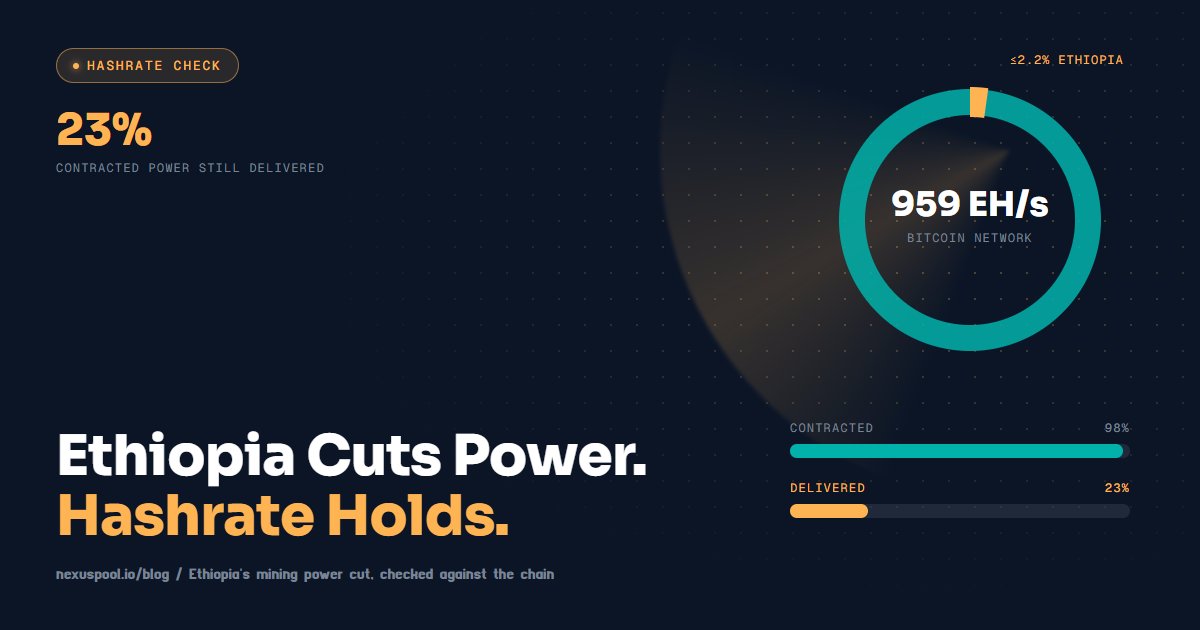
Ethiopia's state utility now delivers about 23% of the electricity it contracted to sell to Bitcoin miners, and on September 15 Bloomberg carried the Ethiopia Bitcoin mining power cut to a global audience. If you point hardware at the network, you want to know one thing: did a hydro-powered mining hub losing three-quarters of its power dent Bitcoin's hashrate? The chain's own numbers say the network shrugged it off. The longer answer matters more, because it sorts the parts of this story you can check yourself from the parts you have to take on trust.
What Did Ethiopia Cut for Its Bitcoin Miners?
The decision predates this week's headlines. Ethiopian Electric Power chief executive Ashebir Balcha disclosed it at the utility's annual performance briefing in Addis Ababa on Friday, August 28, according to the Ethiopian Business Review's account of the briefing. The utility had agreed to deliver 98% of contracted volumes under its power purchase agreements. Expecting a dry period, it cut mining supply by 75% and, in his words, is "currently delivering only around 23%." Bloomberg picked the story up on September 15, and Addis Standard, Cryptonews and Gate ran it the same day.
Water drove the call. Hydropower supplies about 95% of the utility's generation, and Balcha said inflows into the big reservoirs, including the Grand Ethiopian Renaissance Dam and Gibe III, are running at least 20% below expectations after El Niño weakened the rains. As a reservoir drops, a single generating unit can lose up to 50 megawatts of output. The utility chose to protect households and other customers and put the shortfall on data miners. Its managers plan to reassess in October, once they have clearer numbers for the new water year, and they could raise supply or cut it further.
Two figures show the stakes for the utility. Bloomberg reports that mining companies produced 35% of its revenue last financial year and use almost a third of the country's power output, on a system with 9,730 megawatts of installed capacity. Read the 23% with care, though. It measures the share of contracted mining supply still arriving, and says nothing about 23% of Ethiopia's electricity.
How Much Bitcoin Hashrate Could Ethiopia's Power Cut Remove?
You cannot read a miner's country off the blockchain. Country hashrate figures come from pool server locations and operator surveys, and they carry real error. With that caveat, Hashrate Index's Q1 2026 heatmap put Ethiopia at about 27.5 EH/s, roughly 2.6% of the network at the time and eighth in the world.
Now assume hashrate falls in step with delivered power, and that Ethiopia still ran about 27.5 EH/s when the cut began. Losing 77% of that removes 27.5 × 0.77 ≈ 21.2 EH/s. Against today's network estimate of about 959 EH/s, the loss comes to about 2.2%. Treat that as a rough ceiling. Some operators may run backup supply or may have shipped machines elsewhere, and the heatmap figure dates from early 2026.
A 2.2% drop is small next to Bitcoin's ordinary swings. The network's difficulty fell 1.31% on August 23 and rose 1.31% on September 5, two weeks apart, with no single country to blame for either move.
Why Is Bitcoin Difficulty Still Rising After the Cut?
If roughly 21 EH/s went dark in late August, you would expect slower blocks and a falling difficulty. The chain shows the reverse. Difficulty rose 1.31% at block 965,664 on September 5, to 127.45 trillion. In the current epoch, blocks have averaged about 571 seconds against the 600-second target, and the mempool.space difficulty estimate projects a further rise of about 5.1% at block 967,680, due around September 19.
That block pace implies a network hashrate of about 959 EH/s: current difficulty times 2^32, divided by 571 seconds. At the 600-second target, the same difficulty corresponds to about 912 EH/s, so the network runs about 46 EH/s hotter than its difficulty assumes. Other operators added more than twice what Ethiopia could have lost, in the same weeks.
Two caveats apply. Balcha did not name the day the cut started, only that it was in place by August 28, so part of it may fall inside the epoch that ended August 23 with a 1.31% drop. And block times over a few hundred blocks are noisy, so the 5.1% projection will drift before the retarget lands. The direction still holds. For Ethiopian operators and the utility's budget, the Ethiopia Bitcoin mining power cut is a major event. For the network's hashrate, it sits inside the noise.
What Does a 5% Difficulty Rise Do to Solo Mining Odds?
This part reaches every miner, wherever the hardware sits. Your chance of finding a block equals your hashrate divided by the network's, and nothing else moves it.
Take one 200 TH/s machine. At today's difficulty of 127.45 trillion, it expects one block every 86.7 years on average (difficulty × 2^32 ÷ hashrate). If difficulty rises 5.1% to about 134.0 trillion, that stretches to about 91.2 years. The same answer falls out of the hashrate ratio: 959 EH/s ÷ 200 TH/s gives odds of about 1 in 4.8 million per block, and 4.8 million ÷ 52,560 blocks a year is about 91 years.
No pool changes that ratio, and neither does a bill, a protocol, or a power contract in another country. Pool design decides how a found block gets paid and whom you trust along the way. It never changes how often your hardware finds one.
What Can You Verify With NexusPool and the Chain?
Start with the network numbers, since they are public. Difficulty, block times and the next retarget come straight from the chain, so you can read them on mempool.space or query your own node. Country hashrate figures stay estimates, and a utility's statements are claims you can compare against the block data but cannot audit.
Your own pool is the part you control. NexusPool is a solo pool, and its Payout Preflight tool rebuilds the exact coinbase transaction the pool would pay to your address, against the live block template, before you ever find a block. NexusPool's Glass Ledger signs custody and work receipts you can check offline. The technology page documents the Stratum V1 and Stratum V2 path your hashrate takes, and the status page shows whether the pool is up right now.
This post makes no price, profitability or investment call, and NexusPool cannot tell you what Ethiopia's grid will do in October.
So did Ethiopia's power cut dent Bitcoin's hashrate? By about 2% at most, on a generous estimate, and other miners more than replaced it within weeks. On the current pace, the September 19 retarget makes every miner's next block about 5% harder to find anyway, and you can watch it arrive block by block. Mark October too, when Ethiopia's utility decides again.
Trust nothing. Verify the difficulty adjustment on the chain before you believe a headline about hashrate.