Hosted Mining
Hosted Mining Comparison: What You Actually Control
A hosted mining comparison for miners who want to separate hardware custody, payout custody, contracts, fees, and the checks that matter before paying.
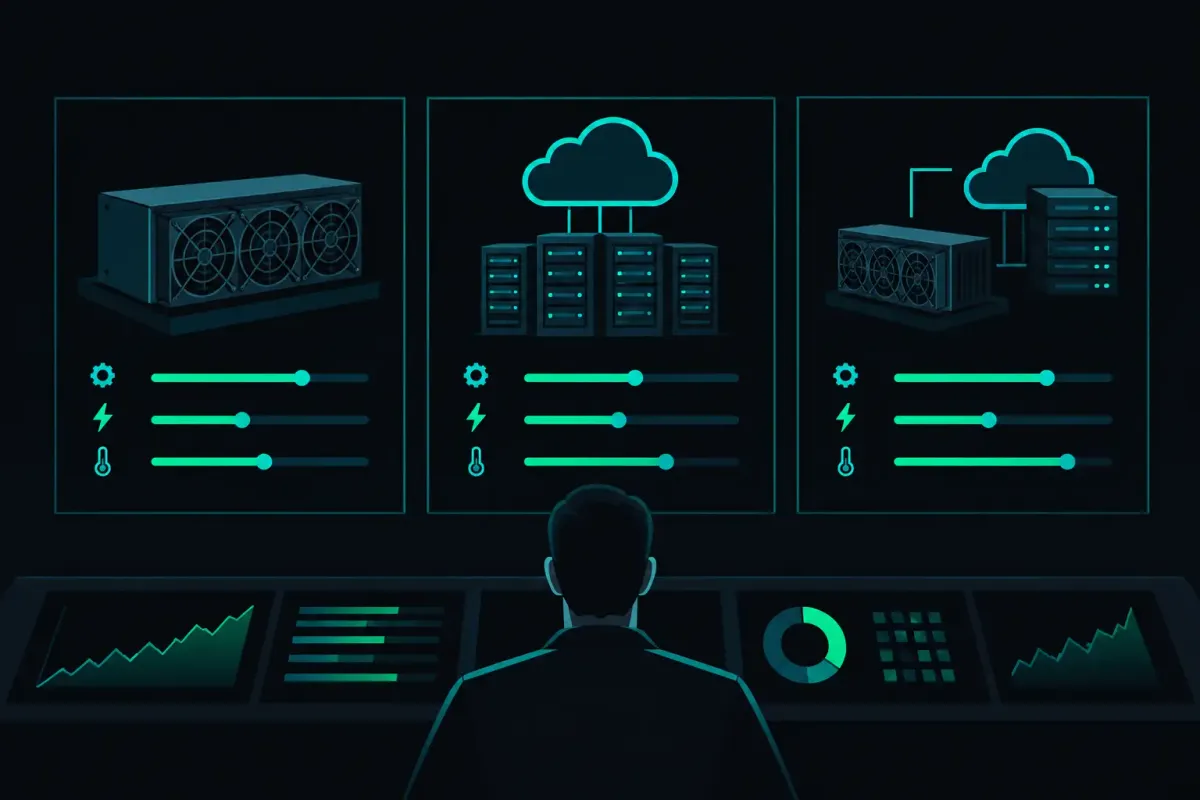
A hosted mining comparison gets confusing when three different products use the same word. One company may hold a miner you bought. Another may sell you a share of hardware it controls. A third may sell a contract that mentions hashrate but gives you no identifiable machine at all. Those are not small differences. They decide what you can verify, who can stop the miner, and where a block reward can land.
If you run a home miner, hosting can sound like a simple trade. You avoid noise, heat, and electrical work. Someone else runs the hardware. The hard part is that you give up direct sight of the machine. A useful comparison starts with custody and payment flow, not advertised hashrate.
Hosted mining comparison: separate the three models
Colocation is the clearest model. You own a specific machine. A facility supplies rack space, power, cooling, and network access. It may charge per kilowatt-hour, per kilowatt, or under a bundled service agreement. The facility has physical control while the miner is on its floor. You should still have a serial number, a purchase record, a right to remove the machine, and a defined procedure if the facility closes or loses power.
Managed mining adds operations. The provider may choose firmware settings, replace fans, reboot equipment, switch pools, and decide when a repair is worth doing. This can be useful for a fleet that cannot be visited often. It also creates a question that needs a written answer: who may change the payout address or the pool endpoint? A provider can operate the machine without controlling the coins. Those permissions should stay separate.
A hashrate contract is different. You do not necessarily own a serial-numbered miner. You buy access to a stated amount of hashing power for a period or under open-ended terms. The operator may have hardware behind the contract. You may have no way to identify it, inspect its condition, or take possession of it. This is not hosting in the ordinary sense. It is a claim on an operator's performance.
The distinction matters most when something goes wrong. With colocation, you can ask where your machine is and arrange collection. With managed mining, you can check the controls granted to the operator. With a contract, your remedy is usually limited to the contract itself. A dashboard is not evidence that a particular miner exists.
Start with the machine, not the projected return
Mining is not a fixed-income product. Solo mining is a lottery, and an average is not a schedule. Pool mining has a different payout structure, but it still depends on the pool's rules, network conditions, fees, and your miner's actual work.
A hosting quote often puts monthly production beside the monthly bill. Treat both as assumptions until you can identify their inputs. Network difficulty can change. Bitcoin's price can change. A machine can underperform its nameplate rating. Curtailment, repairs, firmware settings, and a bad power supply can take it offline.
Ask for the electrical terms in plain units. A rate of cents per kilowatt-hour is only useful if you know whether it includes demand charges, cooling, management, taxes, minimum commitments, and losses between the meter and the miner. A low energy rate paired with a long lockup can be more restrictive than a higher rate with clear exit terms.
The relevant question is not whether a provider can produce a favorable spreadsheet. It is whether you can reproduce the bill from meter readings, contract terms, and machine telemetry.
What you should be able to identify
For a hosted machine, ask for the exact model, serial number, location at the facility level, and the date ownership transfers to you. Ask whether the unit is new, used, repaired, or built from replacement parts. If the provider cannot identify the machine before payment, it is not yet clear what you are buying.
You also need the removal terms. Read the notice period, packing charges, shipping responsibility, unpaid-balance rules, and any lien or abandonment clause. A miner that cannot practically be removed is not fully under your control, even if an invoice calls it yours.
Physical access does not need to mean an unscheduled visit to a data center. It does mean there is a documented path to inspect, transfer, or retrieve the specific hardware you purchased.
Follow the payout path
The pool connection and the hosting arrangement are separate choices. A host can supply power and network access while you choose the mining pool and set the payout address. That is the cleanest boundary.
For solo mining, the payout path deserves extra care. Network difficulty sets the odds at every pool. A pool cannot improve those odds. It can affect the path from your rig's work to a found block, including how it handles a winning submission and where it constructs the payout.
A non-custodial solo setup puts the reward address in the mining connection. If the rig finds a valid Bitcoin block, the block pays that address. No balance needs to accumulate in a pool account before withdrawal.
NexusPool (nexuspool.io) is one example of that arrangement. A Bitcoin miner connects to solo.nexuspool.io:3350 with a Bitcoin address and no account. Its Payout Preflight lets a miner inspect the payout built for that address on the current block before a find. That check addresses payout construction. It does not change a miner's odds.
If a host configures the miners for you, ask who enters the address and whether you can inspect it on the device. Ask what happens after a reboot or a firmware update. Ask whether the host has authority to change pool settings. A promise that payouts are “automatic” is incomplete until you know where they are sent and who can alter the destination.
Compare operational control, not dashboard polish
A good hosting dashboard can show temperature, hashrate, power draw, and status. Those are useful operating signals. They do not settle ownership or payout custody.
Look for data that comes from the machine or the electrical system rather than a monthly summary. Per-device hashrate over time can reveal a weak unit. Temperature and fan readings can show whether a machine is being run within sensible limits. Power readings can be compared with the billed energy. Maintenance notes should identify what was changed and why.
Remote access has trade-offs. Full access lets you inspect settings and direct the miner yourself. It also creates security work. Shared passwords and generic administrator accounts are a poor substitute for a defined access policy. At minimum, know who can reboot the machine, change firmware, change the pool, and change the payout address.
For a small fleet, ask how the host handles a quiet miner. Does it alert you? Does it attempt a reboot? Does it wait for approval before a repair? A replacement hashboard may restore a machine, but it may also change the asset you thought you owned. The authorization rule should be written before the failure.
Questions worth putting in writing
Before sending funds, get direct answers to these questions:
- Which exact machine do I own, and how do I identify it?
- Who controls the pool endpoint and payout address after installation?
- How is energy measured, and which charges are included in the stated rate?
- What repairs can be performed without my approval, and who owns replaced parts?
- How do I remove or transfer the miner, and what fees apply?
The quality of the answer matters as much as the answer itself. “Don’t worry, we handle it” does not describe a control boundary. A contract clause, a serial number, a meter method, and device-level access do.
When hosting is the wrong tool
Hosting is not automatically better than running a miner at home. A home setup gives you direct possession and immediate control of the network and payout settings. It also gives you heat, noise, electrical limits, and the job of responding when a device fails.
Hosting may fit when your local power cost is high, your space cannot handle the heat, or you operate enough machines that remote facilities are practical. It may fit poorly if your main goal is to learn from one small miner. In that case, the ability to touch the device, read its screen, and change one setting at a time can be worth more than a polished portal.
A contract that sells only a stream of reported hashrate fits neither case cleanly. You cannot repair the hardware, choose its operating conditions, or retrieve it. If you still consider one, treat it as counterparty exposure first and mining second.
The useful comparison is not hosted versus home in the abstract. It is which controls you are willing to delegate, which ones remain yours, and what evidence proves the boundary. Verify the machine, the meter, and the payout address before you pay for anyone else to run your miner.