home mining
Hosted Versus Home Mining: What You Control
Hosted versus home mining comes down to control, cost, custody, and proof. Compare the trade-offs before sending a miner offsite under a fixed contract.
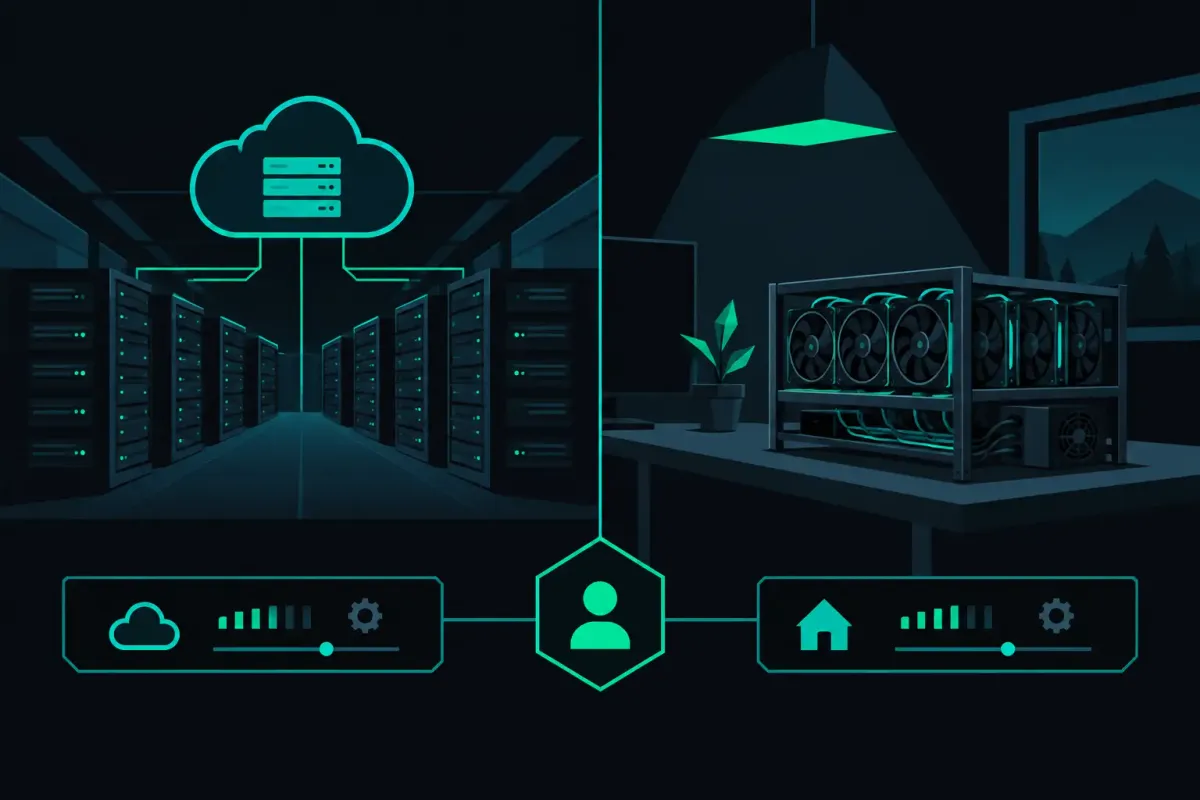
A hosting quote can make a home power bill look embarrassing. Then the contract arrives. It defines where your machine sits, who can touch it, what happens during an outage, how billing changes, and whether you can point the hashrate where you choose. Hosted versus home mining is not only a power-price comparison. It is a decision about control over a physical machine and the work it produces.
For a Bitaxe on a desk, the question may be heat and noise. For a small ASIC fleet, it may be whether a garage circuit can carry the load. Neither choice changes the underlying fact of solo mining: a valid block is found by probability, not effort alone. A lower operating cost can extend how long you choose to mine. It cannot promise a block.
Hosted Versus Home Mining Starts With Ownership
A miner in your house is physically available to you. You can inspect its fans, replace a power supply, check its firmware, and see whether it is actually running. If it goes offline, you may lose hashrate while you troubleshoot, but there is no question about where the machine is.
A hosted miner can still be your property. That depends on the purchase record, the hosting agreement, insurance terms, and the operator's procedures when you request shipment or removal. “You own the hardware” is not enough if recovering it requires a process you have never read.
Home mining also has limits. A machine in a spare room is exposed to your local power quality, internet reliability, dust, heat, and your own availability. If you leave for a week and a breaker trips on day one, the miner does not care that you retained physical custody. It is simply not hashing.
Hosting exchanges physical access for an operator's facilities and operations. That may be a rational trade when your local electricity is expensive, your space cannot handle the heat, or the hardware exceeds what your electrical service can safely support. The exchange is real. Treat it as one.
Ask What the Contract Lets You Verify
Before sending hardware or money, establish what evidence exists beyond a dashboard number. Can you identify your individual machines by serial number? Can you retrieve current photos, maintenance records, and outage notices? Is power billed from a stated rate, a meter reading, or an undefined adjustment? Who authorizes repairs, and what spending limit applies before approval is required?
The question is not whether a host has good intentions. The question is what happens when memory, incentives, and records disagree six months later. A written process gives you something to check.
The Real Cost Is More Than Electricity
Home miners often focus on the electricity line because it is visible every month. That is reasonable, but it is incomplete. Your actual cost includes power delivery, ventilation, noise mitigation, replacement fans, failed power supplies, internet, and the value of the space the machine occupies. A loud ASIC running in a living area has a cost even when the utility bill is low.
Hosting can consolidate some of those costs into a stated power rate and monthly fee. It may also add setup fees, shipping, minimum terms, remote-hands charges, withdrawal charges, and charges for curtailment or redeployment. Read the unit of billing closely. A rate per kilowatt-hour, a rate per kilowatt, and a fixed monthly price distribute risk differently when uptime changes.
Do not compare a host's advertised rate with only the energy portion of your utility bill. Compare the total monthly cost of producing and maintaining hashrate under each arrangement. Then test the estimate against downtime. A cheap rate does not help during a long outage. A home setup with higher energy cost may still be preferable if it gives you flexibility to turn machines on and off without a contract penalty.
The same discipline applies to heat reuse. Using miner heat for a workshop or cold-weather room can offset another heating load. That is not free electricity. It is a specific local benefit that disappears when the machine is hosted elsewhere or when outdoor temperatures change.
Control the Mining Connection Separately
Physical custody and payout custody are different things. You can own a miner at home and still send your work to a pool that holds balances internally. You can host a machine and still configure it to submit work to infrastructure that pays a solved block directly to your Bitcoin address.
Check whether a host permits your chosen Stratum endpoint, worker configuration, and firmware. Some arrangements standardize pool connections or manage configuration on your behalf. That may simplify deployment, but it can also make it harder to independently check where shares go and how a payout is constructed. Ask whether you retain the credentials and network access needed to verify your configuration.
For small miners using Bitaxe hardware, NerdAxe hardware, or standard Stratum V1 ASICs, this can be straightforward. The machine needs a reachable endpoint and a valid payout address. Native Stratum V2 support remains less common outside firmware such as AxeOS and BraiinsOS+. A connection that accepts both protocols on one port can avoid adding a translator solely to reach a V2-capable pool. That is a practical configuration detail, not a reason to stop checking the rest of the path.
NexusPool is built around that separation. It is non-custodial mining infrastructure. A block solved through the pool is constructed for direct on-chain payment of the subsidy and transaction fees to the miner's address, rather than credited to an internal pool balance. The distinction matters most when the outcome is rare and consequential.
Reliability Has a Different Shape at Home
Hosting facilities can offer capacity, cooling, and operational coverage that a home setup cannot match. They can also fail in ways you cannot physically inspect. A site-wide power event, network issue, curtailment, or maintenance window can remove every machine you have placed there at once.
Home setups fail more independently. One breaker, one router, one overheated room, or one failed fan may take down part of a fleet. You can reduce that risk with sensible electrical design, temperature monitoring, remote access, and alerts. None of those tools replaces safe wiring. If you are unsure whether a circuit can carry a load continuously, get a qualified electrician involved before plugging in more hardware.
Latency deserves a measured view. For solo and lottery mining, stale work is wasted work, so a stable path to the pool matters. But shaving a few milliseconds is not a substitute for uptime, correct accounting, or direct payout construction. Test from your actual location. Record disconnects. Compare observed behavior with what the service claims.
When Home Mining Is the Better Fit
Home mining usually fits best when you value direct physical control, can safely support the load, and accept the heat and sound. It also suits miners who enjoy maintaining hardware and want immediate access to it. An ESP32-class miner on a desk is not a data center project. It can be a practical way to learn the protocol and operate hardware you can inspect yourself.
It becomes less attractive as power draw and noise rise. A standard ASIC may require circuit capacity, ventilation, and acoustic isolation that a rental home, apartment, or shared workspace cannot provide. Trying to force that setup into an unsuitable space creates avoidable safety and neighbor problems.
When Hosting Is the Better Fit
Hosting can fit a small fleet when home power is costly, space is limited, or the hardware is simply too loud and hot for the property. It can also make sense for miners who want equipment running while they travel or who need a facility designed for continuous loads.
Choose it with the same suspicion you would bring to any service that holds your equipment. Know the exact entity receiving it. Understand the term, exit process, repair authority, billing method, and insurance position. Maintain your own records of serial numbers, shipping documentation, configuration, and payout addresses. If a host cannot answer basic questions precisely, the low rate is not the whole price.
There is no universally correct answer. A home miner may pay more per unit of power and gain immediate custody. A hosted miner may gain a better operating environment and accept counterparty exposure. The honest choice is the one whose risks you can name, monitor, and leave.
Before you move a machine, run it where you can observe it. Save its configuration. Confirm the address that receives a solved block. Then decide which parts of the operation you are willing to delegate and which parts must remain yours.
Trust nothing. Verify the path from submitted work to your address.