Glass Ledger
Why Wall Street Is Quietly Building Its Own Bitcoin Custody
Coinbase Custody holds most U.S. spot Bitcoin ETF assets. Here is why banks are building in-house custody, and what non-custodial miners already do.
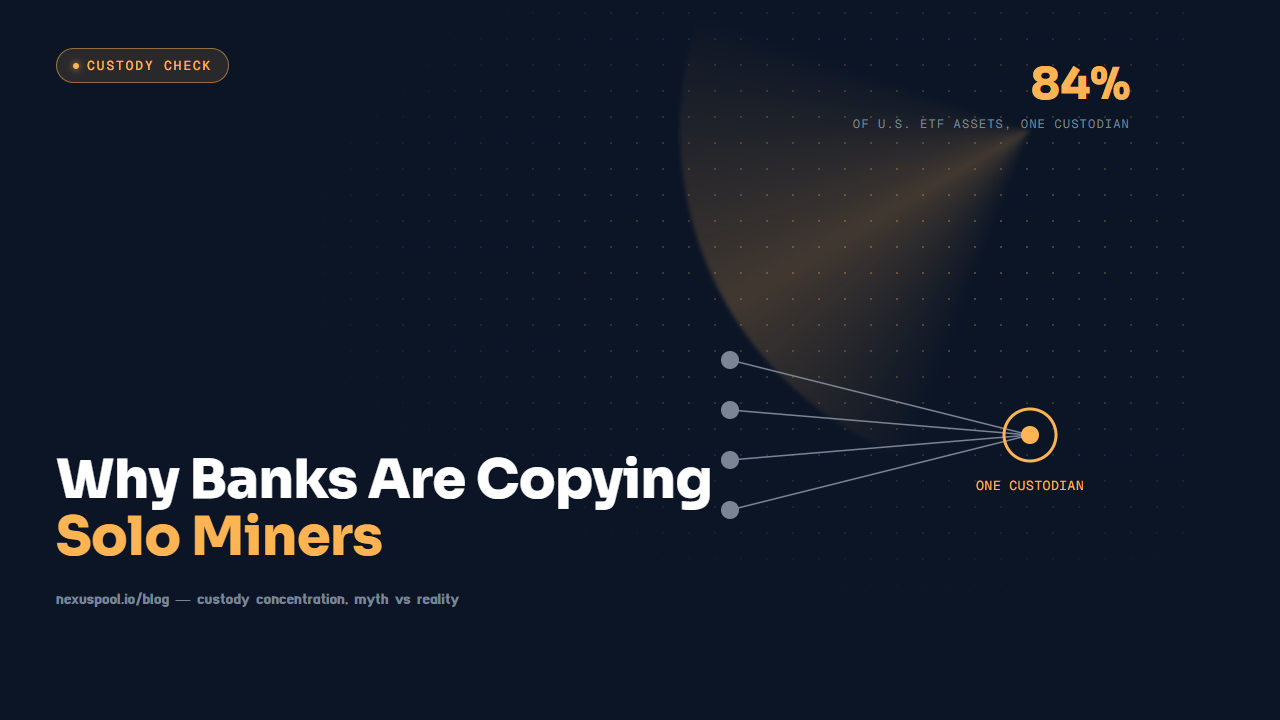
Nearly every US spot Bitcoin ETF settles its holdings with the same custodian. As of early 2026, Coinbase Custody holds roughly 84% of all US spot Bitcoin ETF assets, a level of Bitcoin custody concentration risk that a growing list of major financial institutions has decided it no longer wants to depend on. Morgan Stanley has filed for an OCC national trust bank charter, Fidelity Digital Assets already has one, and BNY Mellon, State Street, Deutsche Bank, and Citigroup are each building or preparing their own digital asset custody platforms rather than routing everything through a single third party. The Office of the Comptroller of the Currency issued interpretive letters in 2025 confirming that national banks can custody crypto directly, and it approved several national trust bank charters for digital asset firms in December 2025 and February 2026, clearing a regulatory path that did not exist a few years earlier.
That shift is worth unpacking, because the reasoning behind it is the same reasoning that has driven individual Bitcoin holders and solo miners toward self-custody for years. Panelists at a May 2026 industry event covering spot Bitcoin ETFs put it plainly: access to Bitcoin through an ETF wrapper was solved years ago, but custody, advisor tooling, and the operational plumbing behind it are still catching up, and institutions are increasingly deciding they would rather own that plumbing than rent it from a single provider. Here are three assumptions worth checking against what is actually happening.
Myth: a single well-known custodian is the responsible, professional choice
The instinct that a large, regulated custodian is inherently the safer option makes intuitive sense. It is also exactly the instinct institutions are now walking back. A security incident, an operational failure, or a regulatory action at one dominant custodian would not just affect that custodian's own customers; it would touch a meaningful share of all US spot Bitcoin ETF assets at once, because so much of the market settled on the same provider. Concentration does not disappear just because the custodian is well capitalized and well known. It just moves the single point of failure up a level.
Myth: custody concentration is a retail investor's problem, not an institutional one
Retail investors who keep coins on an exchange are usually the ones warned about counterparty risk. But the institutions now spending real money building their own trust charters and custody infrastructure are some of the largest financial firms in the world, precisely because they have concluded the same risk applies to them at a larger scale. The economics of building in-house custody only make sense once you are holding enough value that a shared custodian's concentration risk becomes a cost worth engineering around. A home solo miner running a Bitaxe or an Antminer against a non-custodial pool never faces this calculation at all, because the block reward is never routed through a shared custodian in the first place. The concentration problem institutions are now spending real money to re-engineer around simply does not exist on that side of the market.
Myth: self-custody stops mattering once you are "big enough" to use a trusted custodian
| Custody model | Who actually holds the keys | What happens if that party fails |
|---|---|---|
| Single dominant custodian (e.g. an ETF custody provider) | The custodian, on behalf of many clients at once | A failure or freeze can affect a large share of the market simultaneously |
| In-house institutional custody | The institution itself, via its own trust charter | Failure is isolated to that one institution's own holdings |
| Self-custody / non-custodial mining payout | The individual, from the moment the coinbase transaction confirms | Failure of any third party has no effect, because no third party ever held the coins |
Non-custodial mining sits at the far end of that table by design, not by accident. A pool that never takes custody of a miner's reward, paying the full block reward directly to the miner's own address in the coinbase transaction, cannot lose, freeze, or concentrate what it never held. That is a structurally different guarantee than "we are a large, trusted company," and it is the same logic Morgan Stanley and Fidelity are now paying to build for themselves. You can read more about how NexusPool's signed Glass Ledger receipts document that custody model without asking anyone to just take the pool's word for it, and what the pool's own terms do and do not claim.
None of this means solo mining is more profitable, or that any custody model changes the odds of finding a block. Difficulty alone still sets those odds, identical for every miner on a chain, and no custody arrangement, pool, or protocol shifts that math. It also is not investment advice about ETFs, banks, or custody providers named above; it is a description of a public, well-reported trend and the parallel it draws to mining. The reality, in short: institutions are now paying to build the exact thing individual non-custodial miners already had for free, because concentrating custody in one place, however reputable, recreates the single point of failure everyone was trying to avoid. Trust nothing. Verify who actually holds the keys, whether it is a bank or a mining pool.
External source: Coindesk's coverage of the institutional Bitcoin custody gap.