Self-Custody
Liquid Network's Bitcoin Backing, Restored: A Walkthrough
Liquid Network says LBTC is back to full 1:1 bitcoin backing, two months after a software flaw let an attacker mint tokens and drain about 4,000 BTC.
On November 3, 2026, the Liquid Federation said something a lot of people who hold LBTC had been waiting almost two months to hear: Liquid Network restored its bitcoin backing to a full 1:1. Every LBTC in circulation is once again matched by one real bitcoin in the federation's reserve. Getting there took a specific sequence of events, starting with a software flaw that let someone create tokens that were never backed by anything at all. Here is that sequence, step by step, and what it actually changes for anyone thinking about custody design.
First: a flaw in Liquid Network's software let tokens get minted with nothing behind them
Liquid Network is a Bitcoin sidechain built by Blockstream, and LBTC is the token it issues: you lock up real bitcoin with the Liquid Federation, a group of operators who jointly control the sidechain's reserve, and you get LBTC in return, redeemable one for one. On September 6, 2026, a bug in the way Elements, the software that runs Liquid Network, cached range proof verifications let an attacker create approximately 4,000 LBTC with no bitcoin deposited behind them. The attacker then used those unbacked tokens to withdraw about 4,000 real bitcoin, roughly $320 million, from the federation's wallet through a peg-out. Liquid has said its operators were not hacked and no keys were compromised. The problem sat in the software's verification logic itself, not in anyone's key handling. Elements v23.3.4 shipped on September 9 to fix it. The Block's coverage of the restoration lays out the timeline from the September exploit through the November 3 announcement.
Then: the attacker sent most of it back
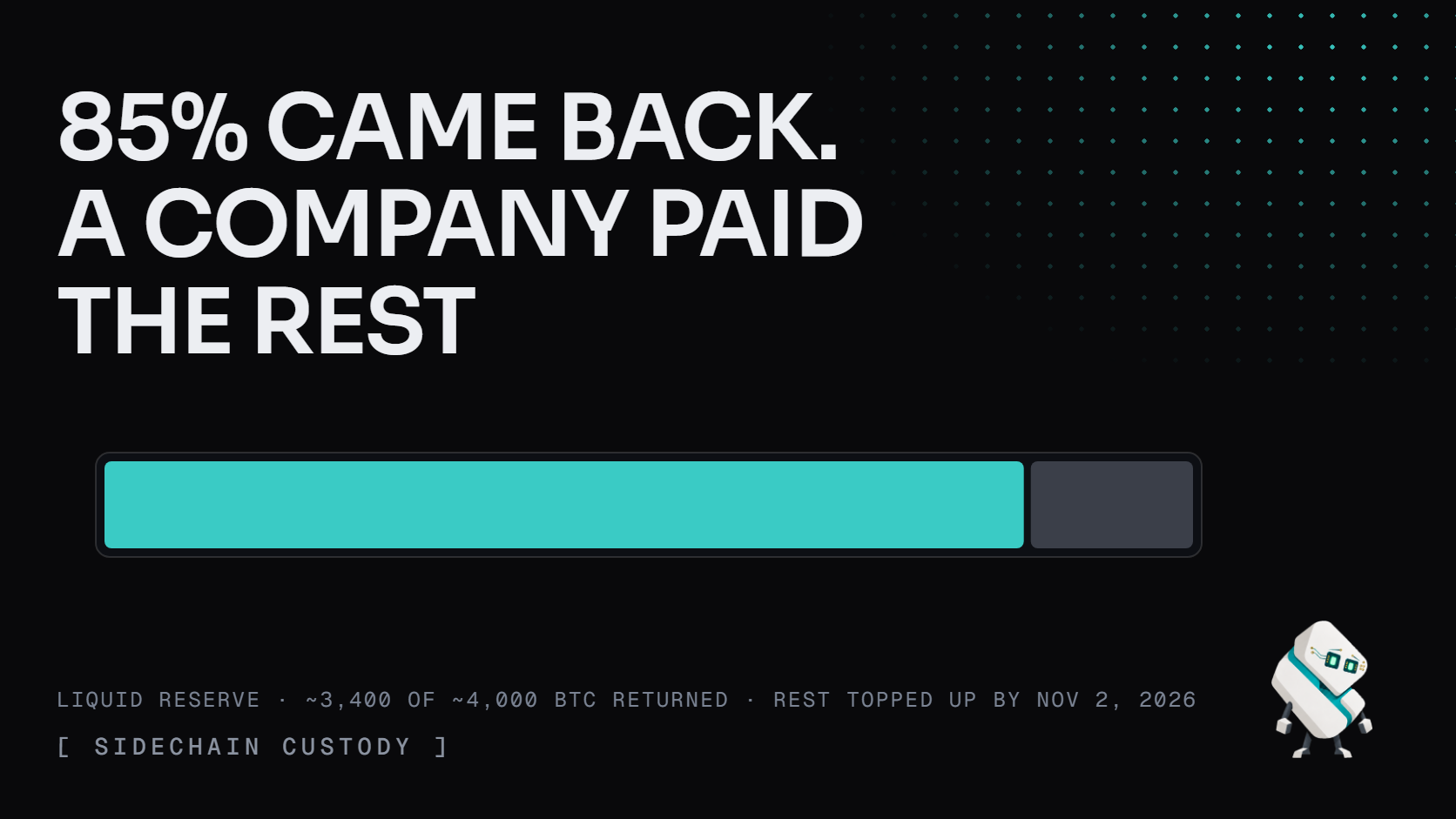
The day after the exploit, once Blockstream had patched the affected bridge nodes, the attacker returned roughly 3,400 BTC. About 600 BTC stayed out, and the attacker asked for a 10% bug bounty in exchange for the rest. Blockstream refused, saying it would not set the precedent of developers of open-source software paying a ransom. The motive for returning most of the coins has not been explained in the public reporting, and this post does not guess at it. What matters for the backing ratio is simpler: about 85% of the gap closed because the person who opened it chose to close it.
Then: Blockstream covered what was left
The returned coins left a shortfall of around 600 BTC. According to Liquid Federation board member Samson Mow, Blockstream supplied it in pieces: a 50 BTC deposit into the federation wallet on October 28, then 300 BTC and a further 250 BTC on November 2, which brought the reserve back to full backing. Blockstream CEO Adam Back posted the network dashboard showing assets matching liabilities at 100% with a reserve deficit of zero. The practical result is that a private company spent its own bitcoin to make a token's backing promise true again, which is a different kind of guarantee than the token's design was supposed to need in the first place.
Then: the federation changed what let the flaw happen
Restoring the reserve was the visible fix. The less visible one is what Back says changed so the same flaw cannot repeat: peg-out authorization keys refreshed and moved to cold hardware wallets, the proof validation caches disabled along with a node bug fix, and consensus rules hardened to fail closed, so a validation error now means rejection rather than acceptance. He also said the network has been through several third-party audits. Swaps between BTC and LBTC have worked again for several weeks, and some semi-automated peg-outs have resumed, but the November 3 announcement did not say whether the remaining withdrawal restrictions are lifted. The federation says changes to governance and oversight are coming in the weeks ahead. None of that is finished yet, which is worth saying plainly rather than treating November 3 as the end of the story.
Finally: what Liquid Network's recovery says about custody design
Strip the steps down and the shape of the story is this: a federation-backed system promised a one-to-one peg, a software bug broke that promise in a few hours, and the fix required an attacker's decision plus a company spending its own money, not a mechanism built into the system that made the backing impossible to break. That is not a condemnation of Liquid Network, which disclosed the issue, publishes its reserve balances, lets node operators check the backing themselves, and worked through a real recovery. It is a structural fact about any design where a token represents bitcoin held somewhere else, guarded by code that can itself contain a flaw.
NexusPool's own payout design sits in a different category, and it is worth being precise about why rather than implying a comparison that does not hold. NexusPool's technology page describes how a solo-mined block pays the finder's own address directly through the coinbase transaction. There is no pegged token standing in for a bitcoin held elsewhere, and no backing ratio to track, because the reward is the bitcoin itself, written into the block. A miner can see the exact coinbase transaction a given address would receive on the current block, before any block is found, using NexusPool's Payout Preflight tool. And each hour NexusPool signs a receipt, its Glass Ledger, covering the shares it counted from a rig and the difficulty it served them at, against a key it publishes, so a reader checks the record instead of taking a company's word for it; the Glass Ledger page explains the mechanism.
None of this claims that pegged sidechains are unsafe to use, that Liquid Network's fix is inadequate, or that any payout design is immune to its own class of risk. It does not claim that NexusPool's core software is published for public review, which it is not. And no payout design changes a miner's odds of finding a block: those are set by hashrate against network difficulty alone, the same at every pool. Mining, like holding any form of bitcoin, carries risk that no single design choice removes, and nothing here is investment advice or a promise of return. What the sequence does show is that a backing promise and a backing guarantee are not the same claim, and in this case the distance between them was closed by returned coins and a company's own bitcoin, not by the system itself.
The walkthrough, compressed: a caching bug let tokens be minted unbacked and then redeemed for real bitcoin, most of the coins came back the next day, a company paid down the rest over two months, and the mechanism that allowed the flaw has since been changed. Four steps, and only the last one addresses why it happened in the first place.
Trust nothing. Verify what actually backs a token before assuming the ratio printed on a dashboard is the one sitting behind it.