Self-Custody
Liquid Froze Bitcoin Redemptions. Check the Reserve
Liquid bitcoin redemptions are still frozen with reserves at 85.77 percent of outstanding L-BTC. Here is how to check the gap yourself.
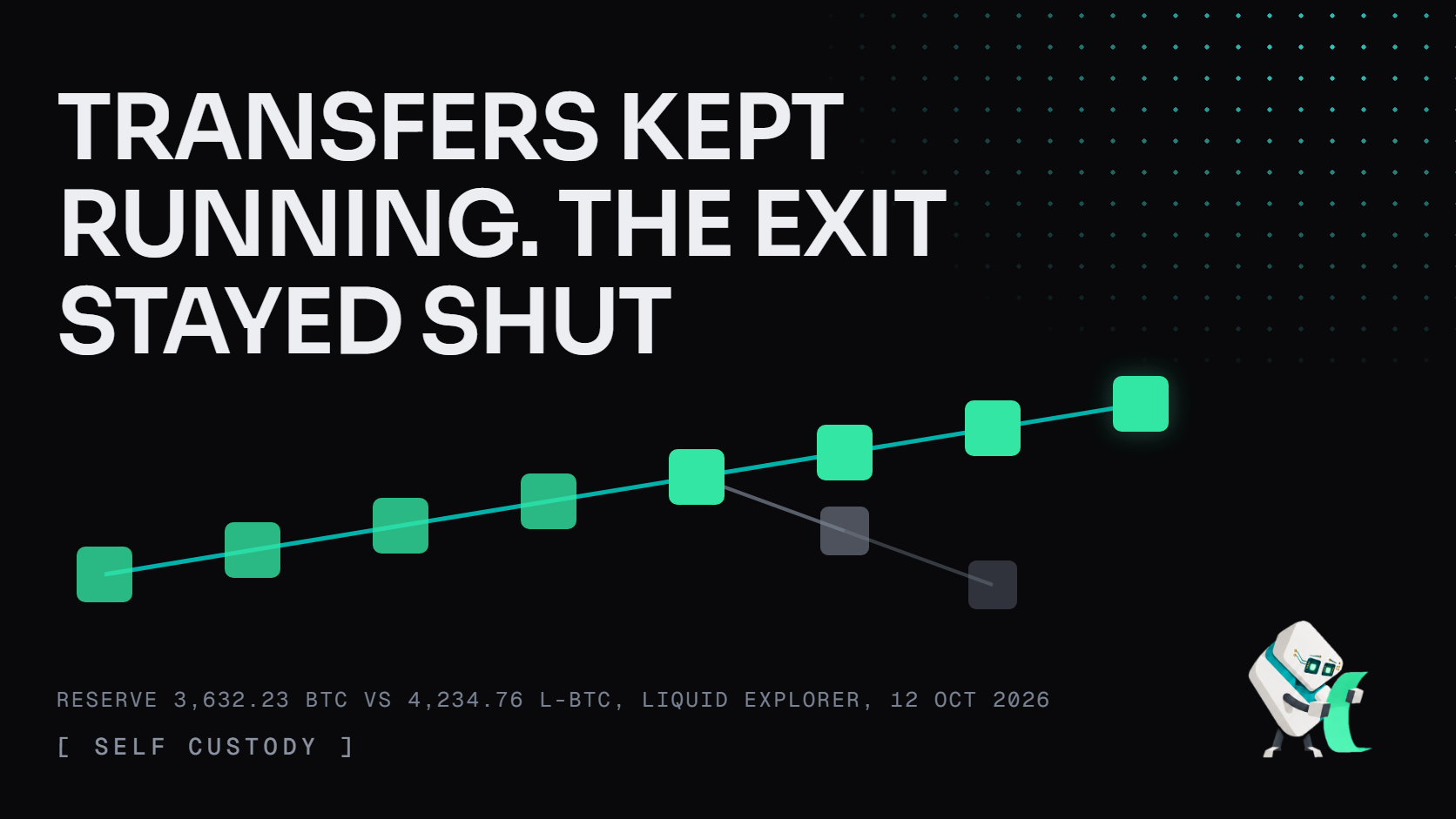
Five weeks after a bug drained most of its reserve, the Liquid Network bitcoin redemptions freeze is still in place. Transfers on the Bitcoin sidechain have worked since September 10. Peg-outs, the step where you hand back an L-BTC token and take real bitcoin off the sidechain, have not reopened. The size of the shortfall sits in a public explorer you can read in about thirty seconds. Most custodial arrangements give you no such number.
The myth: a token named after bitcoin is bitcoin
L-BTC is designed to be worth one bitcoin because a group of members, called the federation, holds one real bitcoin in reserve for every L-BTC in circulation. That design works exactly as long as the reserve actually holds. The myth worth retiring is that the name on the token tells you anything about the backing behind it. A token is a claim. A claim is only as good as the reserve behind it and your ability to exercise it, and right now the second half of that sentence is suspended.
The reality: the reserve is about 602 BTC short, and anyone can check it
The arithmetic below comes from the Liquid explorer's own public API, read on October 12, 2026, not from anyone's statement. The federation reserve holds 363,222,851,073 satoshis, which is 3,632.23 BTC. On the other side, the L-BTC asset has 18,387.58 BTC pegged in across its lifetime, 14,142.80 BTC pegged out, and 10.03 BTC burned. Subtract the second and third from the first, at full satoshi precision, and you get 4,234.76 L-BTC still outstanding.
| Figure | Value |
|---|---|
| BTC held in federation reserve (Oct 12, 2026) | 3,632.23 BTC |
| L-BTC outstanding (peg-ins minus peg-outs minus burns) | 4,234.76 BTC |
| Shortfall | 602.53 BTC |
| Reserve coverage | 85.77% |
| Approximate shortfall value at about $84,000 per BTC | about $50.6 million |
That 85.77% is a floor-level sanity check, not a full audit. The analytics firm TRM Labs, which put coverage at roughly the same figure, said plainly that its estimate does not represent a complete reconciliation of reserves against liabilities, and that caveat is worth carrying rather than dropping. What the number does establish is direction and rough magnitude, computed by you, from data nobody involved controls.
Why Liquid Network bitcoin redemptions stayed frozen for five weeks
The sequence, per Crypto Briefing's reporting on the reserve gap, runs like this. On September 6, 2026, a bug in Elements, the open-source software the sidechain runs on, let someone create and redeem L-BTC without authorization. Roughly 3,996 BTC left the reserve, worth about $320 million at the time, and the reserve bottomed out near 197 BTC from a starting point of about 4,205 BTC. White-hat actors returned around 3,400 BTC by September 7, which is why the hole is 602 BTC today instead of 4,000. The federation's signing keys were not compromised; the software's issuance logic was.
Normal block production and user transactions came back on September 10. Redemptions did not, and the stated conditions for restoring them are substantial: full one-to-one backing restored, upgrades to Elements, completed security audits, and changes to key management including a move to cold storage. A September 29 update said an independent external audit of Elements v23.3.4 was underway. No reopening date has been given, and no public commitment has been made about who covers the remaining 602 BTC.
Two honest limits on all of the above. Nobody outside the federation knows the reopening timeline, and this post makes no prediction about it. And a reserve gap is not the same thing as a loss to any particular holder, because how a shortfall gets allocated if it is never funded is a decision that has not been announced.
What this has to do with NexusPool and mining payouts
This shape of failure is not specific to sidechains, and it is why non-custodial mining is built the way it is. Any arrangement where someone else holds the bitcoin and you hold a claim on it has two separate failure modes: the reserve can shrink, and the exit can close. They are independent. Liquid's transfers kept working this whole time, so a holder moving L-BTC around saw nothing wrong at all. What broke was the ability to leave.
A mining pool that credits you a balance and pays it out later is the same shape of arrangement. NexusPool's technology page describes the alternative: the coinbase transaction on a found block pays the miner's own address directly, so there is no pool-held balance to be short and no withdrawal queue to be frozen. You can inspect the exact coinbase transaction that would pay your address before any block exists, using the Payout Preflight tool. Separately, each hour the pool signs a receipt for the shares it counted from every connected rig, the Glass Ledger, checkable against a published key rather than taken on trust, and the Glass Ledger page shows how that works. Live pool state sits on the public status page.
None of that changes anyone's odds of finding a block, and it is worth saying flatly. Your probability of finding a block is your hashrate divided by the network difficulty, nothing else, and it is identical at every pool and in every custody model. Payout architecture decides who holds the coins between the moment a block is found and the moment you can spend them, and how long you would wait to learn the answer. That is a different question from odds, and it is the question this freeze raises.
The reality, in one line
The reality is that the Liquid Network bitcoin redemptions freeze is the rare custody failure you can measure yourself, because the reserve and the outstanding claims are both public, and most arrangements built on somebody else's balance sheet give you neither number.
Trust nothing. Verify the reserve against the outstanding claims yourself, in the explorer, before you treat any claim on bitcoin as bitcoin.