Merged Mining
The Night the Litecoin Hashrate Chart Stopped Looking Flat
A Litecoin ETF started trading on Nasdaq and network hashrate climbed. Here is what that actually does to a home miner's solo Dogecoin and Litecoin odds.
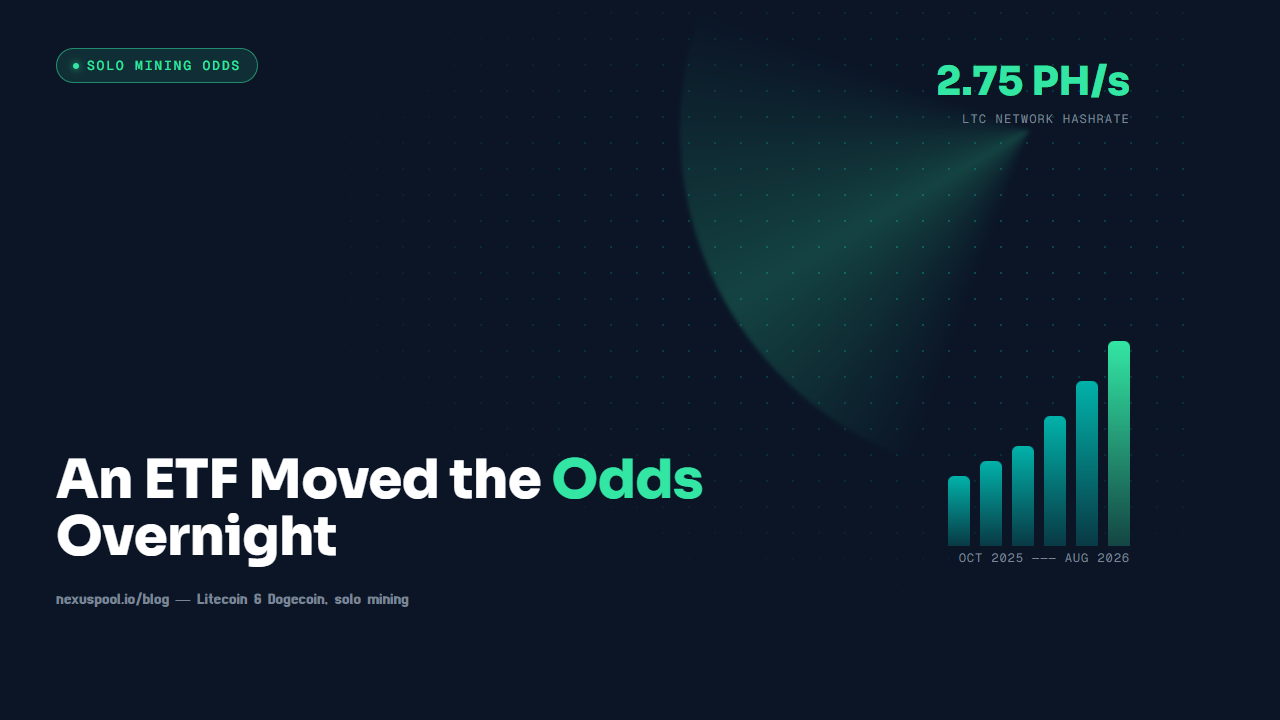
The dashboard has been open in a background tab for months, mostly ignored. It shows one Antminer L9, humming away in a spare room, pointed at a merged Litecoin and Dogecoin solo setup. Tonight the chart behind it looks different. The network hashrate line, usually a lazy drift, has a visible step in it. A Litecoin hashrate ETF story has been sitting in a browser tab for a week, and it is starting to look like the reason.
What the Litecoin Hashrate ETF Story Actually Is
The Canary Litecoin ETF, ticker LTCC, began trading on Nasdaq in late October 2025, becoming the first U.S. spot Litecoin exchange-traded fund, according to Canary Capital's own launch announcement carried by Nasdaq. An ETF does not mine anything. It buys and holds LTC on behalf of shareholders. But regulated products tend to pull in attention and capital that eventually shows up as new mining investment too, and Litecoin's network hashrate has been on a noticeably upward path since, reaching roughly 2.75 petahashes per second by mid-August 2026. That is the step in the chart.
The Part That Is Easy to Miss
Litecoin and Dogecoin share more than headlines. Dogecoin adopted the same Scrypt algorithm as Litecoin specifically so it could use AuxPoW merged mining, meaning a single Scrypt ASIC solving a valid proof of work can satisfy both chains' block requirements at once. Roughly nine out of ten Litecoin miners also merge-mine Dogecoin this way. That single L9 in the spare room has been quietly doing double duty the whole time. It also means that whatever pushes Litecoin's network hashrate up pulls Dogecoin's solo odds down right alongside it, since the same hashrate expansion applies to both.
The Trade-Off of Dogecoin Merged Mining
Merged mining has a real security upside for Dogecoin. Since nearly all of its hashing power also secures Litecoin, the cost of mounting an attack against either chain rises with the combined hashrate of both, not just Dogecoin's own, smaller network. That is a genuine benefit for a chain that would otherwise be far cheaper to attack on its own. The trade-off is that merged mining tends to concentrate hashing power in whichever pools support both chains well, since there is little reason for a Scrypt miner to point hardware at a pool that only credits one side of the pair. That is a separate question from the odds calculation below, and it does not change it. It is worth knowing for the same reason the odds number is worth knowing: neither fact changes just because a miner would rather it didn't.
Running the Numbers Again
The L9 in question is rated at 16 gigahashes per second, a real, published spec for the device. Against a network hashrate of 2.75 petahashes per second, or 2,750,000 gigahashes per second, that machine's odds of solving any single block are 16 divided by 2,750,000, or about 0.00058%. Litecoin targets a block roughly every 2.5 minutes, which works out to about 210,240 blocks a year. Dividing the mean number of blocks that machine would need to attempt by that yearly block count puts the expected wait at just under ten months for a solo find, using only those two figures: 16 GH/s of hashrate against 2.75 PH/s of network hashrate. That number was longer a year ago, when the network hashrate was lower, and it is likely to keep drifting longer if institutional-driven hashrate keeps climbing the way it has since the ETF launched. None of that is a prediction. It is what the same two inputs, updated, currently say.
What This Doesn't Mean
It does not mean the L9 is now less capable, or that anything about the hardware changed. It means more competitors are attempting the same lottery, which is exactly what rising network hashrate always does to a fixed amount of solo hashing power, on any chain. No pool changes that relationship, including this one. Nothing about mining Litecoin or Dogecoin through NexusPool's Litecoin page shortens the odds above. What it does is support solo mining on both chains through the same non-custodial structure, meaning a block found by that L9 pays out directly to its owner's own address rather than sitting in a pool balance waiting to be claimed.
Back at the Dashboard
The chart is still open in the background tab. The step in the hashrate line is still there, and it is not going to reverse itself just because a miner in a spare room decided to look at it tonight. What changes is not the odds, since those were never something to expect on a schedule. What changes is the miner now has an actual number instead of a vague sense that "things got more competitive." NexusPool's Litecoin technology page covers the Stratum V1 and Stratum V2 support that connects a device like an L9 without extra configuration on either protocol version, which does not affect the math above either. It just means the hardware keeps working the same way while the number it is chasing keeps moving.
This is not a promise that solo mining Litecoin or Dogecoin pays off, and it is not investment guidance. Nothing here claims that any pool, including this one, can shorten the odds a given amount of hashing power has against the current network. It is a description of how one real, dated hashrate figure changes one real, dated odds calculation, nothing more. NexusPool's terms page spells out that same boundary in plain language: the software connects hardware to the network, it does not promise an outcome. The lottery ticket costs the same electricity bill either way. The jackpot odds are just a little longer than they were the last time anyone checked.
Trust nothing. Verify tonight's hashrate number before you trust last month's odds.