Glass Ledger
Mining Pool Custody Failures: Myth vs Reality
A newly public $15 billion forfeiture case tied to a mining pool's 2020 hack shows what custodial mining risk actually looks like, against the myth.
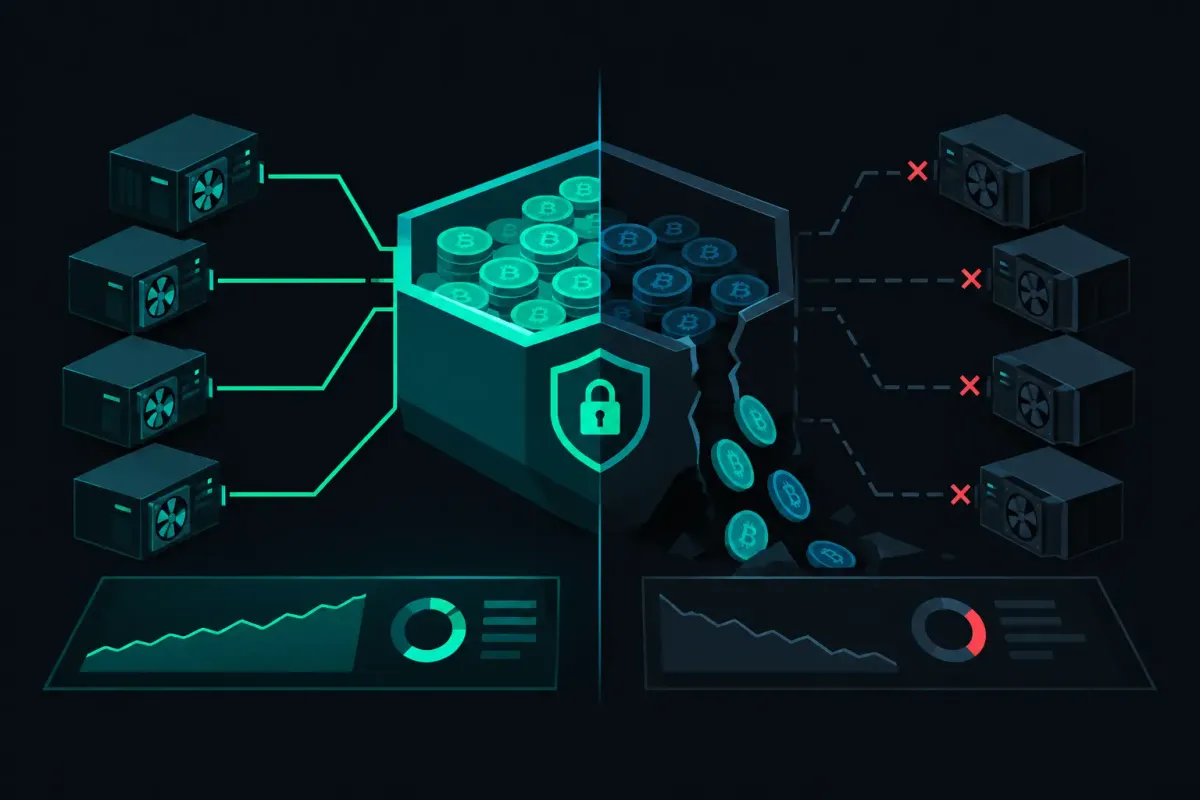
In August 2026, the US Department of Justice announced its largest forfeiture action in history: roughly 127,271 BTC, worth close to $15 billion, seized in a case that traces back to a 2020 hack at a mining pool operator. The pool's system for generating miners' private keys turned out to rely on a weak pseudo-random number generator carrying only 32 bits of real entropy, instead of proper cryptographic randomness. Attackers exploited that weakness to brute-force the keys and drain more than 5,000 wallets in a single event. The theft sat mostly unreported for five years before this year's forfeiture case made it public record. For anyone evaluating mining pool custody risk today, the case is a real, documented example worth separating from the myths that usually surround stories like it.
The Myth: "A Hack Like This Means the Pool Was Careless About Security in General"
The natural read of a headline like this is that the operator must have been sloppy across the board, the kind of place a careful miner would have spotted trouble at in advance. That is usually not how these failures actually work. A pool can run competent infrastructure everywhere else and still have exactly one silent, structural flaw in exactly the wrong place: the specific mechanism that generates the private keys controlling custodial balances. A weak random number generator does not announce itself. Every visible signal, a working dashboard, timely payouts, responsive support, can look completely normal for years while the underlying key material is quietly guessable.
The Reality: The Real Risk Was the Custody Model Itself, Not a Specific Mistake
| What people assume | What actually happened |
|---|---|
| The pool was obviously reckless or scammy | The flaw was invisible from the outside for five years |
| This kind of event is rare and unlikely to recur | Weak-randomness bugs have recurred across multiple platforms over the years |
| A "reputable" pool wouldn't have this problem | Reputation is not a security control; it is not independently verifiable |
| The fix is picking a pool with a better track record | The fix is a custody model where the pool never holds the funds to begin with |
The deeper reality is structural. Any pool that holds a balance on a miner's behalf, however careful its operators are, is a single point of failure for that specific risk. The miner is trusting the pool's internal key management to be sound, and that trust cannot be independently checked from the outside. A pool with a five-year clean track record and a pool with a five-year-old undiscovered flaw can look identical right up until the flaw is found.
What a Non-Custodial Model Actually Removes
A non-custodial pool does not eliminate every security risk in mining, but it removes this specific one entirely, structurally, not by promise. In a non-custodial design, the block reward's coinbase transaction pays the miner's own address directly the moment a block is found, and no balance accumulates inside the pool's own systems at any point. There is no internal key-generation system managing custodial funds, because there is no custodial fund to manage. NexusPool operates this way across every chain it supports, and the exact mechanics are publicly checkable through a tool that reconstructs a coinbase transaction before a block is even found, rather than asking a miner to simply trust that the model works as described.
What This Doesn't Claim
This post does not claim custodial pools are inherently dishonest, or that this specific incident reflects how any other pool operates today. It does not claim non-custodial design prevents every category of mining risk. Hardware fails, electricity costs are real, and no pool of any kind changes the underlying odds of finding a block. This post also does not name the operator involved in the 2020 incident; the structural lesson holds regardless of which specific company it was. Finally, this post does not claim NexusPool's core source code is public today. It is free to use with no fee, but the underlying code is not yet open for outside review.
FAQ
Was this a recent hack, or an old one just made public?
The hack itself happened in 2020. The DOJ forfeiture action and the public accounting of what happened became public in 2026, five years later.
What specifically failed, technically?
The pool's system for generating private keys used a weak random number generator with limited real entropy, making the keys guessable through brute-force computation rather than requiring any breach of the pool's other systems.
Does a non-custodial pool eliminate all mining risk?
No. It removes the specific risk of a pool losing custody of funds it was never holding, since a non-custodial pool pays a found block's reward straight to the miner's own address. It does not touch hardware failure, electricity cost, or the underlying odds of finding a block.
Can a miner verify a pool's non-custodial claim independently?
Yes, if the pool publishes a way to do so. NexusPool's payout preflight tool reconstructs a coinbase transaction and checks it byte for byte before a block is found, so the claim is checkable rather than taken on faith.
Does this affect NexusPool directly?
No. This is an unrelated operator's incident from 2020, used here because it is a real, well-documented example of what custodial risk in mining actually looks like when it goes wrong.
Trust nothing. Verify whether a pool ever holds your funds at all, not just how long it's gone without a headline.