Mining Proxy
Mining Proxy Versus Direct Connection Explained
Mining proxy versus direct connection changes where your rig gets work, who validates shares, and what fails when a local device goes down.
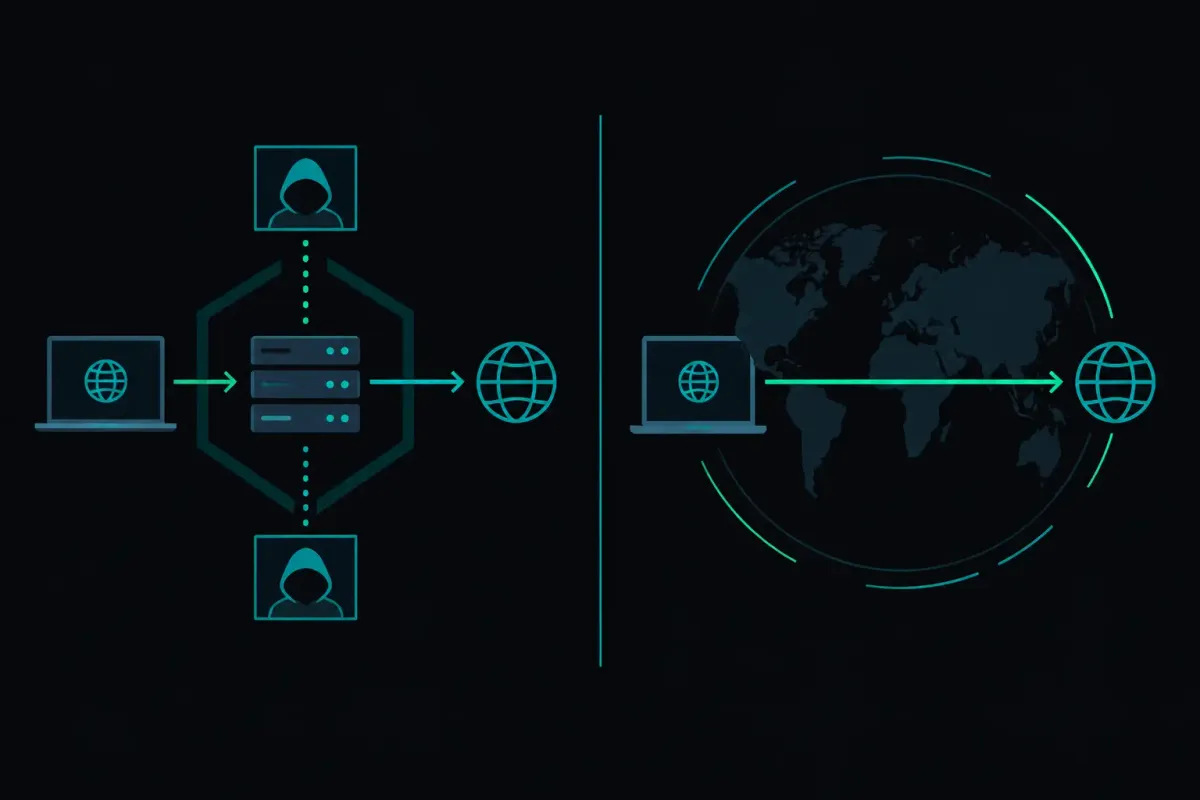
A Bitaxe or ASIC only needs a pool address, a port, and a payout address to start hashing. The choice hidden behind that simple setup is mining proxy versus direct connection. It decides whether your rig talks to the pool itself or first talks to a device on your own network.
Neither path changes the chance that a hash finds a Bitcoin block. Network difficulty sets that chance for a given hashrate at every pool. Solo mining is a lottery. An expected wait is not a schedule, and a local proxy cannot turn it into one.
What the choice does change is the path for work, shares, outages, and troubleshooting.
What a direct mining connection does
With a direct connection, each miner opens its own Stratum connection to the pool endpoint. The rig receives work from the pool, hashes it, and sends shares back over that connection.
For a home miner with one or two devices, this is usually the shortest configuration. Put the pool address and port in the miner's settings, use your Bitcoin address as the username where required, save the settings, and check that the miner begins submitting accepted shares.
There is no local service to install, update, restart, or diagnose. If the rig can reach the internet and the pool endpoint, it can mine.
Direct connection also keeps a failure easy to locate. If one miner stops submitting shares while another miner on the same network continues, start with that miner. Check its network connection, configuration, clock, power, and firmware logs. The other miner has already shown that the home router and internet path are probably not the immediate problem.
A direct connection does not mean the route is physically direct in the ordinary sense. Internet traffic still crosses routers and providers before it reaches a server. It means the miner itself maintains the pool session rather than handing that job to a device you operate locally.
What a mining proxy does
A mining proxy is an intermediary between miners and a pool. Your rigs connect to the proxy over the local network. The proxy maintains one or more upstream connections to the pool and passes work down to the rigs and shares back up.
The proxy might run on a small computer, a server in a farm, a router with suitable software, or a dedicated appliance. Its behavior depends on its configuration. Some proxies concentrate many miner connections. Some translate between mining protocols. Some apply local monitoring or policy. Some are mainly used because a site has network rules that make one controlled outbound connection easier to manage than many separate ones.
That extra component gives an operator one place to inspect traffic and settings. It also creates one more component that can fail. If the proxy loses power, hangs, fills storage, misconfigures DNS, or loses its upstream session, every rig behind it can stop receiving useful work even though the rigs themselves remain powered on.
This is not an argument against proxies. It is the cost of centralizing part of the connection path. For a site with many miners, that cost may be acceptable because centralized configuration and monitoring save operator time. For one home rig, it may be unnecessary machinery.
Mining proxy versus direct connection: the real differences
The useful question is not which method is universally better. It is where you want the connection state to live.
With direct connection, each rig owns its session. A configuration change must be made on each rig, unless your miner management system distributes it. A failure usually affects one rig at a time. The pool sees each miner's connection separately.
With a proxy, the proxy owns the upstream relationship and distributes work locally. You can change the pool endpoint or upstream settings in one place. You can also create a shared point of failure. The pool may see the proxy's upstream sessions while the proxy tracks the individual downstream miners.
Share handling matters here. A share is evidence that a miner tested a candidate according to the assigned work and met the current share target. A proxy has to pass the share correctly and quickly enough for the upstream pool to read it against the relevant job. If it queues, rewrites, drops, or delays traffic, the rigs can show local activity while the pool receives less useful information.
A direct miner avoids that local handoff. It still depends on its own firmware, network, and the path to the pool. Fewer hops do not remove the need to inspect accepted and rejected shares.
New work is where delay becomes visible
Bitcoin mining work changes when the network advances to a new block. A rig still hashing an old template can produce a valid share for that old job, but it is no longer working on the current best tip. This is why the time between a new block and new work reaching the rig matters.
A proxy adds one local step to that handoff. The pool sends a new job to the proxy, then the proxy sends it to each miner. On a healthy wired network, the local distribution can be quick. But it remains another step to measure if a site is trying to understand stale work or delayed job changes.
Distance matters as well. A miner far from a pool region has a longer round trip. That can delay work and share status. It does not change the probability of a hash meeting the network target. It changes communication time, not mining luck.
For a home setup, do not assume a proxy improves latency merely because it is nearby. The proxy is nearby. Its upstream connection still travels to the pool, and it must process and relay the job. Measure from your network if the distinction matters.
When direct connection is the simpler choice
Direct connection usually fits a home miner when each device can reach the internet and the device firmware supports the pool's connection method. It is easier to explain to someone helping you troubleshoot: the miner points at the endpoint, and the endpoint replies.
It also makes replacements uncomplicated. If one small miner fails, its settings can be entered into the replacement without rebuilding a local service. For a few devices, that is often enough reason to keep the path short.
At NexusPool (nexuspool.io), a Bitcoin rig can connect at solo.nexuspool.io:3350 with a Bitcoin address and no account. The same port accepts Stratum V1 and encrypted Stratum V2. The endpoint steers a miner to a nearby healthy region. A miner far from Los Angeles, Chicago, Frankfurt, and Singapore may still see a longer round trip because geography does not negotiate.
For solo mining, check the payout path before worrying about connection architecture. The pool's Payout Preflight can show the coinbase payout built for your address on the current block before your rig finds anything. If your rig finds a valid block, the subsidy and transaction fees are paid to that address inside the block. Connection choice does not change that destination when the payout address is configured correctly.
When a proxy earns its place
A proxy is often reasonable when an operator has enough miners that repeated per-device configuration becomes an operational problem. It can give the operator one controlled outbound path, one place for local logs, and one place to change upstream settings during maintenance.
It can also help when older miner firmware cannot speak the connection method an operator wants to use upstream. In that case, the proxy is performing a specific translation job. Treat that translation layer as production infrastructure. Monitor it, document its configuration, and plan what happens if it restarts.
Small farms should also decide how the proxy identifies workers. If every downstream miner appears under one upstream identity, troubleshooting may depend entirely on the proxy's own records. If the proxy preserves distinct worker labels, an operator can connect a rejected-share pattern to a physical machine more easily. The right answer depends on the proxy and the pool's worker naming rules.
Do not place a proxy on unstable Wi-Fi and call the result centralized management. If it becomes the path for a rack of miners, give it stable power, a reliable wired connection, and logs you can read when something breaks.
How to choose without guessing
Start with the number of devices and the problem you are trying to solve. One miner that already supports the pool connection method usually needs no proxy. Several miners with independent settings may still be easier to run directly if you value fault isolation over centralized control.
A proxy becomes more compelling when you need protocol translation, a controlled outbound path, centralized configuration, or local visibility that your miners cannot provide themselves. It is not compelling merely because it sounds more advanced.
Whichever path you choose, watch the facts that expose trouble: whether the miner receives new jobs, whether shares are accepted, why shares are rejected, and whether the configured payout address is the one you intended. A green dashboard without those details is only a green dashboard.
Before you leave a rig running, inspect the payout built for your address on the current block. Then verify the connection path you actually chose.