Bitcoin
What Is a Non Custodial Bitcoin Mining Pool?
A non custodial bitcoin mining pool keeps rewards out of a pool wallet. Learn how direct payouts, verifiable work, and Stratum V2 change trust for miners.
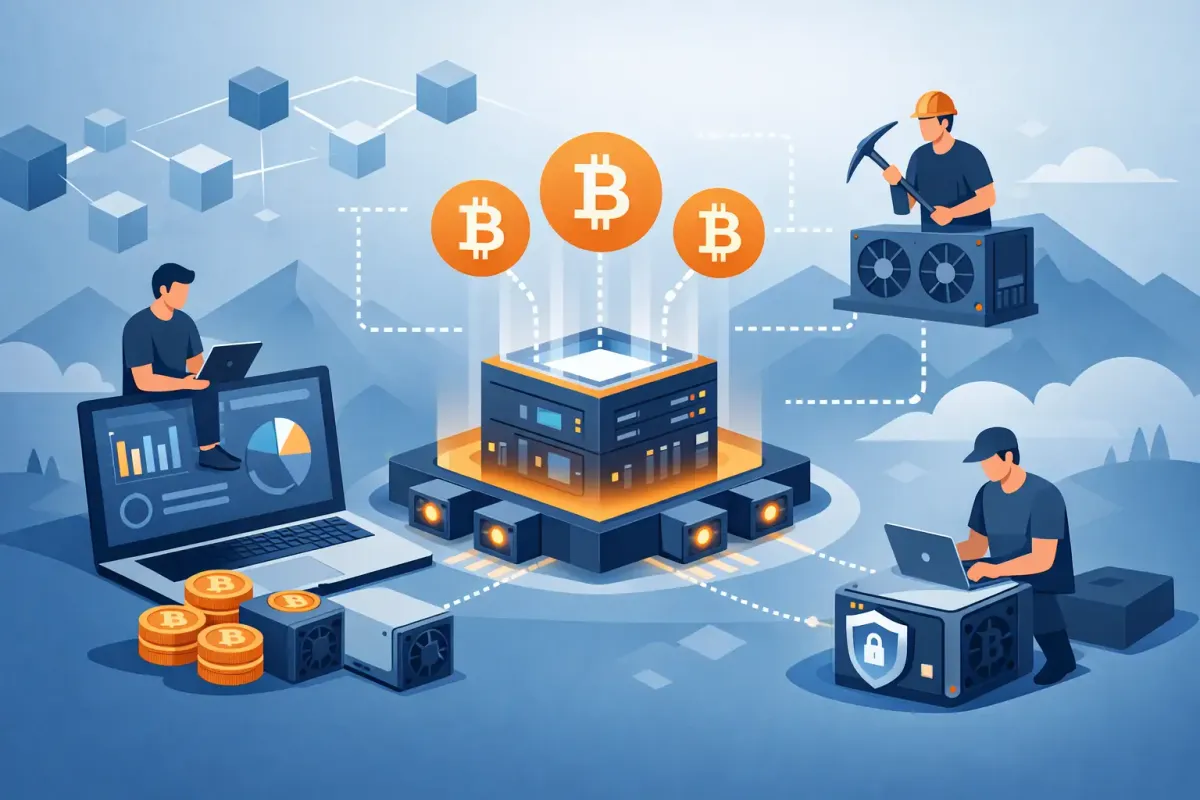
A non custodial bitcoin mining pool should never become the owner of a miner's block reward. That is the test. If your hardware finds a valid Bitcoin block, the coinbase transaction should pay your Bitcoin address directly - not a pool wallet, not an internal account balance, and not a promise to settle later.
That distinction matters most when luck finally arrives. Solo mining is high variance by design. A small home miner may submit valid shares for years without finding a block, while another device finds one unexpectedly. No pool can change those odds. But the infrastructure between your hashboard and Bitcoin's network can determine who controls the reward, who can delay it, and what you are forced to trust.
Custody Is the First Question
Traditional pools generally receive the block reward first. They account for contributed work internally, deduct fees, then distribute balances on their own schedule. That model may be practical for proportional or pay-per-share mining, but it creates a financial intermediary. The operator controls the wallet, the accounting database, the payout policy, and often the evidence miners see.
A non-custodial pool removes the pool wallet from the reward path. In a solo or lottery-style setup, your miner receives work built around your payout address. If your hash solves the network target, the block subsidy and transaction fees are assigned in the block's coinbase transaction to that address. Settlement happens on-chain, under Bitcoin consensus rules.
This does not mean the pool is irrelevant. It still provides job distribution, template handling, share validation, network connectivity, and operational monitoring. It means the pool is infrastructure, not a custodian. The operator can provide work, but should not be able to take possession of a reward earned by your hardware.
Direct Payout Is Necessary, Not Sufficient
A dashboard saying "100% payout" is not proof. A non-custodial design has to hold up at the transaction level.
When a candidate block is found, a miner should be able to inspect the raw coinbase output and confirm the destination address, amount, and transaction construction before the block is broadcast. There should be no hidden fee output, no intermediate pool address, and no withdrawal threshold. If the block is accepted by the network, payment is already in the chain.
That is the cleanest model for a solo miner: one winning hash, one on-chain reward to the address selected by the miner. Transaction fees belong in that calculation too. The block reward is not only the subsidy. A pool claiming direct payment while quietly retaining transaction fees is still taking value from the successful miner.
There is a trade-off. Direct on-chain settlement does not make mining income predictable. It does the opposite: it preserves the real economics of solo mining. You either find a block or you do not. Miners looking for frequent, smaller payouts are choosing a different product and accepting the custodial and accounting assumptions that often come with it.
Work Accounting Must Be Verifiable
Even in solo mining, shares matter. Shares are proofs that your device performed work against a lower difficulty target. They do not earn a proportional payout in a lottery model, but they show whether your miner is connected, hashing, and receiving valid jobs.
The weak version of share accounting is a number on a website. The operator says your miner submitted shares; you have no independent evidence beyond that statement. This is exactly where blind trust enters mining infrastructure.
A stronger design records submitted work in a cryptographically verifiable log. Each accepted share can be represented with the job details needed to validate it: the miner identity, job identifier, nonce-related fields, target information, timestamps, and the result of byte-level validation. A signed ledger gives miners a way to check that a pool counted their work without treating the pool's dashboard as an authority.
NexusPool's Glass Ledger is built around that principle. A cryptographically signed record is not marketing telemetry. It is evidence that can be retained, checked, and compared against the work your device actually submitted.
Verification does not require every home miner to run an audit pipeline every morning. It means the option exists. A claim that cannot be independently tested is still a claim. Proof, not promises.
Stratum Security Is Part of the Custody Model
Mining pools are commonly discussed as payout systems, but the connection itself is a control surface. If an attacker can alter jobs in transit, redirect a miner, or substitute a payout destination, the fact that a pool advertises self-custody does not help much.
Stratum V1 remains widely supported and is often necessary for existing ASICs and open-source home mining hardware. It can be operated securely with encrypted transport where available, careful endpoint verification, and clear worker configuration. But V1 was not designed with the same security model as modern Stratum V2.
Native encrypted Stratum V2 uses Noise-based encrypted channels and supports authority-key pinning. That gives miners a concrete identity to verify when they connect, rather than relying only on a hostname and a conventional TLS chain. The goal is not cosmetic encryption. It is resistance to job tampering and unauthorized proxy behavior.
For a non-custodial Bitcoin mining pool, connection security and payout construction belong together. Your payout address must be protected not only in a web form, but in the actual work your miner receives. If a pool cannot explain how it prevents unauthorized changes to that work, its custody story is incomplete.
Difficulty Should Fit the Miner
A large ASIC, a Bitaxe, and an ESP32-based miner do not submit shares at the same rate. Fixed difficulty can make a low-hashrate device appear dead for long periods, while an oversized stream of low-difficulty shares can create unnecessary traffic for more powerful equipment.
Dynamic per-rig difficulty adjusts the share target based on the hashrate and behavior of each worker. Done correctly, it improves visibility without changing Bitcoin's network difficulty or a miner's chance of finding a real block. The network target remains the only target that wins the lottery.
This is an area where pool language can become misleading. Higher displayed share difficulty does not mean a miner is closer to a block. More shares do not mean a block is due. Share statistics are operational signals, not a prediction engine. We do not change your luck.
For home miners, useful pool telemetry is practical: current hashrate, accepted and rejected shares, estimated latency, worker status, and the actual difficulty assigned to the rig. It should help diagnose a bad Wi-Fi link, an unstable overclock, or a misconfigured worker name. It should not manufacture certainty where probability offers none.
What to Inspect Before You Connect
The right question is not whether a pool calls itself non-custodial. The question is what you can independently verify. Before pointing a miner at any endpoint, examine the reward path, the work path, and the evidence path.
The reward path should identify where a solved block pays and whether both subsidy and transaction fees go there. The work path should explain how jobs are created, how the payout address is committed, and how encrypted connections or key pinning prevent substitution. The evidence path should show how accepted shares, candidate blocks, and payout construction can be checked without privileged access to an operator's database.
Also inspect the boring details. Is there an account required to hold a balance? Is there a withdrawal minimum? Is there a fee that appears only after a block is found? Can the pool alter worker configuration through a web control plane? Does the operator publish clear behavior for stale shares, reconnections, rejected shares, and block propagation failures?
None of these questions guarantee a block. They determine whether the infrastructure deserves to carry your work.
Sovereignty Means Keeping the Risk You Chose
Non-custodial mining is not a shortcut to profitability. It is a refusal to add unnecessary counterparty risk to an already probabilistic activity. The miner supplies the hardware, electricity, and hash. If that hash solves a block, the miner should receive the result without requesting permission from a pool operator.
Choose your payout address deliberately, protect its keys, verify the endpoint your device uses, and treat every dashboard as an observation rather than a source of truth. A mining pool earns trust when its systems make trust less necessary. That is the standard worth connecting to.