Self-Custody
Pool Wallet Versus Self Custody for Miners
Pool wallet versus self custody changes who controls a solved block, what must be trusted, and how home miners can verify every direct Bitcoin block payout.
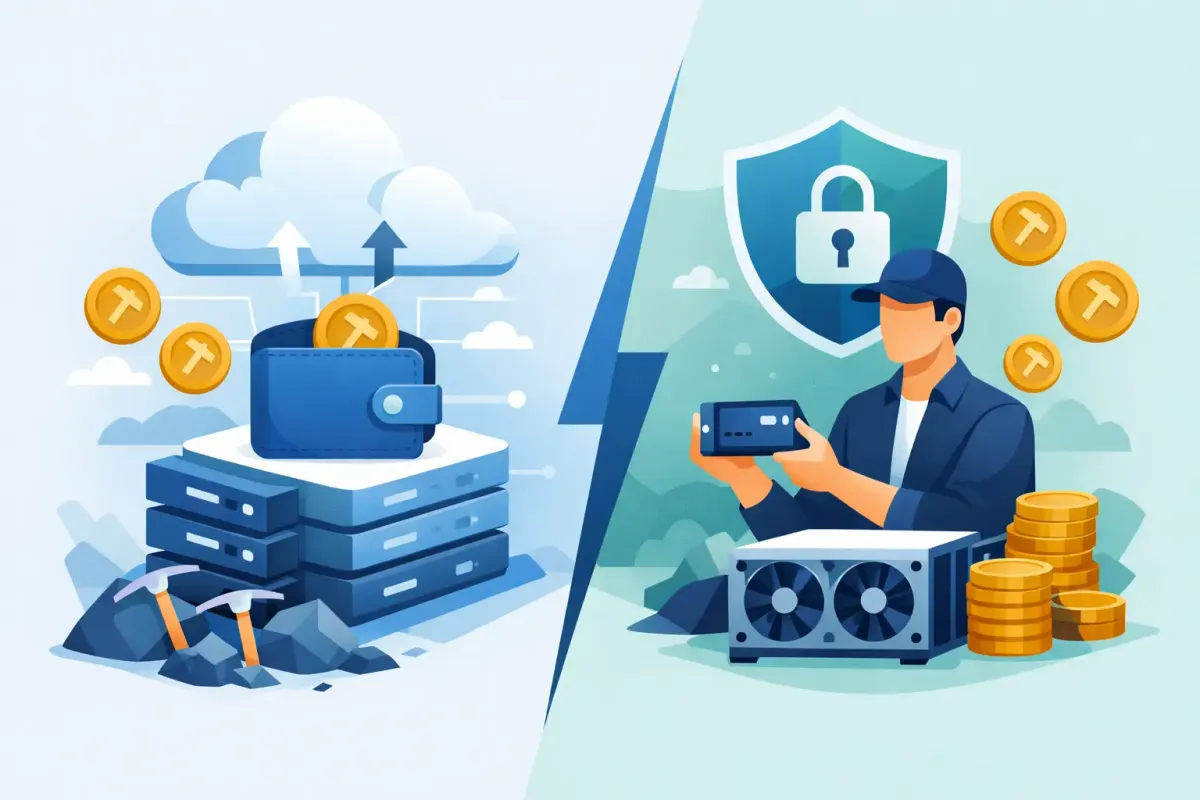
Your Bitaxe can run for years without finding a Bitcoin block. If it finds one tonight, pool wallet versus self custody determines a simple fact: whether the full reward first enters a pool-controlled balance, or whether the coinbase transaction pays an address you control.
That distinction matters most at the one moment mining stops being statistical and becomes final. A valid block does not create a promise from a dashboard. It creates an on-chain transaction with outputs, amounts, and a destination address. The miner should be able to inspect all three.
What a pool wallet actually holds
A pool wallet is an internal accounting system. The pool receives mining rewards into an address or wallet it controls, records each miner's credited balance, and later sends withdrawals under its own payout rules. That model can support many payout methods. It can also make regular small withdrawals possible when individual miners have not found a block themselves.
The balance shown in a pool dashboard is not a UTXO in your wallet. It is the operator's record of what it says you may withdraw. Your ability to spend depends on the pool constructing and broadcasting a later transaction, keeping the funds available, and honoring its withdrawal policy.
None of that automatically means bad intent. It does mean custody exists. The pool holds keys before you do. It may impose minimum withdrawal amounts, payment schedules, address-change delays, or account controls. Its ledger must correctly connect submitted work, reward calculations, fees, and final payments.
For a miner choosing a revenue-sharing pool, this is a trade-off rather than a slogan. A pool wallet can make frequent payouts practical. But it adds counterparty exposure and replaces direct on-chain ownership with a claim on an operator's accounting.
Pool wallet versus self custody at block time
In a self-custody solo or lottery model, the pool provides work and tracks whether your miner submitted valid shares. If your work solves the network block, the block's coinbase transaction is constructed with the reward output going to the Bitcoin address you supplied.
The critical evidence is not an account balance labeled "pending." It is the mined block and its coinbase transaction. Check the payout output. Check that the address is yours. Check the amount. Check that the transaction is confirmed on the Bitcoin network.
A direct payout does not eliminate the Bitcoin maturity rule. Coinbase outputs cannot be spent until they have 100 confirmations. That is a consensus rule, not a pool delay. Once mature, though, the coins are controlled by the private keys for your address. There is no pool withdrawal queue between you and the output.
This model does not change mining odds. Nobody changes your luck. A pool cannot turn a small hashrate miner into a likely block finder by calling the experience self-custody. What it can do is make the result of a successful hash independently visible: this block was found, and this output paid this address.
Shares prove work, not ownership of money
Many mining arguments go wrong by treating shares as if they were Bitcoin payments. A share is evidence that a miner performed work at a difficulty chosen by the pool. Most shares are not valid Bitcoin blocks. They are useful for measuring contribution, assigning vardiff, and operating a pool.
In a proportional or pay-per-share arrangement, those shares feed an accounting formula. The formula determines a balance in the pool wallet. Miners must trust the implementation of that formula, the pool's stated fee, and the payment process.
In solo mining, shares serve a different operational purpose. They show that the rig is connected and hashing. They help the pool identify which worker submitted a winning share if one reaches network difficulty. But the reward is not distributed from accumulated shares. A block either meets Bitcoin's current target or it does not.
That is why a direct-payout solo miner should separate two questions. First: did the pool receive and account for my work? Second: if that work solved a block, was the reward committed to my address? The first can be supported by accepted-share data and difficulty records. The second is answered by the block itself.
What self custody does and does not prove
Self custody means you control the keys to the address receiving the reward. It does not mean every part of mining infrastructure disappears from the trust boundary.
A pool may still select templates, relay jobs, set share difficulty, and run the connection endpoint. In Stratum V1, miners generally receive jobs and submit shares through a plaintext-era protocol unless transport protections are added around it. Native Stratum V2 provides encrypted transport through Noise and supports authority-key pinning. These properties reduce specific connection and job-security risks. They do not, by themselves, prove where a future coinbase output will pay.
Payout construction requires separate verification. The destination address should be visible before a miner commits hashrate. A Payout Preflight check can validate the configured address and show the expected reward construction before mining begins. After a found block, the on-chain transaction remains the final evidence.
There is another limit worth stating plainly. A direct payment can be sent to the wrong address if the miner configured the wrong address. Self custody makes key control your responsibility. Confirm the address character by character when it matters. Keep backups for the seed or signing device. Do not use an exchange deposit address unless you accept that the exchange, not you, controls the destination arrangement and may have its own policies.
A verification routine for home miners
You do not need to audit every byte of a mining stack before connecting. You do need to know which claims can be checked and where the proof should appear.
Start with your configured payout address. Confirm it is an address from a wallet whose keys you control. Then confirm the pool's worker naming format does not alter the address or silently route earnings to an account balance.
Next, watch your miner's accepted shares. A steady stream of accepted work does not promise a block, but rejected shares, unstable latency, or unexplained disconnects are operational signals worth investigating. Dynamic per-rig difficulty can make share reporting useful across a small fleet with very different hashrates.
If the pool publishes a signed work or accounting record, verify the signature against its stated public key and retain the record that applies to your worker. A cryptographic signature can establish that a specific operator key signed specific data at a specific time. It cannot make false operational data true by itself. It gives you a durable statement to compare against logs, shares, and eventually the chain.
Finally, if a block is found, inspect the coinbase transaction directly. Verify the block height, the payout address, and the value of the output. Account for the block subsidy and transaction fees actually included in that block. Do not infer the reward from a headline number or a dashboard total.
NexusPool is built around this direct-payment model for Bitcoin solo and lottery miners. Its Payout Preflight, signed Glass Ledger, and direct on-chain payout are useful only to the extent that a miner can check the stated result against their configured address and Bitcoin's public record.
Which model fits your operation?
A pool wallet may fit a miner who wants frequent, predictable distributions from a shared-reward scheme and accepts the operator's custody and accounting model. Read the payout terms as financial terms, not interface settings. Ask when balances become withdrawable, whether a minimum applies, how fees are calculated, and what happens if an account is unavailable.
Self custody fits a miner who would rather accept solo variance than leave a solved-block reward in another party's wallet. For a home miner with a Gamma, NerdQaxe++, or a conventional ASIC, that preference is often less about expected luck than about ownership at the point it matters.
The decision is not whether to trust software completely. No honest miner should make that claim. The decision is whether the system leaves you with a private balance and a promise, or with a transaction output that your keys can spend after maturity.
Set your payout address carefully. Save your logs. When the rare event arrives, look past the dashboard and read the transaction. Trust nothing. Verify the payout transaction.