Solo Mining Odds
Should You Rent Hashrate to Solo Mine Bitcoin?
A rented-hashrate solo miner won a $200,000 Bitcoin block in August 2026. Here is the real odds math and a checklist before you try it.
On August 2, 2026, a solo miner using CKPool found block 960804 and collected 3.1569 BTC, worth roughly $200,000 at the time. CKPool developer Con Kolivas described the winning machine's hashrate as "wildly variable, presumably rental, peaking at 100 PH." It was the pool's 317th solo block since it started tracking them. The story spread quickly because it fits a pattern that keeps repeating in 2026: someone rents hashing power by the day or week from a marketplace such as NiceHash or MiningRigRentals, points it at a solo pool, and occasionally wins big. A similar case in February 2026 turned a reported $75 rental into a full block reward, covered at the time as roughly 1-in-28,000 odds for that specific bet.
Renting hashrate to try solo mining is a real, currently searched idea, and it deserves a real answer instead of a headline. The market that makes it possible is genuinely bigger than one lucky story: mid-2026 pricing on marketplaces like MiningRigRentals runs roughly $0.05 to $0.10 per terahash per day, with NiceHash at broadly similar effective rates, which is low enough that renting a meaningful chunk of hashrate for a day or a week is within reach of an ordinary hobbyist budget. Below is a checklist to work through before renting anything, built around the actual math rather than the win.
Understand what renting hashrate actually buys you
A rental does not buy better odds per unit of hashing power. It buys temporary access to more hashing power than you would otherwise own, for as long as you keep paying for it. The probability of finding a block on any given attempt is still just your hashrate divided by the network's total hashrate, the same formula that applies to every miner on the chain, whether the hardware is rented or owned.
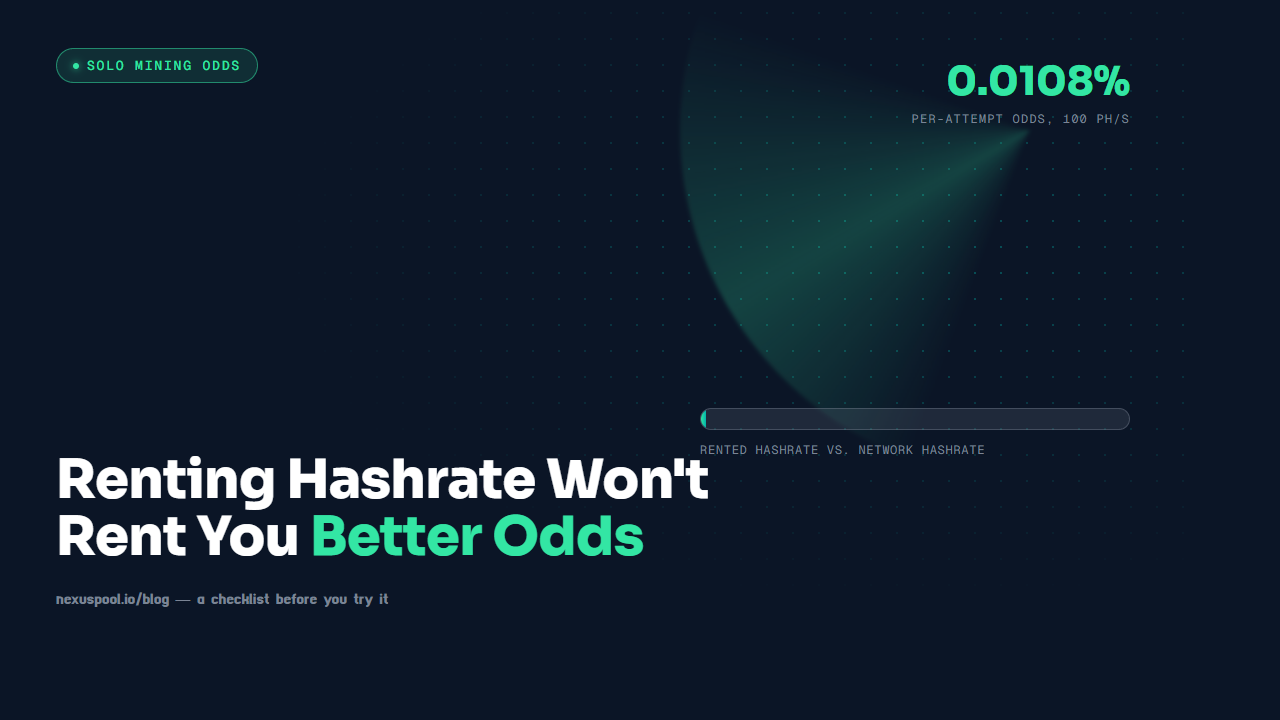
Take the August 2 case and do the math directly. The miner's peak hashrate was 100 PH/s against a Bitcoin network hashrate of roughly 924 EH/s, or 924,000 PH/s, at the time. That gives a per-attempt probability of 100 / 924,000, or about 0.0108%. Inverting that, if 100 PH/s were sustained continuously, the expected gap between finds would be about 9,240 blocks. At Bitcoin's roughly 52,560 blocks a year (the network's 10-minute average block time), 9,240 blocks works out to about 0.176 years, or roughly 64 days between expected wins, which lines up with the figure that circulated alongside the original reporting. Renting the hashrate did not change that formula in any way. It only supplied the hashrate that went into it.
The Rent-Hashrate Checklist
- Check whether you are comparing peak or sustained hashrate. A "peak" figure like the one in this case is not necessarily what ran for the entire rental window. If a marketplace bills you for continuous access but your delivered hashrate is lower or intermittent, your real odds are worse than the headline number implies.
- Price the rental against expected value, not the jackpot. Multiply your per-attempt probability by the block reward to get a rough expected return, then weigh that honestly against what the rental actually costs for the period you are paying for. Short rental bursts aimed at a solo pool are, for most people who try this, a net loss over time. The winners get written about; the much larger number of renters who get nothing do not make headlines.
- Confirm the pool pays the same way regardless of how the hashrate arrived. A non-custodial pool pays the coinbase reward straight to the address you configured, whether the hashrate behind it came from a Bitaxe on your desk or a rig rented for the afternoon. NexusPool's Payout Preflight tool reconstructs and checks the coinbase transaction before a block is even found, which matters exactly as much for rented hashrate as for owned hardware, since the payout mechanics do not change either way.
- Decide in advance whether this is entertainment spending or a financial plan. No odds calculation changes the fact that the expected value of a short rental, at typical current prices, tends to run negative. Treat it as a lottery ticket you understand the math on, not a return you are owed.
- Think about which chain you are actually pointing the rental at. The odds math above is Bitcoin-specific because Bitcoin's network hashrate is enormous. The same rented terahashes aimed at a smaller SHA-256 chain such as Bitcoin Cash, or at Scrypt-based Litecoin or AuxPoW-merged Dogecoin, produce a very different per-attempt probability, because the denominator in the same hashrate-divided-by-network-hashrate formula is so much smaller. That does not make any chain a better investment; it just means the same rental dollar buys a different, calculable shot depending on where you point it.
If your checklist comes back clean, meaning you understand the real per-attempt probability, you have priced the rental against expected value rather than the jackpot, and you are only spending money you would be fine losing outright, then a short rental pointed at a solo pool is at least an informed bet instead of a blind one. If any box does not clear, especially the expected-value one, the more honest move is to skip the rental entirely and, if you still want to mine, run your own hardware through a free, non-custodial pool with same-port Stratum V1 and V2 support, where every reward still goes straight to your own address at 0% fee, on your own schedule, with no rental bill to renew.
Nothing here is investment advice, and none of it improves anyone's actual odds: difficulty alone sets the probability of finding a block for every miner on a given chain, identical for a rented rig and an owned one, and no pool, protocol, or rental marketplace changes that arithmetic. Trust nothing. Verify the odds math yourself before you rent a single terahash.
External source: The Block's reporting on the August 2026 CKPool solo block.