Solo Mining
Why Solo Mining KYC Usually Misses the Point
Solo mining KYC is not a Bitcoin rule. Learn what a pool can identify, how direct block payouts work, and what to verify before you connect a rig today.
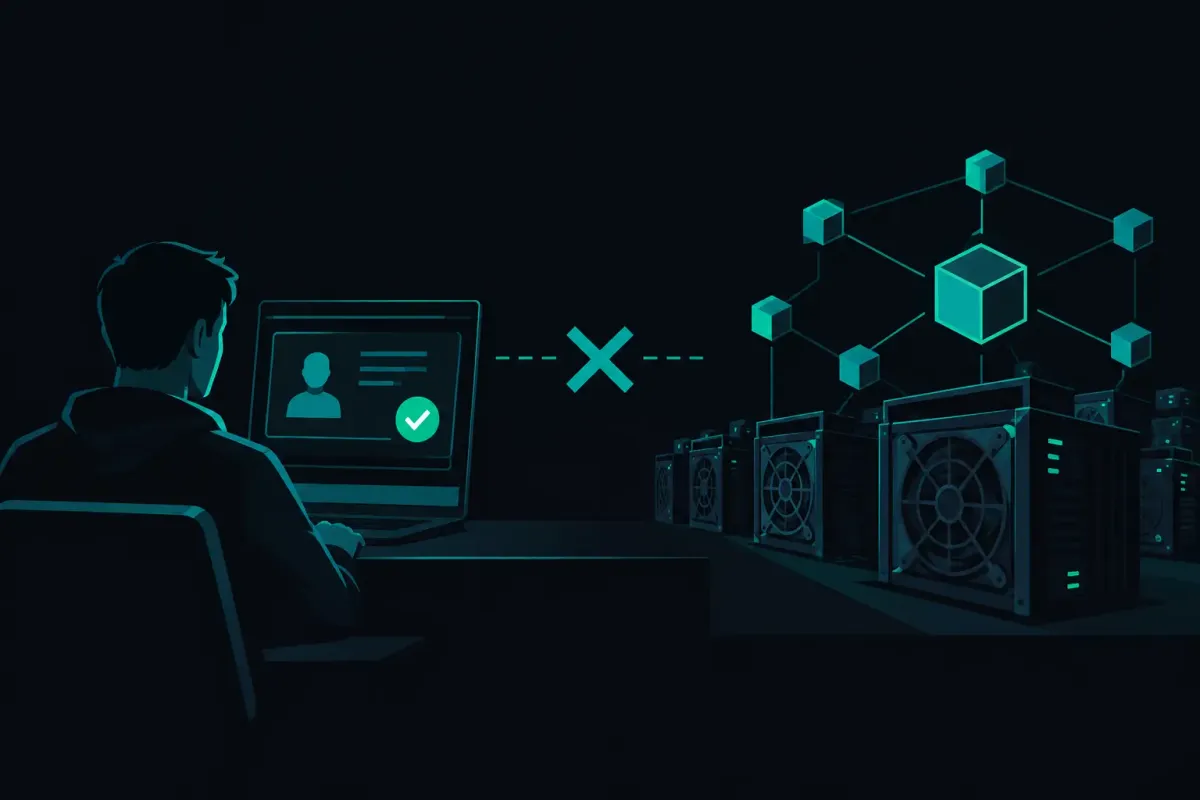
A Bitcoin miner can point a rig at a server with a payout address and begin work. That is why solo mining KYC is usually a pool policy question, not a rule built into Bitcoin.
Bitcoin does not ask for a passport, a utility bill, or a customer profile before it accepts a valid block. It checks the block's proof of work, its transactions, and its consensus rules. If the block is valid, the coinbase transaction can pay an address chosen by the miner.
That does not make mining invisible. It means identity, custody, and payment need to be discussed separately. They are often bundled together under the word KYC, which makes a simple setup sound more mysterious than it is.
What solo mining KYC actually means
KYC means Know Your Customer. In financial services, it usually means collecting enough information to identify a customer and sometimes assess the source or destination of funds. The exact requirement depends on the service, its jurisdiction, and what it does with customer money.
A Bitcoin mining pool can be built in more than one way. It may create an account, maintain an internal balance, accept a withdrawal request later, and send a payout from its own wallet. That arrangement gives the operator a customer record and custody of funds between the block find and the payout.
A direct-payout solo pool has a different path. The miner supplies a Bitcoin address as the connection identity. If that miner finds a valid block, the coinbase transaction pays that address inside the block itself. The subsidy and transaction fees are assigned by the block transaction, not credited to a pool balance first.
The difference matters. An address is not a legal name. It is a destination for Bitcoin. A pool that accepts an address without an account may not need the same customer information needed for a service that holds balances and processes withdrawals.
It also has a limit. No-account mining is not a promise of anonymity. A server still receives a network connection. It may see an IP address, connection timing, worker name, software behavior, and submitted shares. A public Bitcoin address can also be examined on-chain. Address history can sometimes be connected to a person through information gathered elsewhere.
No KYC means no identity document is requested at connection. It does not mean nothing can ever be learned from network and blockchain data.
Bitcoin does not require a mining account
Bitcoin consensus has no field for a miner's name. A candidate block contains a coinbase transaction, and that transaction can create the block reward at a chosen script or address. The network validates whether the block follows the rules. It does not validate a miner's identity.
A pool sits between the rig and the Bitcoin network. The rig receives candidate work from the pool and sends back shares. A share proves that the rig attempted work at the assigned target. Most shares are not blocks. A block is the rare share that also meets Bitcoin's network target.
The pool's role is operational. It builds work, reads submissions, recognizes a winning result, and submits a found block to Bitcoin nodes. None of those steps requires an exchange-style account by technical necessity.
A pool can still choose to request personal information for its own compliance, risk, or business reasons. That choice belongs to the operator. It is not a property of your Bitaxe, ASIC, Bitcoin address, or the Bitcoin protocol.
Direct block payouts change the custody question
The useful question is not only, "Does this pool ask for KYC?" Ask where the reward goes if your rig finds a block.
With a direct coinbase payout, you can inspect the proposed destination before you mine. The output in the candidate coinbase transaction should name your address and show the reward construction for the current block. If the pool takes a fee, that should be visible in the transaction design too.
The final amount changes from block to block because transaction fees change. The subsidy is set by Bitcoin's rules for that block height. The transaction fees come from the transactions selected for that candidate block. A preview is therefore a check of the current candidate, not a promise about a future block's fee total.
NexusPool (nexuspool.io) shows a Payout Preflight for the miner's address and the current block. Its Bitcoin connection accepts a payout address without an account at solo.nexuspool.io:3350. If that rig finds a valid block through the pool, the coinbase transaction pays the subsidy and transaction fees to that address with a 0% pool fee.
That design removes one common custody step. It does not remove normal Bitcoin risks. You still control the private key for the payout address. If you lose that key, a pool cannot recover the reward. If you give someone else an address they control, the block pays them. Check the address character by character before starting a long run.
What a no-KYC pool can still know
A miner should not confuse minimal signup data with a blank record. The server needs enough information to route work and handle share submissions.
At minimum, it knows the address or identifier supplied at login. It can associate shares with that identifier. It can observe when the miner connects, goes quiet, reconnects, or submits malformed work. It may also receive a worker label if the miner provides one.
Your network path reveals more. The server handling the connection sees the source IP address unless you use a network setup that changes it. An internet provider may also see that you connected to a mining endpoint. Encryption can protect the content of a connection from passive observers on the path, but it does not erase the fact that a connection exists.
On-chain visibility begins if a block is found. The coinbase output is public. Anyone can see its destination address and amount after the block is confirmed. They cannot read a legal identity from the address alone, but later spending patterns can create links.
This is not an argument against direct payout. It is the practical boundary. Privacy comes from reducing unnecessary identity collection and handling your own address hygiene carefully. It does not come from assuming a public ledger has forgotten how to keep records.
KYC does not change your mining odds
Network difficulty sets the odds of finding a Bitcoin block. Those odds are the same at every pool for the same hashrate. KYC status does not alter the target your hardware must meet to find a block.
Solo mining is a lottery. An expected time to find a block is an average across many hypothetical runs, not a schedule for one machine. A lower network difficulty means a shorter expected wait. It does not make a block reward more valuable or tell you when your rig will hit.
What the pool can affect is the path after your rig has done the work. Old work can arrive after a new block has already changed the chain tip. A winning submission can be misread. A found block can fail to reach nodes if submission handling is weak. These are operational questions, not luck.
For a home miner, start with the checks that matter most. Confirm the connection address. Confirm the payout address in the candidate reward. Then look for a plain explanation of what happens when a share is rejected and what happens when a found block is submitted.
For a small farm, add failure behavior to the list. Ask where a rig reconnects when a region is unavailable, whether assigned difficulty stays stable through a short outage, and how the pool records work it counted. A technical answer should name the mechanism and its limits rather than promise that nothing can fail.
Questions to ask before connecting a rig
You do not need a legal department to evaluate a no-account solo setup. You need to distinguish a connection identity from a customer account and a direct coinbase output from an internal balance.
Ask whether the pool requests a name, email address, document, or withdrawal account. Ask whether a found block pays your address in the coinbase transaction or first becomes a balance controlled by the pool. Ask whether you can inspect that payout construction before a find.
Then ask what the pool logs and for how long. A serious operator may have legitimate reasons to record connection and security data. The point is to know what exists. "No KYC" answers one narrow question. It does not answer every privacy question.
Finally, keep the payout address under keys you control. Generate a dedicated address if you do not want to join a found block directly to your ordinary spending history. Do not reuse a label that identifies you as a worker name. These are small choices, but they are choices you can make yourself.
Point the rig at the endpoint only after you have checked the payout destination you expect it to use. Trust nothing. Verify the address in the candidate block.