MiningPool
Solo Mining vs Pool Mining: Choose Your Risk
Solo mining vs pool mining comes down to variance, custody, and control. See how Bitcoin payouts, odds, fees, and verification differ for miners at home.
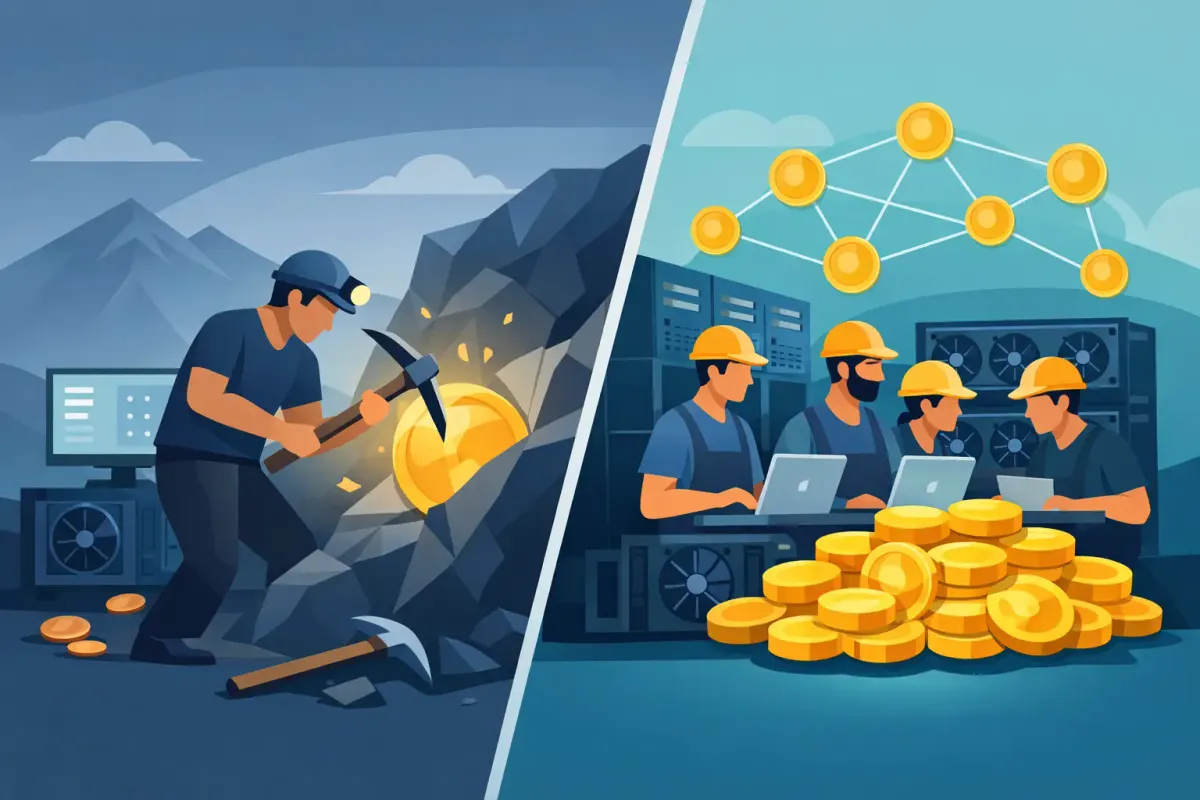
A miner with a Bitaxe on a shelf and a warehouse full of ASICs face the same first question: solo mining vs pool mining. The hardware hashes. The Bitcoin network does not care who owns it. What changes is the contract around the hash: who receives a block reward, who carries variance, who controls payout construction, and what must be trusted between submission and settlement.
A pool cannot change your luck. It can only change how often you are paid and how much authority you hand to an operator along the way.
Solo mining vs pool mining: the actual trade
Solo mining means your hashrate searches for a valid Bitcoin block on its own account. If one of your hashes solves a network-valid block, the full block subsidy plus transaction fees belongs to the payout address in that block's coinbase transaction. If you do not solve a block, you receive nothing. There are no shares converted into a partial payout. There is only a winning block or no winning block.
Conventional pool mining changes that cash flow. Miners submit lower-difficulty shares that prove they were doing useful work. The operator measures those shares and distributes portions of its own block rewards according to a payout method such as PPS, FPPS, or PPLNS. Your income becomes more frequent and statistically smoother, but it is no longer a direct one-to-one result of finding a block with your hardware.
That distinction is bigger than a payout schedule. In a conventional pool, the pool generally controls the mining template, receives the block reward first, tracks your balance internally, calculates deductions, and decides when to pay. Even an honest operator becomes a counterparty. You must trust its share accounting, wallet security, payout rules, solvency, and willingness to send what its dashboard says you earned.
A solo pool is different from a conventional reward-sharing pool. It provides shared connectivity and job distribution, but it does not combine miners' rewards. Each miner works under an individual payout identity. If that miner finds a block, that miner receives the entire reward. The pool is infrastructure, not a custodian and not the owner of a collective reward pot.
Variance is the price of the full reward
The case for solo mining is not predictable income. It is ownership of a rare event.
Your chance of finding a block is proportional to your hashrate relative to the total network hashrate. At any given network difficulty, a miner with 1 TH/s has one-millionth the chance of a miner with 1 PH/s. A 1 PH/s miner has one-thousandth the chance of a 1 EH/s operation. The math is indifferent to whether those hashes come from a single industrial machine or thousands of tiny open-source miners.
Bitcoin targets roughly one block every 10 minutes across the network, but an expected waiting time is not a deadline. If your expected time to find a block is decades, you could find one tomorrow. You could also mine for longer than that expectation and find none. Each valid hash is another independent attempt. Past misses do not make the next hash more likely to win.
Pool mining converts this extreme variance into smaller, more regular payments. That can be rational for an operator who must cover power bills, debt service, payroll, or hosting costs on a schedule. A business cannot usually pay creditors with a mathematically correct explanation of why its block was due eventually.
For a home miner, variance may be the point. A low-power miner can be a direct participant in Bitcoin's proof-of-work process without pretending it is a reliable income machine. The reward, if it comes, is full-scale. The probability is small. Both statements must remain true at the same time.
Do not confuse expected value with a promised outcome. If two configurations submit the same valid work and face the same fees, their long-run expected mining revenue can be comparable. Their distribution of outcomes is radically different. Pool mining spreads winnings across time. Solo mining concentrates them into rare blocks.
What you give up in a conventional pool
The visible pool fee is only one part of the decision. A quoted zero or low fee does not answer the custody question.
Under a typical pooled arrangement, you may need an account, a password, an internal balance, and a withdrawal threshold. The pool can enforce those rules because it receives the reward before you do. It may also charge transaction fees on withdrawals, apply minimum-payment rules, or alter a payout policy. These are operational choices, not Bitcoin consensus rules.
Share accounting also matters. A share is evidence that a miner met the pool's assigned target, not a claim on a Bitcoin UTXO. The operator's database converts that evidence into a balance. If the database is wrong, unavailable, or manipulated, the blockchain cannot independently reconstruct every internal credit. You are relying on records the operator controls.
Mining centralization adds another concern. Pools commonly build block templates and select transactions. When a large fraction of network hashrate follows a small number of template builders, their policy decisions matter. Stratum V2's job declaration capabilities can improve the path toward miner-selected work, but the protocol version alone does not eliminate every concentration risk. Ask who builds the template, who authorizes it, and what your equipment is actually hashing.
None of this means every conventional pool is dishonest. It means a miner should name the trust boundaries accurately. Convenience is a service. It is not proof.
What a solo miner must verify
Running fully independent solo mining against your own Bitcoin node gives you maximum control, but it also requires node operation, template construction, network exposure, and reliable job distribution. A solo-mining service can reduce that operational burden without taking custody, provided its design is verifiable.
Start with the payout path. The coinbase transaction in any solved block should pay the full subsidy and all included transaction fees to your Bitcoin address, subject only to the block's valid construction. There should be no internal account balance to withdraw. You should be able to inspect the confirmed block and see the output on-chain.
Then inspect work attribution. The service should be able to prove which worker received a job and whether submitted shares were accepted. A signed, append-only work record is stronger than a dashboard counter because it can be checked independently. The useful question is not whether the numbers look plausible. It is whether the underlying evidence can be verified against the public key and submitted-work data.
Connection security deserves the same scrutiny. Stratum V1 can work well, but plaintext deployments can expose miners to interception or endpoint substitution. Encrypted Stratum V2 uses the Noise protocol and supports authority-key pinning, allowing a miner or proxy to verify it is speaking to the intended server. Encryption does not improve block odds. It reduces the chance that someone else can tamper with the work path or impersonate infrastructure.
Latency is operational, not cosmetic. A stale share represents work performed on an old job after the network moved on. Measure your path from rig to pool, use geographically sensible infrastructure where available, and monitor rejected and stale work. Dynamic per-rig difficulty can also reduce needless traffic while preserving meaningful work accounting for devices with very different hashrates.
NexusPool is built around this non-custodial model: a solved block is preflight-checked and paid directly to the miner's own Bitcoin address, while signed work records provide evidence beyond a dashboard claim.
Choose based on the risk you actually want
Choose conventional pool mining when stable, frequent cash flow is more valuable than direct ownership of a rare full reward. Read the payout method carefully. PPS shifts more variance to the operator and often commands a higher fee. PPLNS leaves more variance with the miner, especially when hashrate enters or leaves the pool. FPPS may include an estimate of transaction-fee revenue, but it is still an accounting promise from the pool.
Choose solo mining when you understand the odds, can tolerate long periods with no payout, and want any winning block settled without an internal ledger or pooled-reward claim. For many small miners, this is not a yield strategy. It is a sovereignty strategy with a lottery-shaped payout profile.
The wrong choice is not pool mining or solo mining. The wrong choice is treating either as something it is not. Do not call a pool balance Bitcoin in your wallet. Do not call an expected solo-mining interval a schedule. Point your miner where the rules are clear, keep the payout address under your control, and verify the evidence before you trust the operator.