Stratum V1
Stratum V2 vs V1 and the Proofs That Matter
Stratum V2 vs V1 for Bitcoin miners: compare security, job control, setup, and what each protocol can prove before you point your hashrate at a pool.
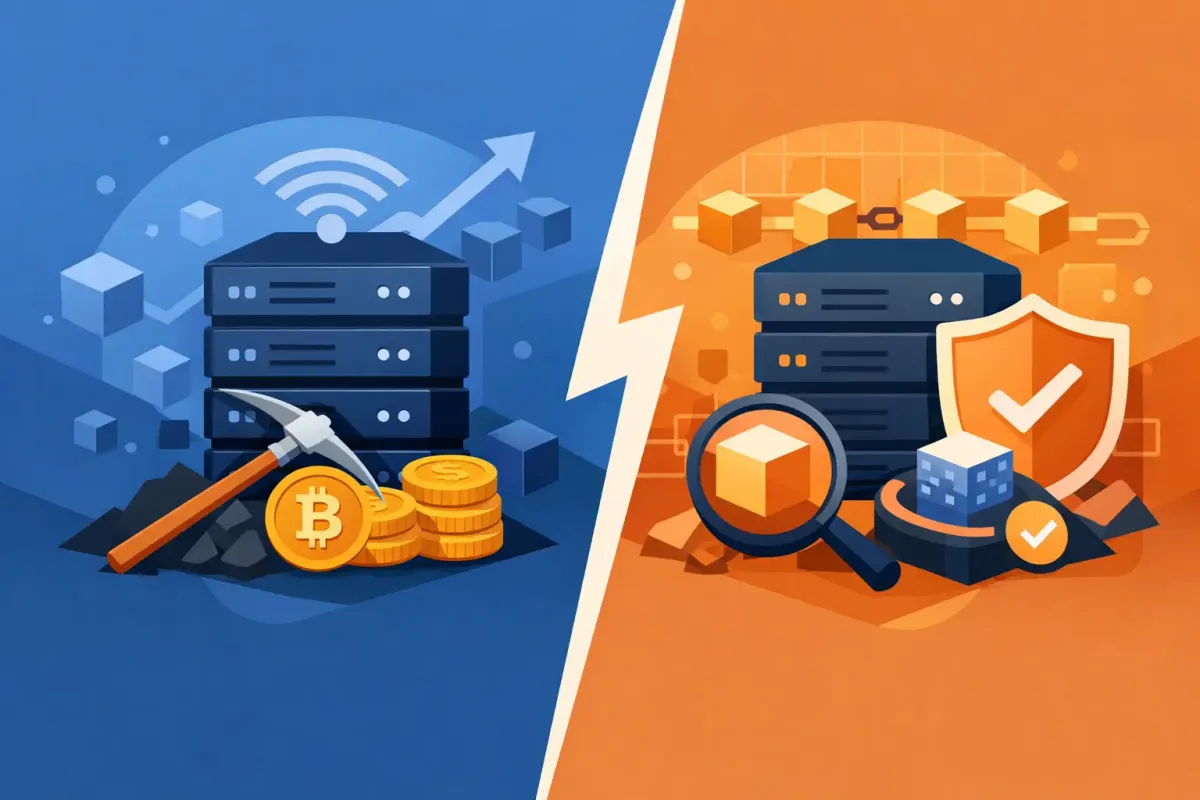
Your miner can be hashing valid work while your connection is exposed, your shares are hard to account for, and your payout still depends on a pool’s internal ledger. That is the real question behind Stratum V2 vs V1. The protocols decide how a miner receives work and reports shares. They do not decide whether an operator deserves trust.
For a home miner running a Bitaxe, NerdQaxe, or a standard ASIC, V1 remains the protocol you are most likely to encounter. It works. It is widely supported. V2 changes meaningful parts of the connection model, especially encryption and message handling, but it is not a magic property that makes every pool behavior verifiable.
The useful comparison is not old versus new. It is which facts the protocol lets you inspect, which risks it removes, and which claims still require evidence outside the Stratum connection.
What Stratum V1 Actually Does
Stratum V1 was built to give miners a practical way to receive jobs from a pool and submit proof-of-work shares back. A miner subscribes, authorizes with a worker identity, receives mining notifications, constructs candidate headers within the parameters it was given, and submits shares when it finds them.
That basic loop is why V1 became the default across miners, firmware, and pool software. A small ESP32 miner can speak it. An older ASIC can speak it. Most mining configuration screens assume it exists.
The weakness is not that V1 cannot deliver work. It can. The weakness is that the original protocol does not provide transport encryption or authenticated pool identity as part of its normal design. Traditional V1 traffic is generally readable and modifiable by a party positioned between your miner and the pool. Some operators add TLS around V1. That can protect the transport when configured correctly, but it is an added layer rather than a property of the Stratum V1 protocol itself.
V1 also uses a text-based JSON-RPC style message format. It is easy to inspect during development, which has value. It is also comparatively verbose, and implementations must carefully parse variable-length messages from untrusted network input. None of that proves a pool counted every share or built an honest payout. It only describes the wire between the miner and the server.
Stratum V2 vs V1: The Security Difference
Stratum V2 replaces the plain, human-readable message flow with a binary protocol designed for mining. Its connections use Noise encryption. Properly configured V2 connections can also authenticate the pool through an authority public key that the miner or operator pins before connecting.
That distinction matters. Encryption hides work messages from passive observers. Authentication addresses a different problem: whether the server on the other end is the pool you intended to reach. If a miner accepts a new unknown authority key without checking it, encryption alone does not solve an impersonation problem. The key fingerprint has to come from a source you already trust and can independently verify.
With V2 authority-key pinning in place, a hostile Wi-Fi network, compromised local router, or DNS manipulation has a harder job. It cannot quietly substitute its own server without presenting a different key. Your miner should reject that mismatch rather than continuing as if nothing happened.
V2 also defines structured binary messages and channel-based mining sessions. This reduces parsing ambiguity and can reduce bandwidth overhead compared with V1. For a single low-hashrate home rig, the bandwidth savings may not change your life. The connection authentication can matter a great deal, especially when the device runs unattended for months.
There is a practical catch. Many miners still do not speak V2 natively. Bitaxe running AxeOS and ASICs using BraiinsOS+ are among the firmware paths that can use it directly. Most stock ASIC firmware remains V1-only. A Stratum V2 translator can bridge that gap, but it adds another service, another configuration point, and another component that must stay online.
A pool that accepts V1 and native V2 on the same endpoint avoids making a small operator run a translator just to connect an existing fleet. The V1 device can keep working. The V2-capable device can use its native encrypted path. Protocol migration should not require throwing away hardware that still produces valid hashes.
Job Control Is Not Automatic
The most discussed V2 capability is job negotiation. In the full Stratum V2 design, a mining device can participate in selecting the block template it hashes rather than accepting every template assembled upstream. That has implications for censorship resistance and for who controls transaction selection.
But read the deployment details before treating that capability as active. Stratum V2 is a protocol family with separate roles and extensions. Job Declaration requires support from the relevant pool and template-provider path. A miner using V2 does not automatically choose transactions. A pool can offer encrypted V2 mining channels while still providing the block template itself.
That is not a flaw. It is an operational fact. Template construction involves Bitcoin node policy, mempool availability, block propagation, and a decision about who bears the complexity of producing valid templates. Home miners should want clear disclosure of which party builds the template and whether miner-directed job declaration is available.
The same rule applies to V1. A V1 connection usually tells you that the pool provided work. It does not tell you how the template was chosen, why a transaction was included, or whether another template was withheld. The protocol does not settle those questions.
What Neither Protocol Can Prove
A clean V2 connection is not proof of non-custody. A pool can encrypt every byte of mining traffic and still hold rewards in an internal balance, delay withdrawals, deduct a fee, or ask you to trust a dashboard.
Likewise, V1 is not automatically dishonest. A V1 pool can publish useful accounting data, pay miners directly, and document its operations. The protocol alone does not determine whether a payout claim is true.
For solo and lottery mining, the critical event is simple: if your work finds a valid block, where does the coinbase payout go? If it goes directly to your Bitcoin address in the block’s coinbase transaction, there is no pool balance to withdraw and no pool wallet holding your reward first. You can inspect the block and the transaction on the Bitcoin network.
Share accounting remains separate from block payment. A pool can show received shares, assigned difficulty, accepted or rejected status, and job identifiers. Useful evidence may include signed records, server timestamps, and enough raw data to test whether a specific share was handled correctly. A dashboard total is an assertion. A signed record with verifiable inputs is evidence.
NexusPool applies this distinction to both connection types. It supports standard V1 for the hardware miners already own and native encrypted V2 for firmware that can use it. Its Payout Preflight checks the destination before work begins, and a solved BTC block pays the configured miner address on-chain. Those are separate properties from Stratum itself. They should be checked separately.
Which Protocol Should You Run?
Run V2 when your firmware supports it natively and you can verify and pin the pool authority key. You get an encrypted mining channel, a defined authentication mechanism, and a protocol designed around structured binary messages. For an internet-exposed or remotely managed miner, that is a sensible default.
Run V1 when it is what your hardware supports. Do not add a translator merely to claim a protocol upgrade if you cannot operate and monitor that translator confidently. A stable V1 connection to a pool with clear accounting and direct on-chain payout can be a more honest setup than a poorly understood chain of V2 components.
Before selecting either endpoint, verify four things. Confirm the payout address is yours. Confirm how the pool identifies and records your worker. Confirm what public key a V2 miner should pin, if applicable. Confirm that a found block pays your address in the coinbase transaction rather than entering a custodial balance.
Then test the ordinary failure cases. Restart the miner and ensure it reconnects as expected. Submit work long enough to see accepted-share behavior. Check that your configured difficulty fits the device. Save the authority key and payout configuration somewhere you control. Mining is already probabilistic. Your evidence should not be.
V2 improves the connection. Direct on-chain payment proves where a solved block went. Signed accounting can support a claim about work. Each mechanism answers a different question.
Trust nothing. Verify your payout transaction.