Bitcoin Mining
Texas Data Center Permit Freeze: What Bitcoin Miners Face
Texas paused new data center permits until an ERCOT audit ends. Here is the timeline, step by step, and what it means for Bitcoin mining in the state.
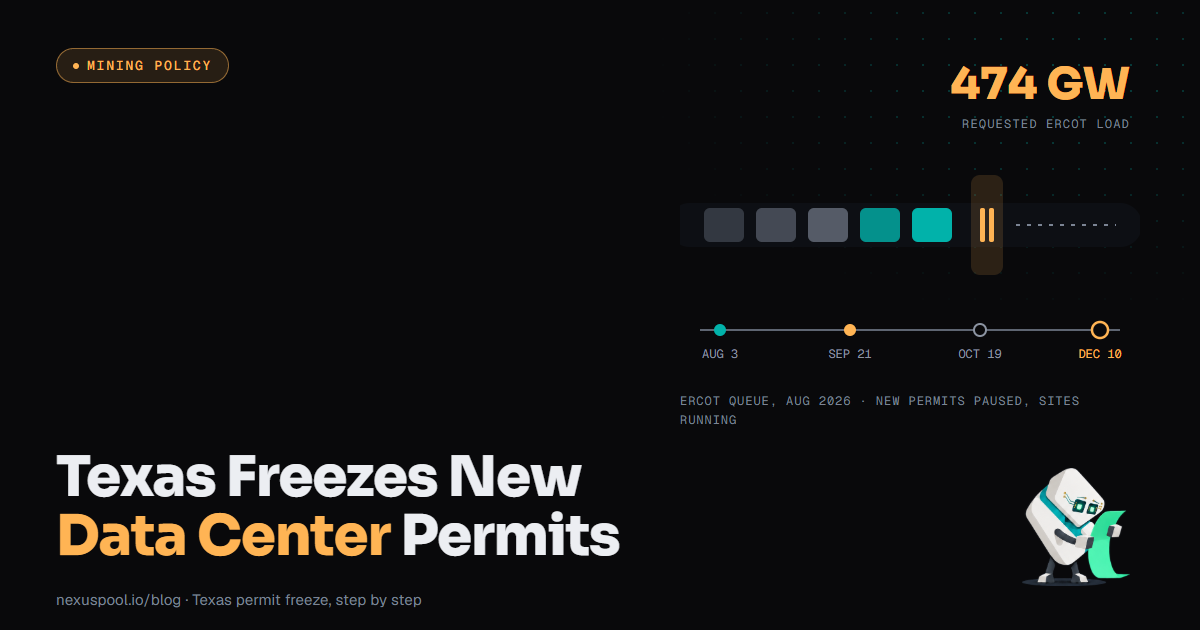
On August 3, 2026, Texas Governor Greg Abbott ordered the Public Utility Commission of Texas (PUCT) and the state grid operator, ERCOT, to audit every data center moving through ERCOT's interconnection process, and he told them no project may connect until that audit is done. On September 21 he widened the order: the Texas Commission on Environmental Quality (TCEQ) must now issue no permits at all to data center projects until the audits finish. The Texas data center permit freeze matters to Bitcoin mining because Texas holds the largest share of United States mining capacity, and because large mining sites compete for the same grid connections as AI compute. Below is the sequence in the order it happened, with what each step covers and what it leaves alone.
Step One: The August Order and the ERCOT Queue Audit
Abbott's August 3 directive cited a queue of more than 474 gigawatts of requests to connect to the Texas grid, over five times the state's record peak demand, and said about 90 percent of those requests come from data centers. He asked the PUCT and ERCOT to collect, from each project, its tax breaks, its power use and on-site generation, its water use and cooling, its steps to limit harm to nearby communities, and who owns it. Any project that fails the audit gets denied a grid connection.
ERCOT's own officials narrowed the practical scope at a PUCT meeting on August 14. The verification covers the 250 to 300 projects eligible for its first "Batch Zero" study, about 200 gigawatts of future demand, most of them data centers of 75 megawatts or more. The rest of the queue, more than 1,800 projects in total, stays behind them. ERCOT and developers both told regulators that many of those projects lack financing or tenants and may never get built. Nothing about a running rig changed at this stage. The order asked for data and put new connections on hold.
Step Two: The September Expansion to Environmental Permits
Seven weeks later Abbott went further. His September 21 letter to TCEQ says the agency "will issue no permits sought by data center projects" until the ERCOT audit and a parallel Texas Water Development Board water audit are complete, as CNBC reported the same day. The August order only touched grid connections. A developer could still build "behind the meter," with its own power plant, and skip ERCOT altogether. The September letter targets that route: an on-site gas plant needs an air permit, and TCEQ now holds those too.
Law firms reading the letter disagree on its reach. Troutman Pepper Locke notes that the text covers all permits sought by data center projects, which could include sites that never connect to the grid. TCEQ has not published guidance narrowing it.
Step Three: What the Freeze Covers, and Whether a Mining Site Counts
Both orders pause new approvals. A facility that already holds its interconnection agreement and its permits keeps running on the terms it has. No part of either letter shuts down a mining site that was drawing power before August. The pause hits expansions, new sites, and anything still waiting in the queue.
Neither letter mentions Bitcoin mining by name. They speak of "data centers," and whether a given mining site falls under that word depends on how ERCOT and TCEQ classify it. The market has read it as mining news anyway. After the August order, Bernstein analysts told clients that most Texas miners run under contracts for capacity ERCOT already approved, so their current operations should not feel the pause. They named Cipher, Core Scientific and CleanSpark as the most exposed, because those companies want to convert pipeline sites into new grid capacity, and they argued that megawatts already approved become more valuable while new ones stall. That describes the real split: the freeze leaves today's hashrate in place and slows the growth of tomorrow's.
Texas also sits inside a wider shift. On September 27, crypto.news reported the seven-day average Bitcoin hashrate at about 915.8 EH/s, a three-week low, with several listed miners moving power to AI customers. A permit pause on new large loads adds one more reason for Texas mining capacity to grow slowly this year.
Step Four: The Dates That Matter Next
The audit runs on a published calendar. ERCOT sent a state and community impact request for information to data center developers of 25 megawatts or more, and responses are due October 12, 2026. TCEQ owes the Governor's office a report on its compliance with the September letter by October 19. ERCOT has said it intends to publish its report with the PUCT on or before December 10, 2026. Neither letter sets an end date for the freeze itself, so you should treat December 10 as the earliest point anything could change, and expect the fight to move to the Legislature next session, where Abbott has said he will push to remove financial incentives for data centers.
What the Texas Freeze Means for Bitcoin Mining Decentralization
A site big enough to need an ERCOT queue slot and a TCEQ permit is big enough for one state's calendar to stop its growth. A rig on a home circuit never enters that queue. You do not file for interconnection, you do not wait on an air permit, and December's report does not decide whether your miner runs in January. Hashrate that depends on a few state permitting pipelines carries a concentration risk that hashrate spread across many small, independently owned machines does not.
That point has limits, and the honest version states them. Home mining is not safer or more profitable because of this freeze. Your odds of finding a block equal your hashrate divided by the network's total, measured through difficulty, and they come out the same at every pool, under every fee model, in every state. No permitting decision in Austin moves that number, and no pool can either.
Where NexusPool Fits for Small Solo Miners
NexusPool's technology page describes a pool built for that smaller scale: solo mining on Bitcoin, Litecoin, Dogecoin through AuxPoW merged mining, and Bitcoin Cash, over Stratum V1 and Stratum V2, with one port that detects which protocol your rig speaks. The block pays your address, and there is no balance for us to hold. With a 0% pool fee, you can open Payout Preflight and read the exact coinbase transaction that would pay your address on the current template before you ever find a block. The Glass Ledger publishes signed receipts you can check yourself. None of this changes a regulatory calendar in Texas, and none of it is investment advice. It describes what happens to a reward once a block is found, for a miner whose setup never touched a state permitting queue.
Recap: The Four Steps, in Order
First, Texas ordered an audit of data centers in its interconnection queue on August 3 and froze their grid approvals. Second, on September 21 it extended the freeze to every TCEQ permit a data center project seeks, which reaches behind-the-meter builds. Third, the pause stops new capacity and leaves operating sites alone, and it names data centers, not miners, even though mining companies with pipeline sites stand most exposed. Fourth, the audit has three dates on its calendar: October 12 for developer responses, October 19 for the TCEQ compliance report, and December 10 for the ERCOT and PUCT report. If you want to know what this means for Texas mining capacity, watch December 10. Everything before it is process.
Trust nothing. Verify the audit timeline against ERCOT's own notices before you assume this freeze means more, or less, than the two letters say.