Glass Ledger
The ASIC Chip Squeeze: Myth vs Reality for Solo Miners
AI chip demand is squeezing TSMC's wafer capacity in 2026. Here is what that actually does, and does not do, to the cost of home Bitcoin mining hardware today.
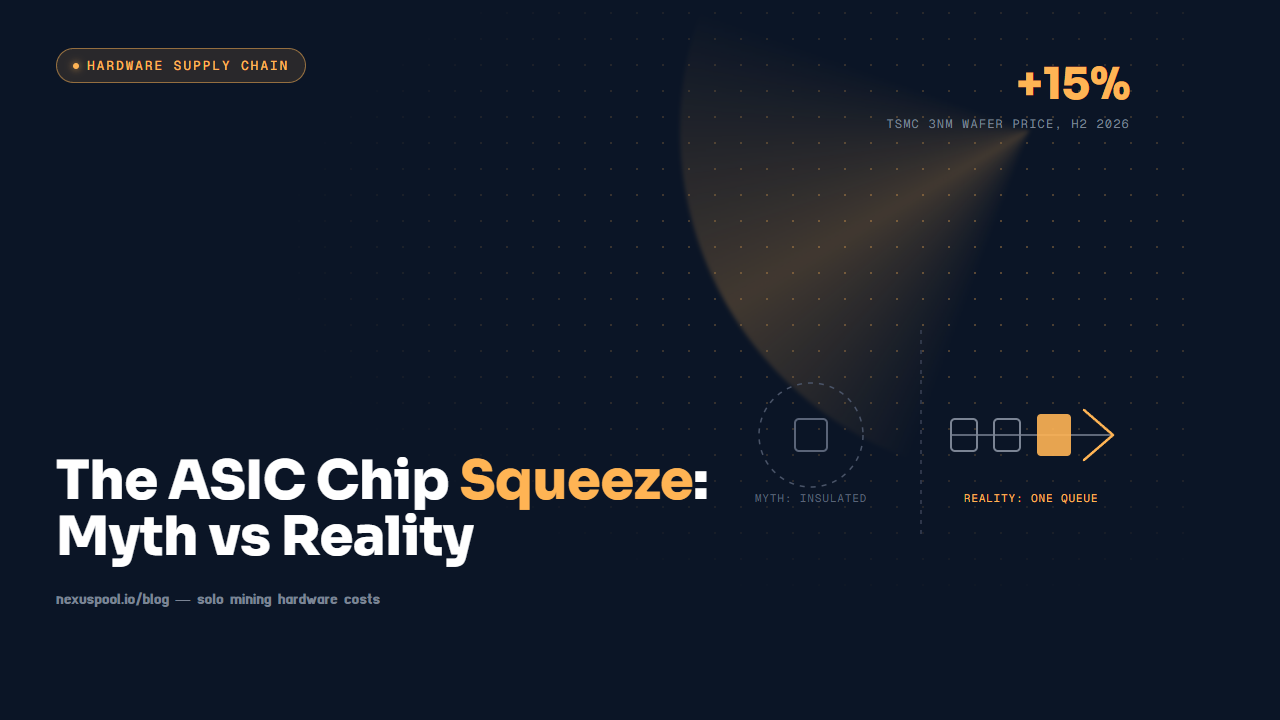
Every few months a new headline warns of an ASIC chip shortage bitcoin mining hardware makers are supposedly facing, and every few months hobbyist miners ask the same question in the same forums: does this actually touch a $200 board sitting on a home shelf, or is it purely an industrial-scale problem. In 2026 the honest answer is more specific than either extreme. TSMC's advanced nodes are booked solid, AI chip customers are paying a premium for that capacity, and the ripple effects reach further down the hardware stack than most casual coverage admits. They just do not reach where the loudest headlines imply.
The Myth: An ASIC Chip Shortage in Bitcoin Mining Is an Industrial Problem, Not Yours
The common assumption goes like this: giant mining companies buy hundreds of thousands of ASICs at a time, so if TSMC's fabs are full, that is a problem for their balance sheets, not for someone running one or two small boards at home. Under this view, a single-chip device holds its price and its availability no matter what happens further up the supply chain, because the volumes involved are too small to matter to a foundry the size of TSMC.
That assumption misreads how chip allocation actually works. TSMC does not carve out a separate, insulated production line for small-batch or hobbyist-adjacent designs. A chip destined for a compact home mining board comes off the same advanced-node wafers as a chip destined for a data center rack, made in the same fabs, competing for the same limited slots on the same production calendar.
The Reality: Wafer Allocation Decisions Set the Price Floor for Every Tier
TSMC's most advanced nodes are running at full capacity in 2026, and when that happens, allocation becomes a competition among the customers willing to pay the most for a slot. Recent industry reporting on TSMC's CoWoS advanced packaging capacity shows roughly how that competition currently shakes out among the largest buyers:
| Buyer | Approximate CoWoS allocation share | Approximate wafer volume |
|---|---|---|
| One large AI chip designer | ~60% | ~595,000 wafers |
| A second AI chip designer | ~15% | ~150,000 wafers |
| A third AI chip designer | ~11% | ~105,000 wafers |
Mining ASIC designers are not on that list, because they are not bidding at that volume or that price. Independent coverage of the custom AI chip market lays out roughly that allocation split among the largest buyers, and TSMC has also signaled a price increase of up to 15% on 3nm wafers for the second half of 2026, with further increases of 5 to 10% expected in 2027, driven by sustained AI demand. When a foundry raises wafer prices across a node because AI customers will pay it, every chip made on that node gets more expensive to produce, including the small, efficient chips that power compact home mining boards. The manufacturer of a $200 device does not get a private, shortage-proof pricing tier just because its order is small.
What this changes in practice is availability and price stability, not the fundamental math of solo mining. A chip squeeze can mean longer waits for a specific model, higher prices on new units, and stronger secondhand demand for boards already in circulation. It does not change what a device does once it is running: hashrate measured against network difficulty, exactly as before.
What a Tighter Chip Market Does Not Touch
Nothing about TSMC's wafer pricing or allocation changes the odds math behind solo mining. A device's chance of finding a block is set by its hashrate divided by the network's total hashrate, and nothing about where its chip was fabricated, what it cost, or how long the wait was to get it factors into that ratio. A more expensive chip is not a better-performing chip merely for being scarcer, and a shortage does not make anyone's odds worse either, since existing hardware keeps hashing at the same rate it always did regardless of what happens to new unit pricing.
This is also not a reason to buy hardware on a rushed timeline out of fear of missing a window, and it is not a signal about where any coin's price is headed. It is a supply chain observation about semiconductor manufacturing, nothing more.
Whatever hardware a miner already owns or eventually buys, how it connects to a pool matters independently of chip economics. NexusPool runs both Stratum V1 and Stratum V2 on the same port with automatic protocol detection, so older firmware and newer, encrypted connections both work without the miner needing to reconfigure anything, chip shortage or not. The pool takes no fee: the full block reward goes straight to the miner's own address, which is a separate question from what any given board costs to buy in the first place. Details on how NexusPool itself operates are on its about page.
This post does not claim that ASIC prices will fall, rise, or stabilize on any particular timeline, and it is not investment or purchasing advice. It also does not claim any odds improvement from any hardware purchase: solo mining odds are set entirely by hashrate against difficulty, identical for every miner on a given chain, and no pool or chip shortage changes that fact. Once a device is running, checking that a pool is actually behaving as advertised is worth doing directly rather than assuming; the current state of NexusPool's own infrastructure is visible on its status page.
The Reality, In Short
A chip squeeze driven by AI demand raises costs and stretches availability across every tier of ASIC production, hobbyist boards included, but it does not touch the difficulty math that decides whether any given device finds a block.
Trust nothing. Verify what your own hardware actually costs and delivers before assuming a shortage headline changes your odds.