Glass Ledger
Bitcoin's August 2026 Fork: A Self-Custody Walkthrough
Bitcoin faces a hard fork snapshot in August 2026 while major custodians opt out of claiming it. Here is a step-by-step check for anyone holding their own keys.
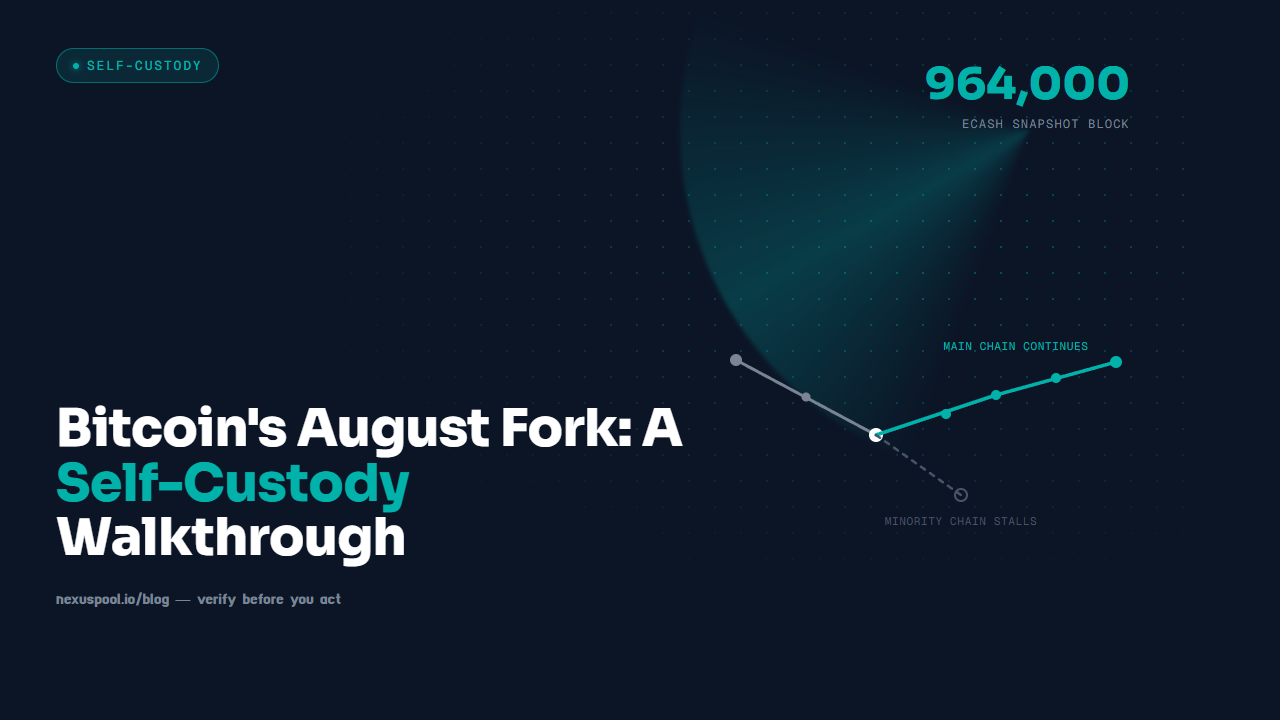
A Bitcoin fork August 2026 self custody question has landed on a lot of people's plates at once this month, and it splits into two separate events that are easy to mix up. A contested soft fork attempt, BIP-110, opened its mandatory signaling window on August 7 with miner support reported below 3% against the 55% threshold needed to activate, and a minority chain running the proposed rules split off, mined a couple of blocks, and stalled while the main chain kept moving. Separately, and unrelated in mechanism, a planned hard fork called eCash is set to snapshot Bitcoin's ledger around block 964,000 and distribute new tokens one to one to whoever held BTC at that height. What makes this fork season unusual is not the software mechanics. It is that a large share of Bitcoin's economic weight now sits inside ETFs and custodians that have already said, contractually, that they will not claim anything from it. Here is a plain walkthrough for anyone holding their own keys.
Step 1: Work Out Which Event Actually Applies to You
BIP-110 is a node-and-relay-policy dispute; it does not create a new asset to claim, and its minority chain has already stalled out without reaching activation. Nothing about it requires action from someone who is not running specialized fork-tracking node software. The eCash snapshot is the one that actually matters for self-custodians, because it is designed to hand out a new, separate asset to anyone who held BTC at the snapshot block, provided their coins are held somewhere the fork software recognizes.
Step 2: Confirm Whether Bitcoin Fork August 2026 Self Custody Even Applies to You
If your BTC sits in an ETF share, a custodial exchange balance, or any account where someone else controls the private keys, the practical decision here belongs to that custodian, not to you directly. Reporting on this fork season has noted that major institutional holders, including large ETF issuers, have chosen not to claim forked assets at all, treating it as outside the scope of what they agreed to hold on a client's behalf. If you hold your own keys instead, in a wallet where you control the seed, the decision is actually yours to make, which is the entire premise behind holding your own keys in the first place.
Step 3: Check Your Wallet or Node Software's Actual Fork Policy
Do not assume your wallet will automatically and safely expose you to a forked asset, and do not assume it will automatically protect you either. Check your specific wallet's documentation or your node's release notes for explicit statements about eCash support and, more importantly, replay protection, which is the mechanism that keeps a transaction broadcast on one chain from being replayed and processed on the other chain without your intent. A wallet or node that has not published an explicit statement on this should be treated as unverified, not as safe by default.
Step 4: Decide Whether to Interact With a Forked Asset At All
Choosing not to touch anything related to a fork is a completely legitimate decision, and it is the one most large institutional holders have made here. There is no obligation to claim, sell, or even track a forked asset just because it exists. If you do decide to interact with it, do so only after step 3 is genuinely satisfied, and treat any forked asset's market value as separate and speculative from the Bitcoin you already hold; this post is not valuing that asset or suggesting a course of action with it one way or the other.
Step 5: Confirm Nothing About Your Own Mining Setup Needs to Change
If you solo mine Bitcoin, none of this changes your odds of finding a block, which remain your hashrate divided by the network's current difficulty, identical for every miner regardless of which side of a policy dispute their node software favors or whether they choose to touch a forked asset at all. What non-custodial mining does share with this moment is the underlying principle: NexusPool pays the full block reward directly to a miner's own address in the coinbase transaction, the same way self-custody of a fork asset means the decision sits with whoever holds the keys, not a third party. Details on how that non-custodial design works are on NexusPool's technology page, and the pool's own signed, offline-checkable receipt system, called Glass Ledger, exists for the same reason a fork like this rewards checking rather than assuming: because a claim about what you are owed is not the same thing as verifying it yourself.
Step 6: Verify Before You Act, Not After
Before any coinbase transaction pays out on NexusPool, the Payout Preflight tool reconstructs and checks it byte for byte, which is the same instinct this fork season calls for: confirm the mechanics directly instead of trusting a summary of them. The same logic applies to a fork snapshot. Read your own wallet's actual documentation, or your node's actual release notes, before assuming anything about what happens to your coins.
This post does not recommend claiming, selling, or ignoring any forked asset, and it is not investment guidance of any kind. It also does not claim that solo mining odds change based on any of this; those odds are set purely by hashrate against difficulty and nothing here alters that fact. Independent reporting on the fork's institutional opt-out is worth reading directly rather than taking any single summary, including this one, as the final word.
Check This First
Work out which event actually applies to you, confirm who really holds your keys, check your wallet's explicit fork and replay-protection policy before touching anything, decide deliberately whether to interact with a forked asset at all, and remember your own mining odds have not moved an inch through any of it.
Trust nothing. Verify your own wallet's fork policy directly before this snapshot, not after.