Bitcoin Cash Mining
Bitcoin Cash Rose 29%. So Did Its Mining Difficulty
Bitcoin Cash jumped 29% on CME futures news, and its difficulty rose 30% within 36 hours. What that does to solo mining odds, with the chain's own numbers.
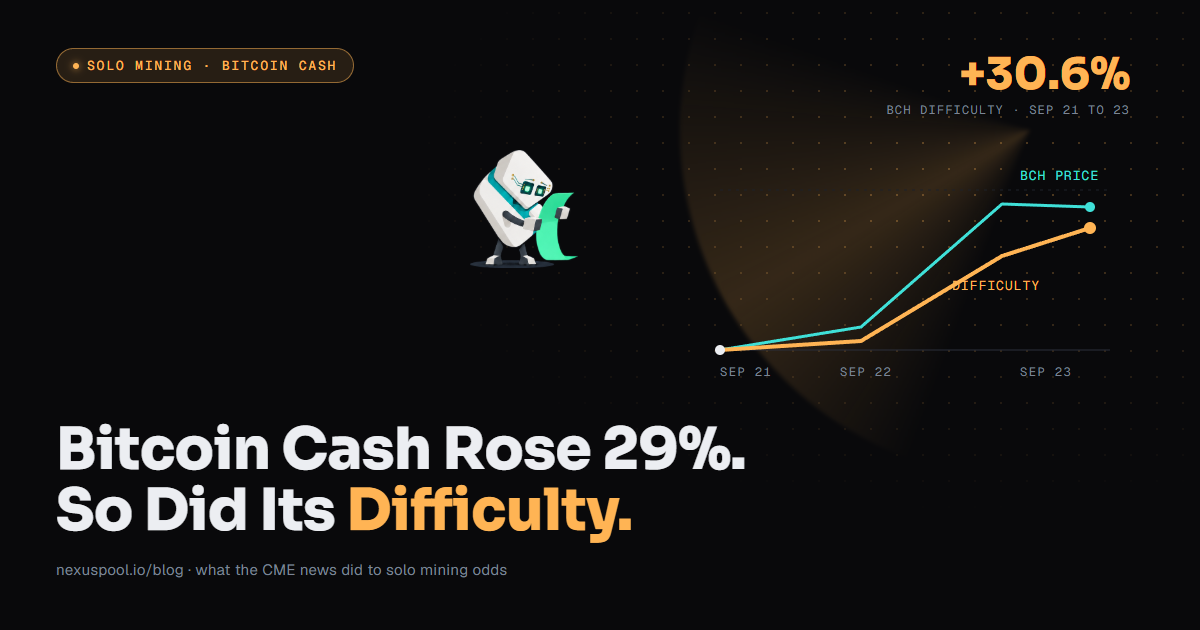
Bitcoin Cash opened Tuesday near $267. By Wednesday it was trading around $345, a jump of roughly 29% in a day, after CME Group said it would list Bitcoin Cash futures on October 19, pending regulatory review. Within hours, mining forums asked the same thing in a dozen phrasings: does this change anything about mining the coin? For anyone running a home rig and weighing Bitcoin Cash solo mining odds, the chain itself has already answered part of that question, and the answer is not the one the price chart suggests.
Does Bitcoin Cash Get Easier to Solo Mine When the Price Jumps?
No. It got harder, and fast. Bitcoin Cash's difficulty follows the hash power pointed at the network, not the coin's dollar price. But a higher price makes every Bitcoin Cash block worth more, and SHA-256 hardware can switch chains in minutes, so hash power that had been working elsewhere moved over. On Tuesday, September 22, the network produced 220 blocks against a target of 144. Bitcoin Cash retunes its difficulty after every block rather than every two weeks, so it caught up within hours.
The chain's own records show it. At midnight UTC on September 21, Bitcoin Cash's difficulty stood at about 416.3 billion. By midafternoon UTC on Wednesday, September 23, it was about 543.6 billion, up 30.6%. That matches the price move within two points. The market priced the coin up, and within about a day and a half the miners priced the work up to match.
For a single small rig, take a 1 TH/s device, a realistic size for open-hardware SHA-256 miners. At Monday's difficulty, the network hash rate it implied was about 2.98 EH/s, which put that rig's chance at roughly 1 in 3.0 million per block and its expected wait at about 57 years. At Wednesday afternoon's difficulty, the implied network rate is about 3.89 EH/s, so the same rig now sits at roughly 1 in 3.9 million per block, with an expected wait of about 74 years. Same hardware, same electricity bill, 17 more years on the average. An average is not a schedule, and a block can arrive on day one or never, but the average is what moved.
Will CME Futures Keep Pulling Hashrate Toward Bitcoin Cash?
Nobody knows yet. CME Group's announcement describes a standard contract of 250 BCH and a micro contract of 25 BCH, a regulated way for institutional desks to trade Bitcoin Cash exposure. That is a market access story more than a mining story. Miners follow revenue per hash, not headlines, so the extra hash power arrived because the price did, not because a derivatives exchange said anything about mining.
Whether it stays depends on whether the price holds. If the rally fades by the weekend, the hash power that switched over has every reason to switch back, and Bitcoin Cash's difficulty will fall again block by block as it leaves. If the price holds, the new difficulty level holds with it. Nobody, including NexusPool, can tell a reader in advance which of those happens.
Are Bitcoin Cash Solo Mining Odds Better Than Bitcoin's?
Per hash, Bitcoin Cash's difficulty is far lower than Bitcoin's, which is why the expected wait above lands in decades rather than millennia for the same rig. That is a real, calculable difference between the two chains. It is also a difference that shrinks every time the Bitcoin Cash price jumps and more hash power follows it, as this week showed.
Choosing between the two is a question about where to aim hash power, not about which mining pool to use. Difficulty sets the odds of finding a block on a given chain, and it sets them identically at every pool, NexusPool included. Moving a rig from Bitcoin to Bitcoin Cash does not make anyone's odds better in some general sense; it changes which network's difficulty applies to the same hash rate. Solo mining on either chain is a lottery. A smaller difficulty means a shorter expected wait, not more value, and nothing here is a suggestion that Bitcoin Cash is the better bet or advice about a token whose price just moved 29% in a day.
If I Switch, Does My Block Reward Still Go to My Own Address?
Yes. This is where NexusPool's own setup matters. NexusPool's Bitcoin Cash solo mining works the same non-custodial way as its Bitcoin mining: the coinbase transaction on any block a rig finds pays that rig's own address directly, with a 0% pool fee, because there is no pool-held balance in the first place. A miner can see the exact coinbase their address would receive on the current block before ever finding one, through NexusPool's Payout Preflight tool, rather than taking a pool's word for what a payout would look like. The whole reward goes to your address. Check it before you mine.
What Does a CME Listing Change About How Bitcoin Cash Works?
Nothing at the protocol level. Bitcoin Cash's ten-minute block target, its per-block difficulty adjustment and its SHA-256 proof of work are untouched by a derivatives exchange adding a contract. What changes is who watches the price and who can trade it, which is a market structure story. Reading the two as one story is the mistake to avoid: a futures listing is about price discovery and institutional access, while mining odds come from difficulty and the hash rate behind it, full stop.
None of this is a reason to move hash power on a single day's chart, and nothing on NexusPool's technology page or in any pool's software can improve the odds that difficulty already sets. Anyone deciding whether to solo mine Bitcoin Cash should run their own numbers against their own hardware, using the network's live difficulty at the moment they decide, because this week proved it can move 30% in a day and a half. This is not investment advice, and nothing above promises a block, a reward or a return.
So, the single biggest question in all of this: did the CME news make Bitcoin Cash easier to solo mine? No. For the first 36 hours it made it about 30% harder, because the miners read the same headline everyone else did.
Trust nothing. Verify the difficulty and the coinbase before you point a single hash at Bitcoin Cash.