Glass Ledger
Bitcoin's 2028 Halving, By the Numbers
Block 1,050,000 cuts Bitcoin's subsidy to 1.5625 BTC. Here is the halving countdown math, and what actually changes for a solo miner.
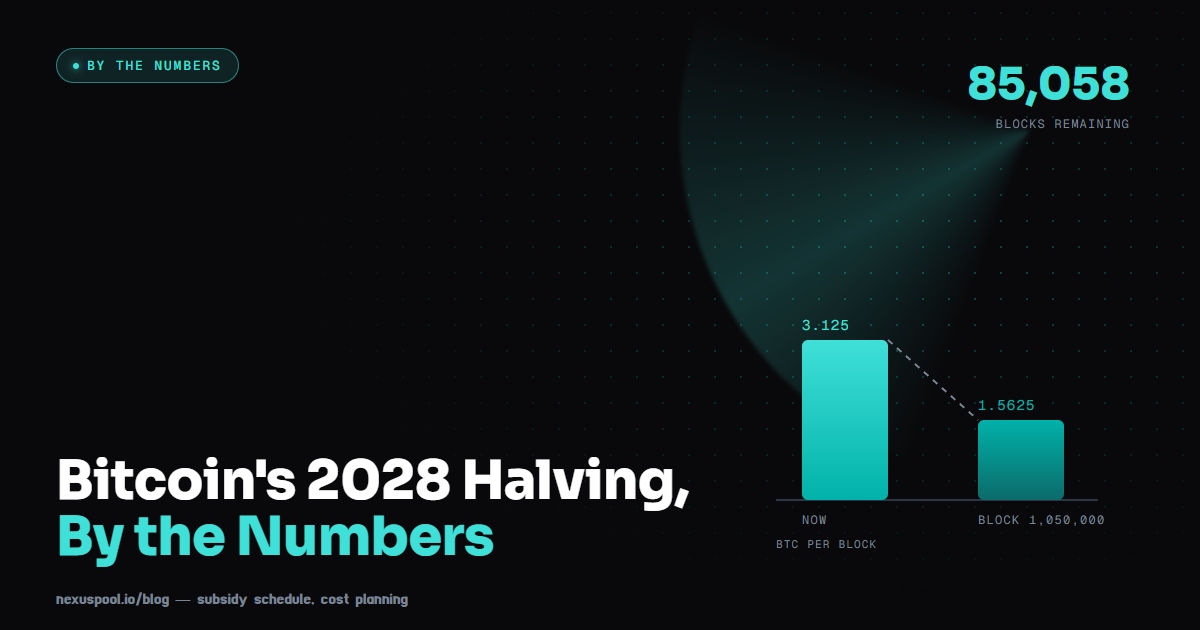
One number anchors everything in this post: block 1,050,000. That is the block height at which Bitcoin's fifth halving cuts the per-block subsidy in half, and it is close enough now that the Bitcoin 2028 halving countdown has real numbers behind it rather than a distant, round-sounding year. As of the network's most recent difficulty reading, Bitcoin sat at block 964,942 with difficulty at 125.81T, according to CoinWarz's live difficulty tracker. From that single data point, the rest of the countdown is arithmetic anyone can check themselves.
The 2028 Halving Countdown, By the Numbers
| Metric | Figure |
|---|---|
| Current block height (per CoinWarz, early September 2026) | 964,942 |
| Halving block height | 1,050,000 |
| Blocks remaining | 85,058 |
| Average block time | ~10 minutes |
| Estimated days remaining | ~591 days (~1.6 years) |
| Estimated halving window | March to April 2028 |
| Current block subsidy | 3.125 BTC |
| Post-halving block subsidy | 1.5625 BTC |
| Recent average fee share of block reward | roughly 1-2% |
| Fee share generally cited as a "healthy" post-halving benchmark | roughly 10-20% |
The blocks-remaining figure is straightforward subtraction: 1,050,000 minus 964,942 equals 85,058 blocks left before the subsidy cuts in half. Multiplying that by Bitcoin's roughly 10-minute average block interval gives about 850,580 minutes, or about 591 days, which lands the estimated halving date somewhere in March or April of 2028, matching independent analyst estimates of the same window.
What the Subsidy Column Actually Means
Every block currently mints 3.125 BTC in new supply, paid to whoever finds it, on top of whatever transaction fees that block happens to collect. At block 1,050,000, that minted amount drops to 1.5625 BTC, permanently, for every miner on the network at once. This is not a probability or a rate that varies by miner; it is a fixed protocol rule that changes the size of the prize, not the odds of winning it.
Why the Fee Rows Matter More Than They Sound Like They Should
The subsidy is only part of a block's total reward; the other part is transaction fees. Recent data puts average fee revenue at roughly 1 to 2 percent of total block reward, a thin margin. Analysts generally point to something like 10 to 20 percent as the range that would represent a genuinely healthy fee market, one where transaction demand meaningfully offsets a halved subsidy rather than leaving miners to absorb the full cut. Getting from where fees sit today to that range is not guaranteed by the halving itself; it depends on transaction demand that has nothing to do with the subsidy schedule.
What Does Not Change: Your Odds
This is the number this post will not compute, on purpose: no specific odds figure for any individual miner appears anywhere above, because doing that honestly requires a real hashrate number to divide against the network's total, and this post is not written for one specific rig. What can be said in general is that your own odds of finding a block are set by your hashrate relative to the network's total hashrate at the time you are mining, a ratio the halving does not touch at all. The halving changes what a found block pays. It does not change how often you find one. Conflating the two is one of the more common mistakes in how people talk about halvings, and it is worth keeping separate in your own head regardless of which chain you are pointed at.
What This Means for Cost Planning, Not Speculation
Electricity costs do not halve alongside the subsidy. A miner whose power cost per kWh and hardware efficiency only pencil out at the current 3.125 BTC subsidy has roughly 591 days, per the numbers above, to either improve that cost structure, plan for the reward being cut in half, or accept a genuinely different risk profile after block 1,050,000. None of that is a prediction about Bitcoin's price, which is a separate variable this post makes no claim about. It is a fixed, protocol-level fact about supply, sitting next to a genuinely uncertain fact about future fee revenue, and the difference between those two kinds of numbers is worth keeping straight before making any decision based on either one.
Where NexusPool Fits Into the Math
None of this changes the parts of the equation NexusPool controls. Solo mining through NexusPool itself pays 100% of whatever a found block actually contains, subsidy plus fees, straight to the miner's own address with a 0% pool fee, both before and after block 1,050,000. You can see how that payout structure is documented on the site's technology overview, and the pool's terms are laid out plainly on its terms page if you want the full picture before relying on any of this for your own planning.
This post is not investment advice, makes no claim about Bitcoin's future price, and is not a claim that any pool, tool, or protocol change improves your odds of finding a block; those odds are set purely by difficulty relative to your own hashrate. It is also not a claim that NexusPool's core software is open source. For the current chain data this countdown is built on, see CoinWarz's Bitcoin difficulty chart.
The numbers, in short: about 591 days and 85,058 blocks stand between the current 3.125 BTC subsidy and a permanent cut to 1.5625 BTC. Use that runway to check your own costs against the smaller number, not to guess at price.
Trust nothing. Verify the block height and subsidy math yourself before you plan around either one.