Glass Ledger
Does Your Mining Pool Hold a Balance for You? A Self-Check
Poolin's bankruptcy auction is this week, with unsecured IOU holders facing a fraction of what they are owed. A checklist for your own pool's custody risk.
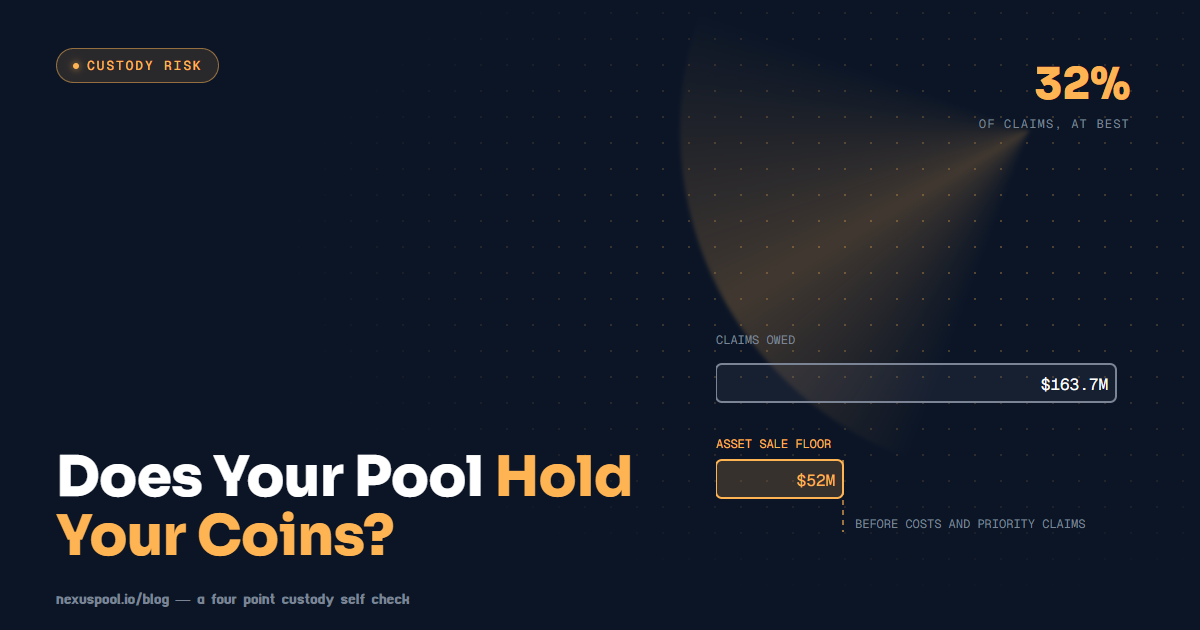
Poolin, once one of the largest Bitcoin mining pools in the world, filed Chapter 11 bankruptcy on July 22, 2026. This week the case reaches a concrete milestone: qualified bids on a proposed $52 million sale of its two West Texas mining sites were due September 8, an auction is scheduled for September 10, and a hearing to approve the winning bid is set for September 18. Against roughly $163.7 million in unsecured Poolin Wallet IOU claims, mostly balances frozen since the pool suspended withdrawals back in 2022, that $52 million sale price works out to roughly 32 cents on the dollar before administrative and priority costs are even subtracted, and those costs get paid first. Unsecured IOU holders, the miners who left a balance sitting with Poolin instead of withdrawing it, are positioned to recover meaningfully less than that once the line is worked through. This is a good moment to run a mining pool custody risk checklist on your own setup, whatever pool you currently use.
Check This: Does Your Payout Ever Sit With the Pool, Even Briefly?
Some pools pay out a block reward, or your share of one, into an internal balance the pool controls, then let you withdraw from that balance on your own schedule or above a minimum threshold. Every dollar or satoshi sitting in that internal balance, for however long it sits there, is a claim against the pool's solvency, not bitcoin you actually hold. Poolin's IOU holders did not lose their coins to a hack. They lost access to them because the coins were never really theirs to control once they sat in Poolin's own custody, and the pool itself ran out of money.
Check This: What Does "Non-Custodial" Actually Mean for the Pool You Use?
The word gets used loosely. A pool is genuinely non-custodial only if the coinbase transaction for a block you find pays your own address directly, with no internal balance, no accumulated credit, and no withdrawal step in between. If a pool advertises itself as non-custodial but still lets a balance build up on its own dashboard before you cash out, ask specifically how that balance is held and whether it is your bitcoin sitting in your own UTXO or a number in the pool's own database that only becomes real bitcoin when you successfully withdraw it.
Check This: What Happens to That Balance If the Pool Shuts Down Tomorrow?
Poolin's creditors are living through the answer to this question right now. A pool that holds a balance for you is, functionally, an unsecured lender you never agreed to be. If it fails, bankruptcy law puts secured creditors and administrative costs ahead of you in line, and what is left gets split among everyone else holding a similar IOU. There is no deposit insurance backstop in this arrangement, and no guarantee the sale of a pool's physical assets, mining sites, servers, whatever it owns, will cover what it owes.
Check This: Does the Pool Publish Anything You Can Verify Independently?
A pool that pays your own address directly gives you something to check on-chain yourself: the coinbase transaction, visible on the same block explorer anyone else uses, with no need to trust the pool's own reporting. A pool holding an internal balance gives you a number on a dashboard it controls and updates. Ask whether the pool publishes signed, independently checkable records of what it owes you, or only a figure you have to take on faith.
The Mining Pool Custody Risk Checklist, All Four Points
Run through these against your own pool before you read another word:
- My payout goes straight into the block's own coinbase transaction, not into an internal balance I withdraw later
- I have confirmed what "non-custodial" means for this specific pool, not just taken the label on faith
- I know exactly what happens to any balance I hold with this pool if the pool itself shuts down or files for bankruptcy tomorrow
- This pool publishes signed, independently checkable records of what it owes me, not just a dashboard number it controls
If X, Then Y
If your current pool ever lets a mined reward sit as an internal balance you withdraw later, rather than paying your own address directly in the block's own coinbase transaction, that balance carries the exact kind of counterparty risk Poolin's IOU holders are now working through in bankruptcy court, and the size or reputation of the pool holding it does not change that fact. If your pool instead pays your own address directly, every block found, with nothing held back and nothing to withdraw, that specific risk does not apply to you, though every other normal risk of solo mining, most of all the low odds of finding a block at all, still does.
NexusPool is built around the second model. A found block pays the miner's own address directly through the coinbase transaction, 0% pool fee, across Bitcoin, Litecoin, Dogecoin, and Bitcoin Cash, with nothing accumulated on NexusPool's side and nothing to withdraw. The signed receipts behind NexusPool's Glass Ledger system document that design, NexusPool's current uptime and status are published for anyone evaluating where to point their own hashrate, and more on NexusPool generally is available for anyone comparing pools using this checklist. This is not a claim that any specific currently operating pool holds custodial balances the way Poolin did, and it is not a claim about which pool is the best choice for any individual miner. It does not improve, and does not claim to improve, the underlying odds of finding a block, which are set entirely by network difficulty relative to a miner's own hashrate, identical for every miner on a given chain regardless of pool choice. It is not investment advice, and it is not a claim that NexusPool's own core software is open source or public today. For detailed reporting on the Poolin bankruptcy's asset sale and creditor recovery math, see TFTC's coverage of the Poolin Chapter 11 filing.
Trust nothing. Verify whether your own next payout ever touches a balance the pool controls before you assume it is already yours.