Payout Preflight
ASIC Prices Crashed. Your Odds Didn't
Bitmain's 2026 ASIC price cuts made mining hardware cheaper than ever. Here is the real solo mining odds math behind the falling price tags.
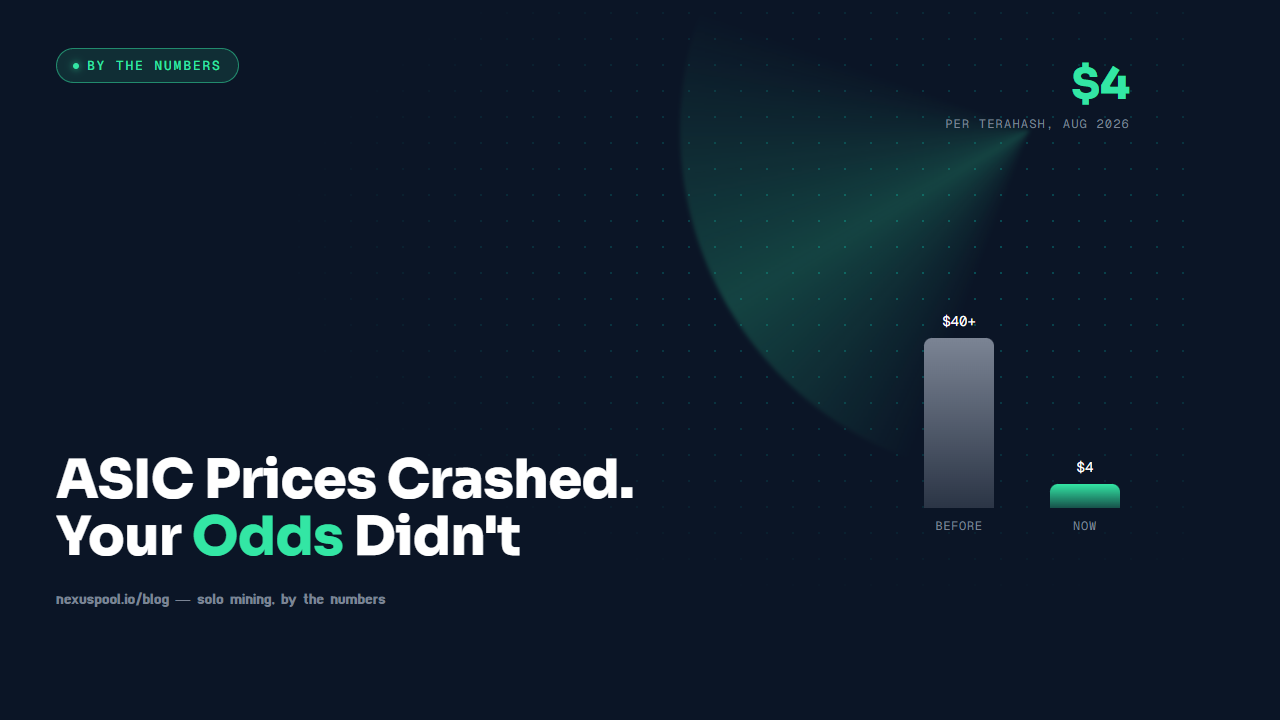
The number driving mining forums this month is four dollars. Bitmain has been quoting some Antminer S19 XP Hydro units as low as three to four dollars per terahash of hashing power, with S21 immersion and hydro models landing around seven to eight dollars per terahash before coupons, according to reporting from Cryptonews. That is a steep drop from list price, and it is happening because hashprice, the dollar value a miner earns per unit of hashing power per day, has fallen below breakeven for a lot of operators. A Bitcoin ASIC price crash like this changes what a hobbyist can afford. It does not change what that hardware actually wins.
The Number: $4 Per Terahash
Four dollars a terahash means a 255 terahash-per-second S19 XP Hydro unit, industrial-grade hardware that used to sell for several thousand dollars, now lists for roughly one thousand dollars, sometimes bundled with hosting. A single discounted board pulling around 100 terahashes per second can be had for a few hundred dollars. That is a real shift in who can afford to point serious hashing power at a solo attempt instead of routing it through a pool that shares the reward across thousands of participants.
What the Price Tag Does Not Touch
Solo mining odds are set by exactly one ratio: a miner's own hashrate divided by the network's total hashrate. Nothing about a discount, a bundle deal, or which pool software sits between the miner and the network changes that ratio. It does not matter whether the hardware cost four dollars a terahash or forty. A cheaper machine does not mine faster, and no pool, including this one, can improve the odds a given amount of hashing power has against the current network.
The Solo Mining Odds Table
Bitcoin's network hashrate stood at roughly 1.02 zettahashes per second, or 1,020,000,000 terahashes per second, in mid-August 2026. Using that figure and Bitcoin's roughly 52,560 blocks mined per year at its 10-minute average block time, here is what different hashrate tiers actually mean for a solo attempt, regardless of what each tier cost:
| Hardware tier | Hashrate | Approx. entry cost, August 2026 pricing | Expected solo wait for one block |
|---|---|---|---|
| Bitaxe-class hobby miner | 1.2 TH/s | about $200 retail | roughly 16,200 years |
| One discounted secondhand S19-class board | 100 TH/s | about $400 at $4/TH | roughly 194 years |
| One full S19 XP Hydro unit | 255 TH/s | about $1,000 at $4/TH | roughly 76 years |
| Small home setup, 10 units | 2,550 TH/s | about $10,200 at $4/TH | roughly 7.6 years |
Each figure is the mean expected wait, meaning the miner is just as likely to find a block well before that point as well after it. Solo mining stays a lottery at every tier on this table. A cheaper entry price buys more tickets. It does not shorten the odds on any single ticket.
A Calculator for Your Own Number
The table above uses two fixed inputs: a network hashrate of 1,020,000,000 TH/s and 52,560 blocks per year. The snippet below runs the same math for any hashrate a reader enters, and it is meant for Ghost's native HTML card (the /html card in the post editor), not the regular text area:
Assumes network hashrate of 1,020,000,000 TH/s and 52,560 blocks per year. This is a mean expected value for a lottery-style outcome, not a promise or a schedule.
Plain-text fallback of the same math: expected wait in years equals (network hashrate divided by your hashrate) divided by 52,560. Plug in your own hashrate and the current network figure to get your own number.
What This Bitcoin ASIC Price Crash Actually Means for a Hobbyist
A Bitcoin ASIC price crash is a real, useful development for anyone weighing whether to buy hardware, not because it improves anyone's odds, but because it lowers the cost of finding out whether solo mining is something worth doing at your own risk tolerance. Whatever tier a reader ends up buying into, NexusPool's technology page explains how the pool's Stratum V1 and Stratum V2 support connects that hardware without extra configuration, and the coinbase transaction that would pay out a found block goes straight to the miner's own address, not to a pool balance. There is no reward to promise here and no way to know in advance whether a given machine will ever find a block. This is not investment advice, and nothing in this piece changes the odds math above.
Before pointing real hashrate at a solo attempt, a miner can use NexusPool's Payout Preflight tool to check that the coinbase transaction structure is correct before a block is even found, byte for byte. It will not change the number in the table. It will confirm that if the number ever comes in, the payout goes where it is supposed to.
Trust nothing. Verify what your own hardware, at your own price point, would actually be worth if it won.