Glass Ledger
Bitcoin Difficulty Drop: What It Means for Solo Odds
Bitcoin's mining difficulty just dropped toward its 2026 low. Here is the actual math behind what that does, and does not do, to your own solo mining odds.
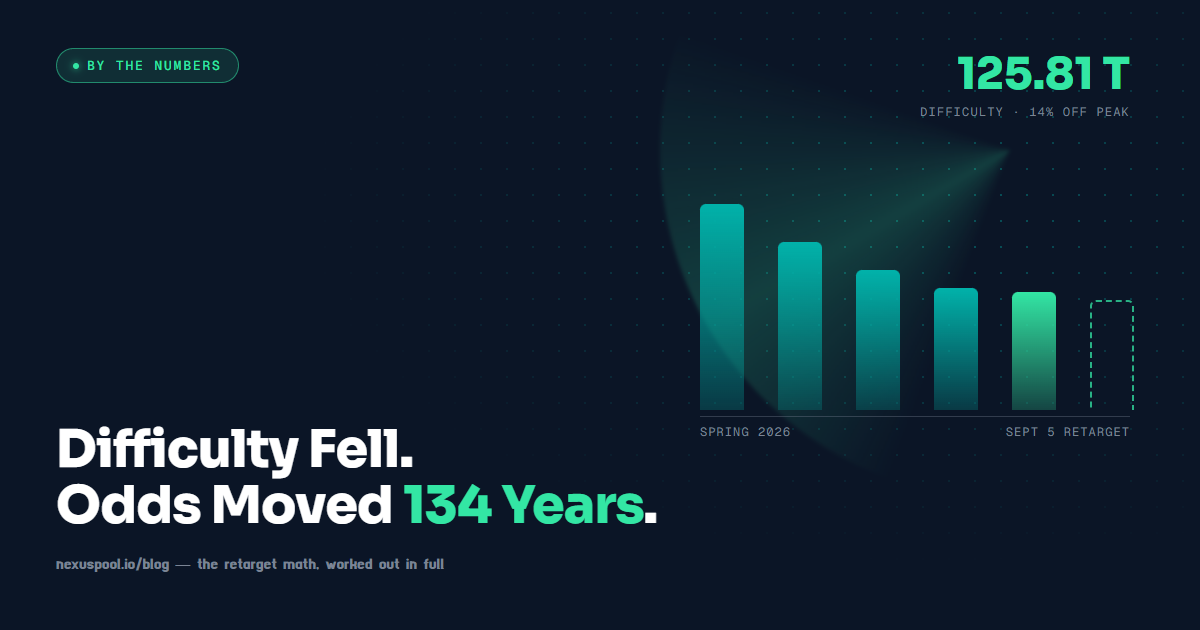
Bitcoin's mining difficulty sits at 125.81 trillion as of late August 2026, and the next retarget, expected around September 5, is projected to shave off close to another one percent. That would put difficulty just above its 2026 low, roughly 14 percent below the peak the network hit earlier this year. Anyone weighing a Bitcoin difficulty drop against their own solo mining odds deserves the actual arithmetic, not a vibe. So here it is, worked out in full, with the two inputs that produced every figure below.
The Number: 125.81 Trillion, and Where It Has Been
| Point in 2026 | Difficulty | Approx. network hashrate |
|---|---|---|
| Spring high | ~146.3 T | ~1,050 EH/s |
| Early August | ~126.2 T | ~903 EH/s |
| Late August (current) | 125.81 T | ~900.6 EH/s |
| Projected after Sept 5 retarget | ~124.6 T | ~892.1 EH/s |
Difficulty converts to network hashrate through a fixed formula: hashrate equals difficulty times 2^32, divided by the 600-second target block time. Run 125.81 trillion, the figure tracked in real time by CoinWarz's difficulty chart, through that formula and the network is doing roughly 900.6 exahashes per second right now. That figure, not the difficulty number itself, is the one that actually determines any single miner's odds.
What a Bitcoin Difficulty Drop Does to Solo Mining Odds
Here is the calculation, with both inputs stated up front: a 1.2 TH/s solo miner (a common single-chip open-hardware setup) against a network hashrate of roughly 900.6 EH/s.
Per-block probability = 1.2 trillion H/s divided by 900.6 quintillion H/s = about 1 in 750.5 million per block attempt.
Expected wait in blocks = the reciprocal of that probability, so roughly 750.5 million blocks.
Expected wait in years = 750.5 million blocks divided by 52,560 blocks per year (Bitcoin's roughly 10-minute average) = about 14,278 years.
Now run the same 1.2 TH/s device against the projected post-retarget network hashrate of 892.1 EH/s:
Per-block probability = 1.2 trillion divided by 892.1 quintillion = about 1 in 743.4 million.
Expected wait = 743.4 million blocks, or about 14,145 years.
So What Actually Changed
Roughly 134 years, off an already multi-millennial figure. That is the honest scale of a one-percent difficulty move for a single home miner. It is a real, measurable shift in the math, and it is nowhere near the kind of change that turns solo mining into something with a predictable payoff. The two numbers used above, hashrate and network hashrate, are the only two inputs that ever go into this calculation, on Bitcoin or on Litecoin or Dogecoin's merged-mining chain, and difficulty is what sets the second one. No pool fee, no protocol version, and no piece of hardware moves that fraction in a miner's favor. NexusPool runs a 0% pool fee and pays 100% of any found block straight to the miner's own address, which you can read about on NexusPool's technology page, but that changes what happens if a block is found, not the odds of finding one.
Why the Network Is Losing Hashrate At All
The short version: weak mining economics are pushing capacity out, not a coordinated pullback. Roughly 150 EH/s of Bitcoin hashrate sits sidelined industry-wide as of late August, largely operators for whom the numbers no longer work at current prices. That backdrop matters context-wise, though it is a separate story from the mechanical odds math above, since difficulty adjusts to whatever hashrate is actually competing, not to what used to compete. 2026 has logged ten difficulty decreases against seven increases so far, a ratio that would have been unthinkable during Bitcoin's steadier growth years, and it is the clearest sign that the retarget mechanism is doing exactly what it was designed to do: track real, current competition rather than any single year's trend line.
Why This Matters More For Merged-Mining Chains
The same formula applies chain by chain, which matters if solo mining interests extend past Bitcoin. Litecoin's difficulty, and by extension Dogecoin's through AuxPoW merged mining, moves on its own retarget schedule and its own network hashrate, entirely independent of what Bitcoin's SHA-256 network is doing. A Scrypt-based solo rig pointed at Litecoin and Dogecoin simultaneously is running the identical hashrate-over-network-hashrate fraction described above, just against different inputs. Nothing about a Bitcoin difficulty drop changes those numbers, and nothing about a Litecoin difficulty move changes Bitcoin's. Each chain's difficulty is its own, self-contained arithmetic problem.
What Solo Miners Should Do With These Numbers
Do not read a difficulty drop as a green light or a reason to expect a different outcome than before. Do the calculation for your own hardware using this run's two inputs, your device's hashrate and the current network hashrate (both published every two weeks at each retarget), and treat the result as what it is: a real probability, not a forecast. If you are running the numbers because you are actually mining, know what happens on the other side of a lucky block before it happens. NexusPool's Payout Preflight tool reconstructs and checks the coinbase transaction that would pay you, byte for byte, before a block is ever found, so there is nothing to figure out under pressure if the improbable happens. None of this is a promise that a lower difficulty makes solo mining a good bet, or that these figures will look the same at the next retarget two weeks from now; difficulty alone sets the odds, identically for every miner on a given chain, and full terms on how NexusPool operates are posted on NexusPool's terms page.
Trust nothing. Verify the difficulty-to-odds math for your own hardware before you read too much into a single retarget.