Solo Mining
Is Solo Bitcoin Mining Winning More Often in 2026?
Solo miners found 22 Bitcoin blocks in the past year, up about 17% from before. Here is whether that actually means the odds have changed for any single miner.
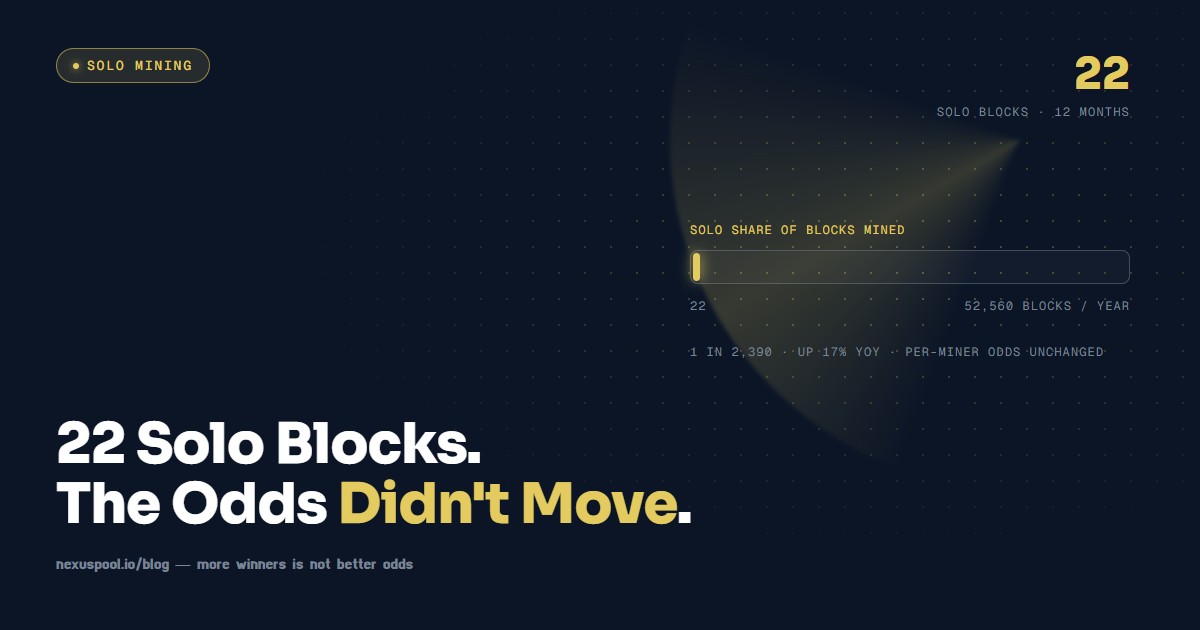
Solo miners found 22 Bitcoin blocks over the trailing 12 months, worth roughly 69 BTC combined, an increase of about 17 percent from the year before. That is a real, sourced statistic, and it has been enough to put solo Bitcoin mining back in headlines through most of 2026. The question worth asking before reading anything into that number is whether it means the odds actually moved for any individual miner, or whether something else entirely is going on. Both are true, and they are not the same thing.
Are Solo Bitcoin Miners Really Finding More Blocks in 2026?
Yes. As CryptoSlate reported, those 22 blocks over 12 months work out to roughly 1 in every 2,390 blocks mined network-wide going to an individual rather than a pool, a small but measurable share, and one that's grown year over year as more people run open-hardware devices like Bitaxe and NerdQAxe units at home. A handful of specific wins carried the story through the summer: one solo device solved a block in early July and collected the full 3.1382 BTC reward after running for less than a day, and a separate solo win in early August landed a reward of roughly 3.1569 BTC. Neither miner needed an industrial facility. Both needed a working device, a connection to a solo-paying pool, and, in the plainest sense of the word, luck.
Does That Mean Solo Bitcoin Mining Odds Got Better?
No, and this is the part worth sitting with. More people trying does not change what happens to any one of them. Take a 3 TH/s solo device, a mid-range multi-chip open-hardware setup, against a current network hashrate of roughly 900.6 exahashes per second (derived from Bitcoin's 125.81 trillion difficulty). Per-block probability = 3 trillion divided by 900.6 quintillion = about 1 in 300.2 million. Expected wait = 300.2 million blocks divided by 52,560 blocks per year = roughly 5,711 years. That number does not care how many other people are also running the same calculation on their own hardware right now. Difficulty divides network hashrate the same way regardless of headcount; more participants raise the odds that someone, somewhere, gets lucky in a given year, without improving the odds for any specific someone.
Why Does It Feel Like Solo Wins Are Constantly in the News?
Three reasons, stacked together. Open-hardware devices have gotten cheap and plentiful enough that far more people are actually running them than five years ago, which mechanically raises the pool of attempts. Win-tracking has gotten better and more visible, so a block that would have gone unremarked in 2021 gets picked up by outlets covering mining now. And there's a straightforward survivorship effect: the 22 wins get a headline each; the enormous number of solo miners who ran the same math and didn't get lucky this year generate no news at all. It is worth being honest about the shape of that distribution: for every solo miner whose device solved a block this year, there are, mathematically, hundreds of thousands of device-years of hashing that produced nothing. The headline never runs for those.
Does This Apply Beyond Bitcoin?
The same math runs on any proof-of-work chain, with each chain's own difficulty and network hashrate as the two inputs. A Scrypt-based rig solo mining Litecoin, with Dogecoin coming along through AuxPoW merged mining, is working the identical fraction against Litecoin's own, far smaller network hashrate, which is why solo wins happen more frequently in absolute terms on smaller chains even though the underlying arithmetic is unchanged. Bitcoin Cash runs the same SHA-256 algorithm as Bitcoin at a fraction of the network hashrate, which is part of why it draws attention from miners weighing where their existing hardware has better odds, chain for chain, without any pool or protocol changing the fraction on either side.
Should This Change How You Actually Mine?
Not on odds grounds, no. What is worth weighing is what you get if the improbable happens, since that part genuinely differs by setup. A non-custodial pool structure like NexusPool's non-custodial solo mining pool pays a found block's reward straight to the miner's own address through the coinbase transaction, at a 0% fee, with nothing held on a pool's balance sheet in between, whether the block is on Bitcoin, Litecoin, Dogecoin through merged mining, or Bitcoin Cash; NexusPool's Litecoin solo mining support works the same way on that chain. None of that moves the odds by a single decimal point. It only affects what happens in the (still statistically unlikely) event that the odds land in your favor, which is worth knowing in advance rather than working out in the moment; anyone curious can run a Payout Preflight check before you ever find a block to see exactly how that payout gets reconstructed and verified ahead of time. None of this is investment advice, and none of it says the odds have gotten better for any individual rig; a rising count of solo wins is a story about more people trying, not about the math changing in anyone's favor.
So, in one line: solo mining is winning more often in aggregate because more people are trying it, not because any single miner's odds have improved at all.
Trust nothing. Verify your own solo odds instead of trusting a headline about someone else's win.