Bitcoin Difficulty
Bitcoin Difficulty Retarget: What It Cost Solo Miners
Bitcoin difficulty rose 4.16% on September 19 while BTC cleared $85,000. Here is what both did to hashprice, and the one number that did not move.
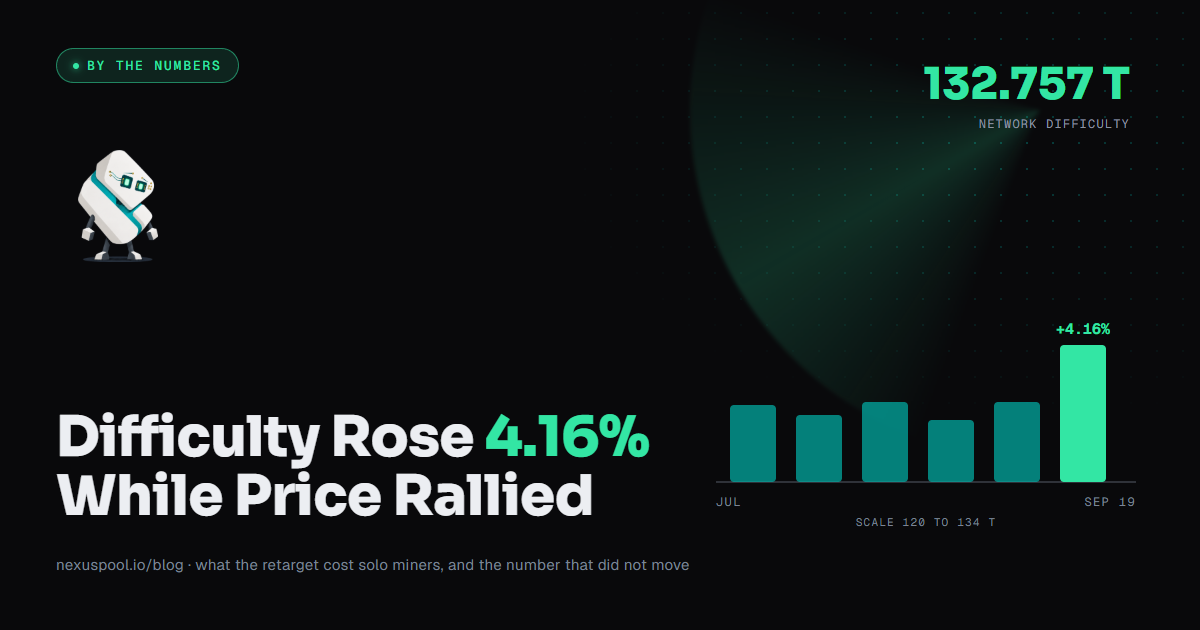
Two numbers moved in opposite directions for Bitcoin miners this week, and most of the coverage only counted one of them. Bitcoin cleared $85,000 on September 21, its strongest advance since January, after roughly $648 million in short positions were liquidated. Two days earlier, on September 19 at 07:09 UTC, the network quietly made mining 4.16% harder for everyone.
Both facts are true at once, and the interaction between them decides what a miner actually earns. Here is the arithmetic, computed from primary data rather than repeated from a headline.
The Bitcoin Difficulty Retarget, by the Numbers
At block 967,680 on September 19, difficulty rose from 127.451 trillion to 132.757 trillion. That is an increase of 4.1632%, which I recomputed from the two raw difficulty values rather than accepting a rounded figure.
Difficulty is not a measurement of hashrate. It is a target the protocol sets every 2,016 blocks to pull average block production back toward ten minutes. You can invert it to get the hashrate the network must have been running to produce blocks at that pace: multiply difficulty by 2^32 and divide by 600 seconds. At 132.757 trillion, that implies about 950.31 EH/s.
The observed three-day average at the time of writing sits at about 937.18 EH/s. Those two figures are not in conflict, and the gap between them is not an error in either one. The implied number describes the work the last retarget was calibrated against. The observed number is a rolling estimate of what is running right now, and it lags and leads by turns because block discovery is a random process. Any article quoting a single hashrate figure without saying which of the two it means is hiding a 13 EH/s ambiguity.
What the Rally Did to Hashprice
Gross revenue per unit of computing power is the number that actually pays an electricity bill. It is built from three inputs, all of which are public.
The network mints 144 blocks a day on average, each carrying a 3.125 BTC subsidy, for 450 BTC. Transaction fees added about 0.45% on top across a recent 144-block sample, bringing the daily total to roughly 452.04 BTC. At a BTC price of $84,751, that is about $38.31 million paid out to all miners per day.
Divide that by the network's hashrate and you get hashprice. This is where the denominator choice above stops being pedantic: against the difficulty-implied 950.31 EH/s the answer is $40.31 per PH/s per day, and against the observed 937.18 EH/s it is $40.88. CryptoSlate's September 21 analysis published $40.31, and reproducing it exactly confirms they used the implied figure. The 1.4% spread between the two is a modeling choice, not a discrepancy, and it is worth knowing which one a dashboard is showing you before you plan around it.
Note also what carries that revenue. Fees contributed 0.45% of rewards in the sampled window, so hashprice today is almost entirely a subsidy story riding on the BTC price. A rally lifts it. A retarget cuts it. This week both happened, and the price move was the larger of the two.
The Bitcoin Difficulty Estimate That Flipped in a Day
Here is the part worth being careful about. CryptoSlate's analysis, frozen when the new epoch was 14.43% complete, reported a projected 2.48% difficulty decline for the next retarget and framed it as an early caution signal. Several aggregators repeated that number as though it described miners switching off.
When I queried mempool.space's difficulty adjustment endpoint directly for this post, with the same epoch now 16.37% complete, the projection had flipped to positive 0.4268%, with 1,686 blocks remaining and an average block time of 615.4 seconds. The estimated retarget date is around October 3.
Nothing dramatic happened in between. That swing, from minus 2.48% to plus 0.43% across roughly 2% of an epoch, is what a noisy estimator looks like. Block arrivals follow a random process, so a few slow blocks early in an epoch drag the projection down and a few fast ones pull it back. The estimate becomes informative as the sample matures, not before. To its credit, the CryptoSlate piece said exactly this about its own number and cited the underlying research; the aggregators that stripped the caveat did the damage. If you want to watch a genuinely settled figure instead, NexusPool's status page and mempool.space both report completed retargets rather than projections.
The One Number That Did Not Move
Now the honest part, and the reason this post exists rather than a price piece.
A solo miner's probability of finding a block is their hashrate divided by the network's. Price is not in that equation anywhere. Using the difficulty-implied denominator consistently for both sides:
| Hardware | Before Sept 19 | After Sept 19 |
|---|---|---|
| 1.2 TH/s (Bitaxe class) | 1 in 760,274,829 | 1 in 791,926,790 |
| 200 TH/s (S19 class) | 1 in 4,561,649 | 1 in 4,751,561 |
| 500 TH/s (S21 class) | 1 in 1,824,660 | 1 in 1,900,624 |
At Bitcoin's pace of roughly 52,560 blocks a year, that 1.2 TH/s row translates from an expected wait of about 14,465 years to about 15,067 years. The 200 TH/s row moves from roughly 86.8 years to 90.4 years. Every row got worse by the same 4.16%, because that is precisely what a retarget is.
The $85,000 headline changed none of those numbers. It changed what a block is worth if you find one, and it changed hashprice for industrial operators selling hashrate into a market. It did not move a single miner one step closer to a block. Neither does any pool, including this one. Odds are fixed by your hashrate divided by network difficulty and are identical everywhere, which is why NexusPool's technology page describes what the pool does to the payout path rather than to the odds, and why Payout Preflight checks the transaction that would pay you instead of promising a better chance of triggering one. The Glass Ledger records exist for the same reason: they document custody, not luck.
So the by-the-numbers summary of the week is short. Revenue per unit of hash improved a few percent on a price move. Difficulty took 4.16% back. The next retarget projection is currently noise and will not mean much for another week. And your odds of finding a block are 4.16% worse than they were on Saturday, no matter what the price chart did.
Trust nothing. Verify the difficulty your odds are actually being measured against.