Non-Custodial Mining
BitMEX's Last Days: An 11-Year Custodian Closes
BitMEX shuts down September 23 with a clean 11-year security record intact. Its closure shows custodial risk is bigger than just getting hacked.
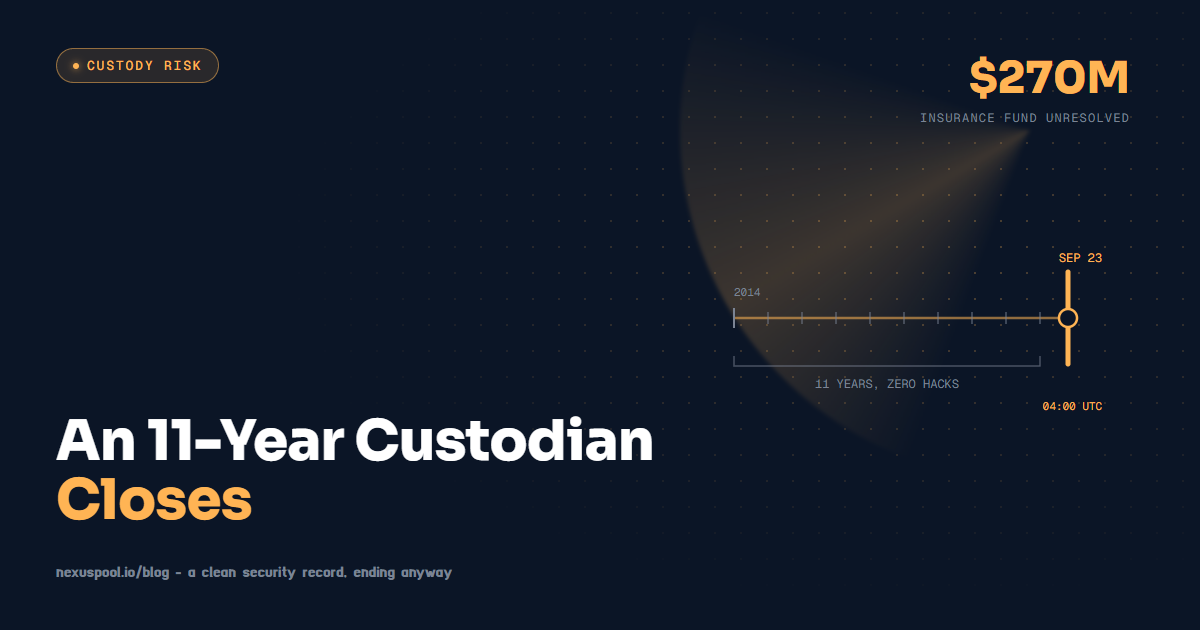
It is Saturday, September 20, and somewhere a BitMEX trader who has held an open position on the exchange since before most of this year's news cycle logs in to find a banner counting down the hours. Three days. Then the exchange that has processed leveraged Bitcoin trades since 2014, survived multiple market crashes, and never lost a single dollar of customer funds to a hacker in eleven years of operation shuts its doors for good, in the BitMEX shutdown scheduled for 04:00 UTC on September 23.
The trader is not being liquidated. Nobody hacked BitMEX. Nothing about the closure has anything to do with a security failure at all. That is precisely what makes this BitMEX shutdown worth sitting with for a minute, because it demonstrates a category of custodial risk that has nothing to do with the thing most people worry about when they think about exchange security.
How the BitMEX shutdown countdown actually started
HDR Global Trading Limited, BitMEX's operator, announced the closure back on July 23, framing it as the outcome of a strategic review of the business. The wind-down had its own internal schedule: from August 26, the exchange blocked new positions and allowed only reductions, tightening the exits before pulling them away entirely. Any position still open when the clock runs out on September 23 gets force-closed automatically, whether or not the trader is watching.
After that, BitMEX has said users can still log in to view wallet balances, transaction history, and withdrawal pages, but nothing else. Balances left unclaimed past the deadline face a monthly charge, the greater of fifty dollars or one percent per year, a quiet incentive to not treat "I'll get to it eventually" as a real plan.
BitMEX's founders, Arthur Hayes, Ben Delo, and Samuel Reed, pleaded guilty in 2022 to Bank Secrecy Act violations tied to anti-money-laundering failures at the firm. That legal history sits in the background of this closure without being its stated cause, and BitMEX itself has pointed to the strategic review rather than the settlement as the reason for shutting down.
The BitMEX shutdown dilemma facing every open account
Sitting at that login screen, the trader has to reckon with something that has nothing to do with whether BitMEX's engineers did their jobs well. They did. Eleven years without a hack is a genuinely rare record among crypto exchanges of BitMEX's size and age. The problem the trader now faces is that a spotless security record was never the whole picture of custodial risk. The funds were always exposed to a decision BitMEX's ownership could make unilaterally, for reasons having nothing to do with the trader's consent or the platform's technical soundness.
There is also an unresolved detail hanging over the whole closure: BitMEX's insurance fund, an internal reserve built from liquidation proceeds and estimated near two hundred seventy million dollars in Bitcoin and stablecoins. That fund was never customer-owned; it exists to absorb liquidation losses and prevent auto-deleveraging during volatile markets. Once every position is settled and every customer paid, any leftover balance would ordinarily belong to BitMEX's parent company, and the exchange has not said publicly what it plans to do with it. Nobody outside the company currently has a clear answer, which is itself a small but pointed illustration of how much a custodial relationship depends on an operator's discretion even at the very end.
The trader is not alone in facing this. Every account still open on BitMEX this weekend, whether it holds a leveraged position or a simple spot balance, runs on the same clock and the same terms. None of those account holders had a vote in the decision to close, and none of them can appeal to a security failure as the reason things are ending, because there was not one. The only lever any of them actually has is the withdrawal button. That button does keep working after the deadline, since BitMEX has said users can still log in to view balances and withdraw their funds afterward, but every other service stops, and the monthly fee starts running on whatever is left behind.
What changes for the trader, now that the facts are on the table
By the time the countdown hits zero, the trader in that opening scene has one job left: get the funds out before the account narrows to a balances-and-withdrawals-only shell with a monthly fee eating whatever stays behind. That is the entire lesson of an eleven-year, zero-hack custodian shutting down anyway. Security competence and business continuity are two different guarantees, and only one of them was ever actually promised.
Solo mining routes around this specific failure mode by removing the custodial step entirely rather than trying to secure it better. When NexusPool finds a block, the coinbase transaction pays the miner's own configured address directly, and the Payout Preflight tool lets a miner check where that payout would land before a block is ever found. There is no exchange-style account sitting in between that could announce a wind-down, freeze a balance, or leave a trader parsing a countdown banner on a Saturday morning, because nothing is ever held on a miner's behalf to begin with. The signed receipts NexusPool provides for every job exist for the same reason: so a miner can check the pool's own accounting rather than simply trusting it, though that verification is scoped to mining activity and has no bearing on how any exchange, including BitMEX, manages its own funds or insurance reserves.
None of this is investment advice, and mining is not a substitute for trading or a guaranteed source of income. Solo mining odds depend entirely on a miner's hashrate relative to the network's total hashrate for whatever chain they are mining, identical for every participant regardless of which pool they use, and no pool design changes that arithmetic. CoinDesk's coverage of the closure has the fuller timeline of how BitMEX arrived at this decision.
Trust nothing. Verify that the funds you think are yours are somewhere nobody else can schedule a closing date for.
Trust nothing. Verify that the thing holding your funds today plans to still exist tomorrow.