Node Operators
Bitcoin Full Node Mining Templates Explained
Bitcoin full node mining templates determine what your hardware hashes. Learn how node policy, transactions, payouts, and verification shape each job now.
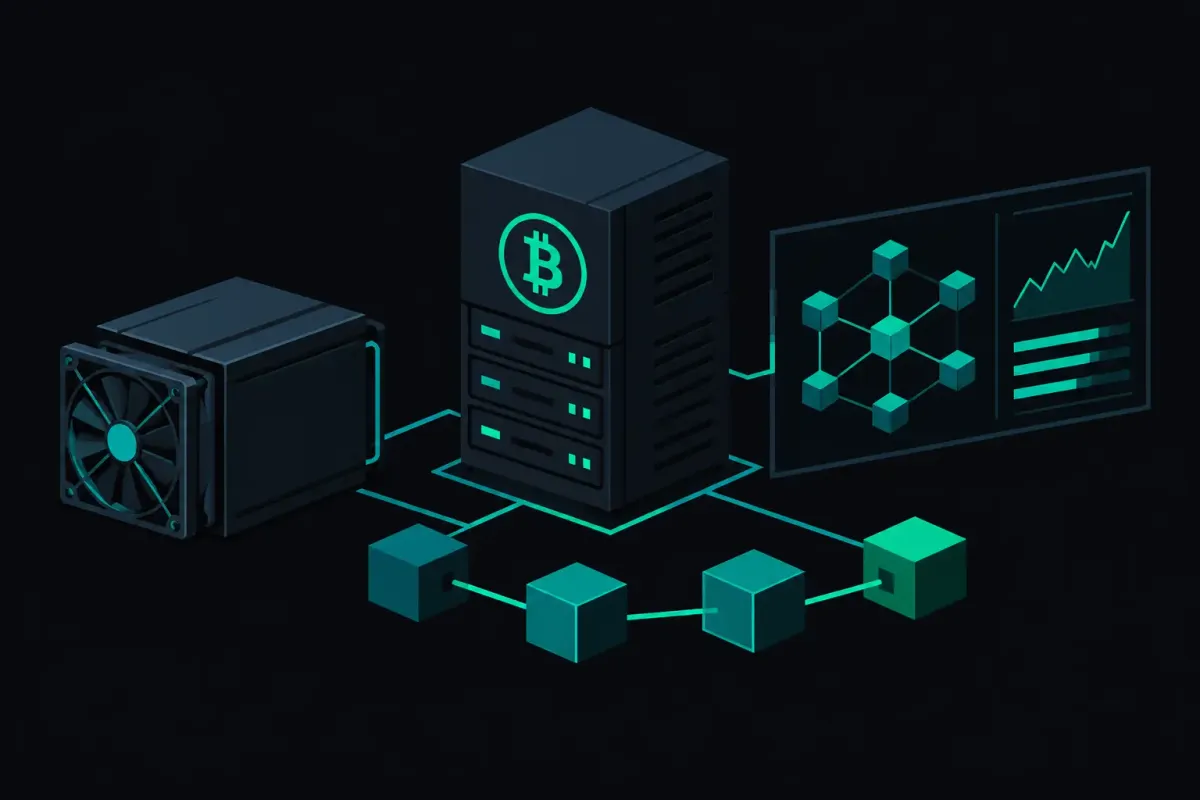
A Bitcoin miner never hashes "Bitcoin" in the abstract. It hashes a candidate block header built from a specific set of data. Bitcoin full node mining templates are the instructions behind that candidate: which transactions are included, where the coinbase reward goes, what the current target is, and which previous block the work extends.
That distinction matters most when a pool says it offers solo mining. You may own the hardware and supply the hash rate, but someone still constructs the work. If a valid block appears, the template determines what block you found and where its reward was committed before the hash was ever attempted.
What a mining template actually contains
A block template is a proposed next block assembled by a Bitcoin full node. The node tracks the chain tip, validates unconfirmed transactions in its mempool, applies its local policy, and selects transactions that fit the available block weight and meet its fee rules. It then gives mining infrastructure the material required to construct candidate blocks.
The resulting job includes a previous-block hash, version information, a timestamp range, difficulty target, coinbase construction rules, and the transactions or transaction data needed to calculate a Merkle root. The ASIC repeatedly changes values that are allowed to vary, especially the nonce and coinbase extranonce, then hashes the 80-byte block header. A hash below the network target is a valid block. Anything else is merely evidence that work was attempted.
The word "template" can cause confusion because it is not a static configuration file. It expires when the chain changes. A new block found anywhere on the network makes the prior parent obsolete. A meaningful mempool update can also justify new work. Good mining infrastructure distributes fresh jobs quickly because hashing an old parent creates stale work. No template system improves the probability of any individual hash. It only makes sure the hashes are aimed at a current, valid candidate.
Why the full node is part of the security model
A mining server can relay jobs without running the node that produced them. It can also obtain templates from a third party. That may be operationally convenient, but it inserts another system between the miner and the rules that define a valid block.
A pool connected to its own full Bitcoin node can validate the chain, maintain its own mempool view, build its own templates, and submit a solved block through infrastructure it controls. The node independently checks consensus rules before it offers work. It rejects invalid transactions, tracks the best chain according to its validation state, and refuses a block that does not spend correctly or meet proof-of-work requirements.
This is not a promise that a particular template contains every transaction you would have selected. Mempools differ. Nodes have different policy settings, fee estimation behavior, relay peers, and timing. Two honest full nodes can produce different valid templates for the same height. The relevant question is more concrete: can the operator explain which node built the work, what payout commitment was placed in the coinbase transaction, and how a solved block was handled?
For a solo miner, the coinbase output is the sharp edge of that question. The block subsidy and transaction fees are created by the coinbase transaction. If your own Bitcoin address is encoded there, the block reward is committed to that address on-chain. It does not first enter a pool wallet for later accounting. The block itself is the record.
How templates reach a miner
With Stratum V1, the pool sends jobs and the miner submits shares. A share is a header hash that meets a pool-assigned difficulty but usually does not meet the Bitcoin network target. Shares let the server measure whether a connection is alive and whether submitted work corresponds to a job it issued. They are not Bitcoin transactions and they do not create a claim on a block reward by themselves.
Stratum V2 separates job negotiation and work distribution more deliberately, while adding encrypted transport through Noise. Native V2-capable firmware, including AxeOS on Bitaxe hardware and BraiinsOS+, can use that protocol directly. Most standard ASICs still speak V1 or need a translator for V2. For a small operator, one endpoint that accepts both protocols can remove a box, a failure point, and a separate piece of software that must be trusted.
Protocol encryption protects the connection from passive observation and some active interference. It does not prove that a job has the transaction selection you personally prefer. Nor does it replace verifying the authority key and endpoint you intended to use. Security begins with the fact that the miner knows whom it connected to. It continues with what the miner can inspect after a block is found.
What you can verify before and after a block
Most home miners will never find a block. That is the arithmetic of small hash rate against a network that measures its work in exahashes per second. Verification therefore cannot depend only on the rare event of a payout. It should start with the work path you can observe every day.
Check that your worker is accepted, that its reported hash rate is plausible relative to the device, and that job updates arrive without unusual delay. Compare local hardware readings with pool-side accounting where it is available. Dynamic per-rig difficulty can reduce pointless share traffic for faster machines while keeping enough share cadence to detect a dead connection. It is operational telemetry, not a change to Bitcoin difficulty or your odds of finding a network-valid block.
If a block is solved, verify the facts that matter on-chain. Identify the block height and hash. Decode the coinbase transaction. Confirm that the output script pays the address you configured. Confirm the reward amount equals the subsidy for that height plus the fees represented in the block. Then wait for the confirmations your own risk policy requires before treating the funds as settled.
There is a trade-off here. Direct payment to your address means you do not receive smooth, frequent pool payouts. In solo mining, you receive nothing until you find a valid block, and then the entire coinbase reward is tied to that block. That variance is not a billing preference. It is the underlying game. A pool can change payment distribution, but it cannot turn low-probability hashing into a predictable income stream without moving risk somewhere else.
Template quality is mostly about validity and time
Miners sometimes treat a larger transaction-fee total as proof of a better template. Fees matter, but the highest-looking template is not automatically the best one. A candidate block must remain valid under consensus rules, fit within weight limits, and propagate well enough that the network accepts it before a competing block wins the race. A template also needs a current parent. A theoretically richer block built on a stale tip is worthless.
The node's mempool policy shapes this process. Minimum relay fees, ancestor limits, replacement policy, and transaction arrival order can all influence selection. This is normal. Bitcoin consensus defines which blocks are valid. Node policy determines which unconfirmed transactions a node is willing to relay and consider before they enter a block.
For the miner, the practical standard is not mystical template optimization. It is a current job from a validating full node, a payout script that matches your address, clear work accounting, and a connection you can authenticate. The rest is latency, software behavior, and the network's next hash.
A practical setup check
Before pointing a Bitaxe, NerdAxe, or ASIC at a solo endpoint, enter a payout address you control and inspect every character before saving. A wrong address can still be a valid Bitcoin address. The network will not know that you meant another one.
Use the endpoint and protocol your firmware supports. Keep the device clock reasonably accurate, watch rejected-share reasons, and investigate persistent stales rather than assuming they are bad luck. If you use a V2 authority key, pin the published key exactly. A key mismatch is a stop sign, not a warning to click past.
NexusPool is built around this model: its mining engine is connected to its own Bitcoin full node, and a solved BTC block pays 100% of its subsidy and transaction fees directly to the miner's configured address. That statement is useful only because a solved block leaves evidence anyone can inspect. The pool does not get custody of a reward it never receives.
The template is where mining stops being a dashboard number and becomes a proposed Bitcoin block. Know who assembled it. Know where its coinbase pays. Know how to check the answer when the improbable finally happens.
Trust nothing. Verify the block template.