CLARITY Act
CLARITY Act Vote: What It Means for Bitcoin Miners
The Senate votes Tuesday on the CLARITY Act. Read its mining and non-custodial language step by step, from the final text, before the result lands.
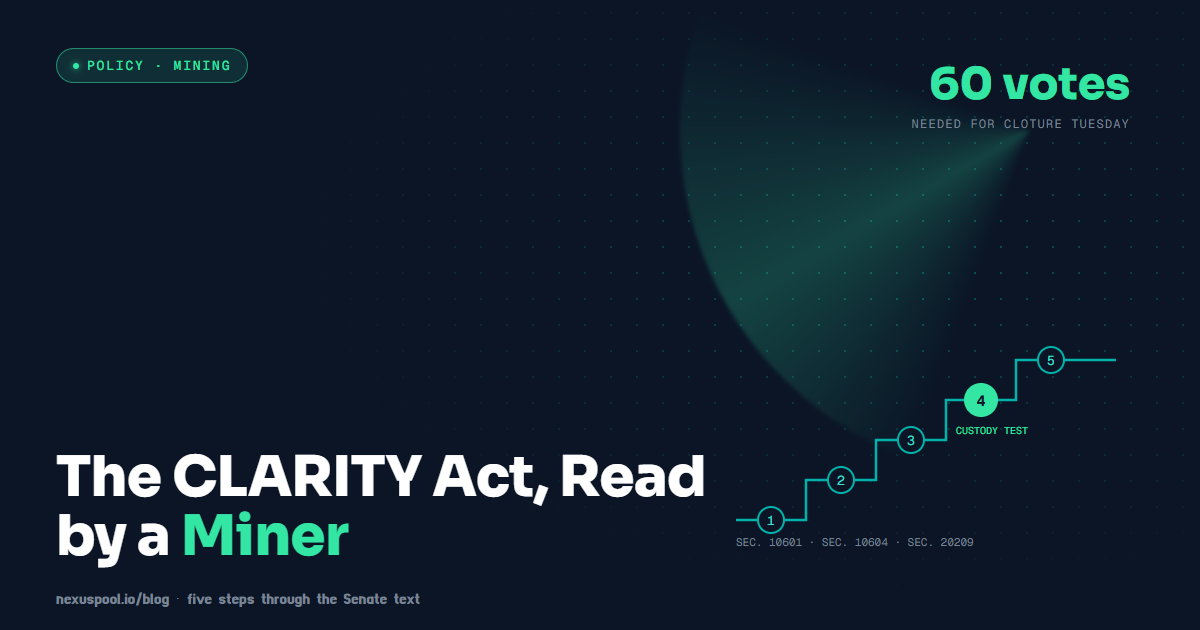
On Monday, September 14, Senators Cynthia Lummis, John Boozman and Tim Scott released the final text of the Digital Asset Market Clarity Act, and the Senate holds a procedural vote on it Tuesday afternoon. Reuters, CNBC and Bloomberg all led with the ethics deal and the fight with the banks. If you mine Bitcoin, the lines that matter to you sit further down, in a title called "Protecting Software Developers," and in a definition that turns on one question: can the operator move your coins? This guide walks through what the CLARITY Act means for Bitcoin miners in five steps, using the bill text itself rather than the headlines.
Step 1: Know What Tuesday's CLARITY Act Vote Decides
Tuesday is not the final vote. The Senate will vote on cloture on the motion to proceed, which decides whether the chamber opens debate on the bill at all. Cloture needs 60 votes, and CNBC counts that, with full attendance, at least seven Democrats would have to join Republicans. If cloture succeeds, the text released Monday gets offered as a substitute amendment, and senators can still amend it before any passage vote.
That text carries history. The bill cleared the Senate Banking Committee in May and then stalled over the summer. The sponsors say the final version includes 126 substantive changes that Democrats requested, plus ethics rules drawn from a proposal by Senators Thom Tillis and Ruben Gallego. Senator Lummis's release announcing the final text links the full draft, which runs past 600 pages, and every section number below comes from that document.
Step 2: Find the Mining Language in the Bill
Open Title VI, "Protecting Software Developers and Software Innovation." Section 10601 adds a new section to both the Securities Act of 1933 and the Securities Exchange Act of 1934. It says a person is not subject to either law "solely based on" a list of activities. The first item covers compiling network transactions, relaying, sequencing and validating. The second reads "providing computational work, operating a node or oracle service," or supplying network bandwidth.
Providing computational work is mining. The Exchange Act version also covers developers of self-custody wallets, and Section 20209 repeats the list in the Commodity Exchange Act, the law the CFTC enforces. In plain terms, running hashrate against a proof-of-work chain would not by itself pull you under SEC or CFTC registration. Two limits come attached. The words "solely based on" mean the shield covers the mining, not anything else you do alongside it. And the commodities version keeps the CFTC's anti-fraud and anti-manipulation authority intact, so the exemption is no license to mislead anyone.
Step 3: Read the Non-Custodial Test in the CLARITY Act
The part with the most consequence for pools is Section 10604, the Blockchain Regulatory Certainty Act, which Monday's release says was edited to shield developers from money transmission registration. It protects a "non-controlling developer or provider," and it defines that term with a custody test. A provider qualifies if, in the regular course of operations, it "does not have the legal right or the unilateral and independent ability to control, initiate upon demand, or effectuate transactions involving digital assets to which users are entitled" without a third party's approval.
A provider that passes that test would not be treated as a money transmitting business under federal law, and could not face a look-alike registration requirement just for publishing software, supplying tools for a customer's own custody, or providing infrastructure support. The section also spells out what it does not cover: anyone who knowingly moves criminal proceeds on another person's behalf gets no protection, and states keep enforcing their own laws where those laws are consistent with the section.
Step 4: Check Which Side of That Line Your Pool Sits On
Now apply the test to where your block rewards go. A custodial pool credits your work to an internal balance and later sends coins from wallets it controls. By design, that pool holds the unilateral ability to initiate transactions involving coins you are entitled to, which is the exact ability the definition excludes. A non-custodial solo pool builds the coinbase transaction so the block reward pays your address directly. The operator never holds your reward, so it never has a transaction of yours to initiate.
NexusPool uses the second design, and you do not need to take that on faith. The Payout Preflight tool rebuilds the exact coinbase transaction the pool would pay to your address, against the live block template, before you find a block. Glass Ledger signs custody and work receipts you can check offline. The technology page documents the Stratum V1 and Stratum V2 path your hashrate takes, and the terms state what the software does and does not do.
A caution belongs here. No court or regulator has applied this definition to a mining pool, the bill has not passed, and the text can still change on the Senate floor. This guide describes what the draft says. It is not legal advice about how any operator, including NexusPool, would be classified.
Step 5: Note What the CLARITY Act Does Not Change for Miners
The bill regulates markets, exchanges, brokers, stablecoins and custody. It does not touch how the IRS taxes a block reward; that fight runs through a separate House bill with its own markup. It does not change difficulty, the halving schedule or any consensus rule. And it does not change your odds of finding a block by a single share. Those odds equal your hashrate divided by the network's hashrate, identical at every pool, custodial or not, whatever Congress decides this week.
The Sequence, Start to Finish
Tuesday decides whether debate opens, and 60 votes are needed. Title VI says mining alone does not make you an SEC or CFTC registrant. Section 10604 protects providers that cannot move user funds. Your own pool's payout path tells you which side of that line it sits on, and a free check of the coinbase shows you that path before you find a block. None of it moves your odds. This post is not investment, tax or legal advice, and it does not claim NexusPool's core software is open source, because it is not.
Trust nothing. Verify where your pool's coinbase sends the reward before the Senate decides what that design is worth.