Bitcoin
Bitcoin Hashrate Rebound: What the September Numbers Say
Bitcoin hashrate bounced off 850 EH/s a third time while 235 EH/s sits idle. The real numbers behind the rebound, and why it caps itself.
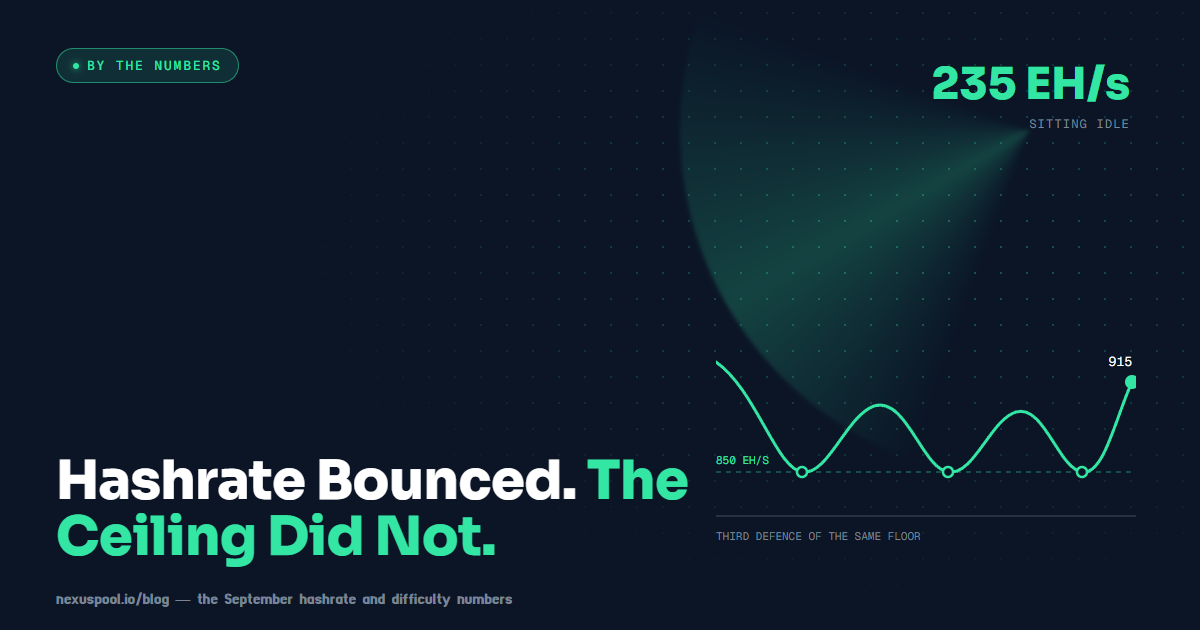
Bitcoin's network hashrate fell to 853 EH/s on September 7, 2026, then climbed back to 915 EH/s a day later. That was the third time in recent weeks the number bounced off roughly the same 850 EH/s floor, and it arrived in the same week difficulty rose for the eighth time this year and hashprice finished a 22% run. Read individually, each of those figures looks like a recovery. Read together, they describe something more specific and less comfortable, because roughly a fifth of the world's mining machines are currently switched off, and the conditions that would bring them back are the same conditions that would erase most of the revenue improvement that made coming back attractive in the first place. Here are the actual numbers, and what each one does and does not tell a miner.
The Bitcoin Hashrate Rebound, Line by Line
| Figure | Value | Where it stands |
|---|---|---|
| Hashrate, September 7 | 853 EH/s | Third touch of roughly the same 850 EH/s area in recent weeks |
| Hashrate, September 8 | 915 EH/s | A 7.3% single-day recovery off that floor |
| All-time peak | About 1.15 ZH/s, October 2025 | The network has now spent more than 300 days below it |
| Distance from peak | About 20% below | Even after the rebound, roughly a fifth of the old total is missing |
| Difficulty | 127.45T, up 1.31% at block 965,664 | The eighth increase of 2026, against ten decreases so far this year |
| Hashprice | $39.63 per PH/s per day | Up 22.24% from $32.42 about a month earlier |
| Transaction fees | 0.43% of miner reward over 24 hours | Revenue in 2026 is almost entirely block subsidy, not fees |
| Idle ASIC capacity | About 235 EH/s, per Luxor's September 8 report | The gap between roughly 1,150 EH/s of net ASIC capacity and 915 EH/s implied active |
What the 235 EH/s Idle Number Actually Measures
That 235 EH/s figure is the one worth sitting with, because it is a subtraction rather than a measurement. Luxor arrives at it by comparing roughly 1,150 EH/s of total net ASIC capacity that exists as physical hardware against about 915 EH/s of activity implied by August's average difficulty. The difference is machines that exist and are not hashing. It works out to a little over 20% of the fleet.
Those machines are not all off for the same reason, and that distinction matters more than the total does. Luxor's own breakdown separates uneconomic machines, switched off because revenue does not cover the power bill, from deliberately curtailed machines, which work fine and are simply worth more to their owner powered down at that moment. It also counts hardware in transit between sites and hardware down for maintenance. Only the first category is a genuine distress signal. A Texas operator powering down through the summer to avoid transmission charges tied to peak demand is not in trouble, it is doing arithmetic. That seasonal window closes in September, which removes one specific reason for a share of that capacity to stay dark, independent of whether anyone's finances improved.
Why the Hashrate Rebound Contains Its Own Ceiling
Bitcoin retargets difficulty every 2,016 blocks, aiming to keep blocks arriving about ten minutes apart. If curtailed capacity returns and blocks start arriving faster, difficulty rises to compensate. At higher difficulty, the same machine earns less expected revenue per unit of hashrate, with the subsidy and fees held constant. That is the whole mechanism, and it is not a flaw. It is the protocol doing exactly what it was designed to do.
The consequence for an operator is direct. The 22% hashprice improvement that makes restarting a marginal machine look sensible is partly a product of competitors being switched off. Enough of them making the same rational decision at the same time compresses the number that justified the decision. The base case most analysts describe is not a collapse, it is a give-back: some Texas capacity returns after September, difficulty rises moderately, and hashprice hands back part of the August gain. The harsher case is worth naming plainly too, where a large share of idle capacity restarts while bitcoin's price stalls, difficulty climbs sharply, and the rebound turns into a margin squeeze for the least efficient hardware on the network.
What This Changes for a Solo Miner, and What It Does Not
For anyone pointing hashrate at a chain rather than running a fleet, most of the above is context rather than instruction. Difficulty at 127.45T sets the target every miner on Bitcoin is hashing against, identical for everyone, and no pool changes it. A miner's chance of finding a block is their own hashrate divided by the network's, and that arithmetic does not care about hashprice, curtailment schedules, or which quarter a public miner signed a hosting contract in. If the network's total hashrate falls, every remaining miner's share of the total rises slightly, and if idle capacity comes back, it falls again. That is the only channel through which any of these numbers touches solo odds, and across the range being discussed here the effect is small.
What the numbers do change is the cost side, which is the part a home miner actually controls. A 0.43% fee share means the block subsidy is carrying essentially all miner revenue right now, so fee-market speculation is not where the margin is. Power price is. And a network sitting 20% below its peak means the marginal machine deciding whether to run is being decided on electricity cost, not on strategy.
The Numbers, Tied to What to Actually Do
Three figures are worth tracking rather than the headline hashrate. The next difficulty adjustment, because it tells you how much idle capacity actually came back rather than how much could. Hashprice a week after that adjustment, because that is where the give-back shows up if it happens. And your own power cost per kilowatt hour against the current hashprice, because that is the only one of the three you can act on. If your own arithmetic works at $39.63 per PH/s per day but breaks at $34, you are running on a number that just moved 22% in a month and can move back the same way.
Where the reward lands when a block is found is a separate question from all of this, and it is one worth settling before the numbers move again. On NexusPool a found block pays the miner's own address directly through the coinbase transaction, subsidy plus fees, with a 0% pool fee and nothing held back as a balance, across Bitcoin, Litecoin, Dogecoin, and Bitcoin Cash. The protocol details, including native Stratum V1 and Stratum V2 support, are documented on NexusPool's technology page, the signed and independently checkable payout records are described on the Glass Ledger page, current uptime is published on NexusPool's status page, and anyone who wants to confirm a payout path before a block is ever found can use the Payout Preflight tool. None of this changes the odds of finding a block, which are set entirely by network difficulty relative to a miner's own hashrate and are identical at every pool on a given chain. It is not investment advice, it is not a forecast of hashrate, difficulty, or bitcoin's price, and it is not a claim that NexusPool's own core software is open source or public today. For the full breakdown of Luxor's idle-capacity estimate and the restart scenarios behind it, see CryptoSlate's analysis of the 235 EH/s sitting dark.
Trust nothing. Verify your own power cost against the current hashprice before you read a hashrate rebound as good news for your machine.