Litecoin
Litecoin LiteForge: What Miners Should Actually Ask
Litecoin's LiteForge rollup has processed over 157 million testnet transactions ahead of a Q4 mainnet target. What it does and does not change for miners.
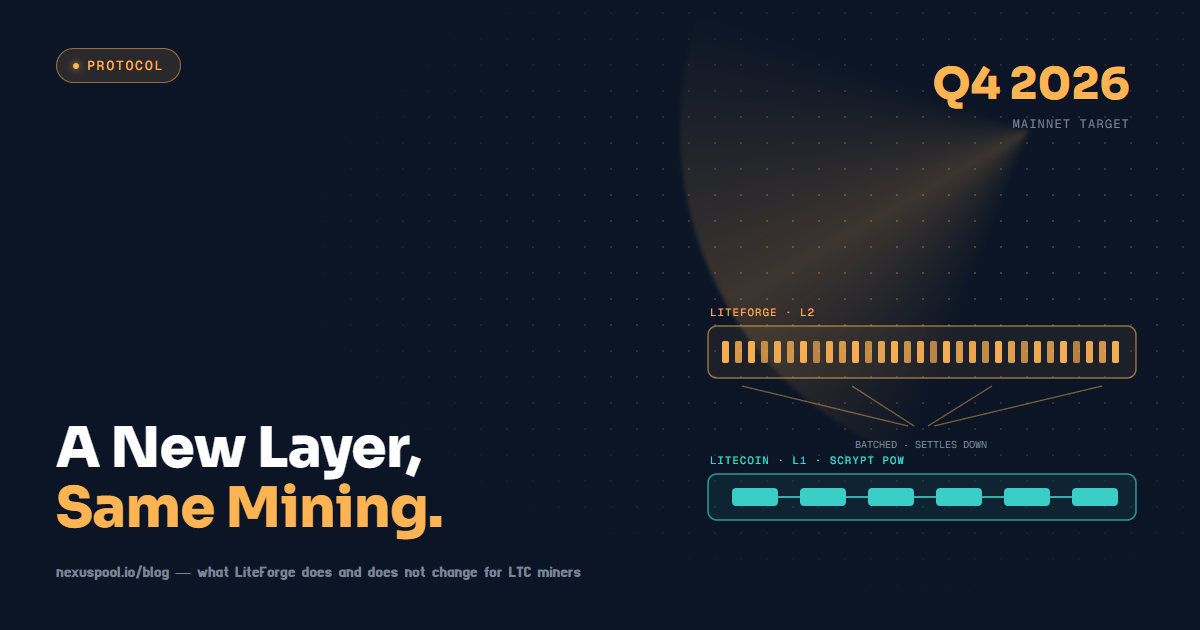
Litecoin's LiteForge testnet, built on the LitVM framework, has processed more than 157 million transactions since it launched in April 2026, up from roughly 63 million in late June and about 140 million a month later, and developers are targeting a mainnet launch in the fourth quarter of 2026 once a round of independent security audits wraps up. The pitch is straightforward on its face: an EVM-compatible rollup that lets Litecoin support smart contracts, DeFi applications, and other Web3 tooling that its base chain was never built to run. For anyone who actually mines LTC, whether solo on a home rig or as part of understanding what is happening to the coin's protocol, the coverage of this milestone raises more questions than it answers. Here are the ones worth asking directly, with straight answers to each.
Does LiteForge Change How Litecoin Mining Actually Works?
No. LiteForge is a rollup, a separate execution layer that batches its own activity and settles periodically back to Litecoin's base chain. Litecoin's own consensus, its Scrypt proof-of-work, its block time, its block reward, and its AuxPoW merged mining relationship with Dogecoin all continue exactly as they do today. A miner finding an LTC block under LiteForge is doing precisely the same work as a miner finding an LTC block before LiteForge existed. Nothing about how a block gets mined, verified, or paid out changes because a rollup exists on top of the chain.
Is This the Same Thing as a Hard Fork?
Not in the way Litecoin's past protocol changes, like the MWEB privacy upgrade, have worked. A hard fork changes the rules Litecoin's own nodes and miners must follow directly. LiteForge instead operates as its own layer that periodically posts data back to the Litecoin base chain, similar in structure to how rollups work on other networks that support this kind of scaling. Litecoin's core validation rules are not being rewritten to accommodate it. That distinction matters for anyone worried that adding smart-contract capability requires every miner to adopt new consensus rules. It does not.
Why Add Smart Contracts to a Coin Built for Payments?
The stated goal, per LitVM's own framing, is to give Litecoin a foundational settlement layer for applications, prediction markets, DeFi products, and tokenized assets, that developers can build using existing Ethereum tooling rather than learning a Litecoin-specific stack from scratch. Whether that succeeds in attracting real developer activity beyond testnet transaction counts is an open question the mainnet launch will actually test. A high testnet transaction count measures activity on the test network, not necessarily eventual mainnet usage once real value is at stake and gas costs apply.
Does Any of This Affect a Miner's Own Odds of Finding a Block?
No, and this is worth stating plainly rather than leaving implied. A miner's probability of finding a Litecoin block is set entirely by that miner's own hashrate divided by Litecoin's total network hashrate, the same ratio that determines odds on every proof-of-work chain, and nothing about a rollup running on top of the base chain touches that ratio in either direction. LiteForge does not make solo mining easier, harder, faster, or slower. It is an entirely separate layer solving a separate problem, applications and smart contracts, not consensus or block production.
What Should a Miner Watch Before LiteForge's Mainnet?
The honest answer is: whether the pending security audits turn up anything that delays the Q4 target, and whether mainnet activity resembles testnet activity once real economic stakes apply instead of test tokens. A rollup's testnet numbers are the easiest phase of its life to rack up, since there is little cost to generating transactions that do not carry real value. The audits Litecoin developers have flagged as a gating requirement are the more meaningful signal to watch before treating a Q4 2026 launch as settled.
The Direct Answer
The single biggest question this milestone raises for a Litecoin miner is whether LiteForge changes anything about mining LTC itself, and the direct answer is no: consensus, block production, and payout mechanics stay exactly as they are, with the rollup operating as an additional, separate layer built on top rather than a change to the base chain miners secure.
Litecoin's base-chain economics, block reward, AuxPoW merged mining with Dogecoin, and its next halving still set the terms for anyone mining it directly, independent of whatever happens with LiteForge's mainnet timeline. NexusPool supports solo mining Litecoin with the block reward paid straight to the miner's own address through the coinbase transaction, 0% pool fee, alongside native support for Bitcoin, Dogecoin, and Bitcoin Cash. NexusPool's Litecoin technology page documents the merged-mining and protocol details behind that setup, and NexusPool's Litecoin support page covers what solo mining the chain looks like in practice today. The same non-custodial argument applies whichever layer the ecosystem eventually adds, and the signed, offline-checkable payout receipts behind it are published on NexusPool's Glass Ledger page. This is not a claim that LiteForge, LitVM, or any rollup built on Litecoin is safe or unsafe for developers or users to build on, and it takes no position on whether the project will hit its Q4 2026 mainnet target. It does not change, and does not claim to change, the odds of finding a Litecoin block, which depend only on a miner's own hashrate relative to network difficulty. It is not investment advice, and it is not a claim that NexusPool's own core software is open source or public today. For more on LiteForge's testnet progress and mainnet timeline, see AMBCrypto's coverage of LitVM's LiteForge testnet milestone.
Trust nothing. Verify what a protocol upgrade actually changes about mining before assuming it touches your own setup at all.