Glass Ledger
Bitcoin's Hashrate Slowdown and What It Means for You
Public miners are redirecting power to AI as Bitcoin hashrate growth flattens. Here is what that actually changes, and does not change, for home solo miners.
Picture a mining floor somewhere in West Texas this summer, one of dozens like it across the state. A row of ASICs that spent five years doing nothing but Bitcoin's SHA-256 proof of work gets powered down, and in its place goes a rack built for something else entirely: GPU-driven AI compute, sold to a data-hungry customer on a contract that pays better than hashing ever did this year. Nobody is shutting down. They are reallocating the same megawatts to a more profitable job. That decision, repeated at facility after facility in 2026, is the real story behind a term that would have sounded strange five years ago: a Bitcoin hashrate slowdown.
The Numbers Behind the Bitcoin Hashrate Slowdown
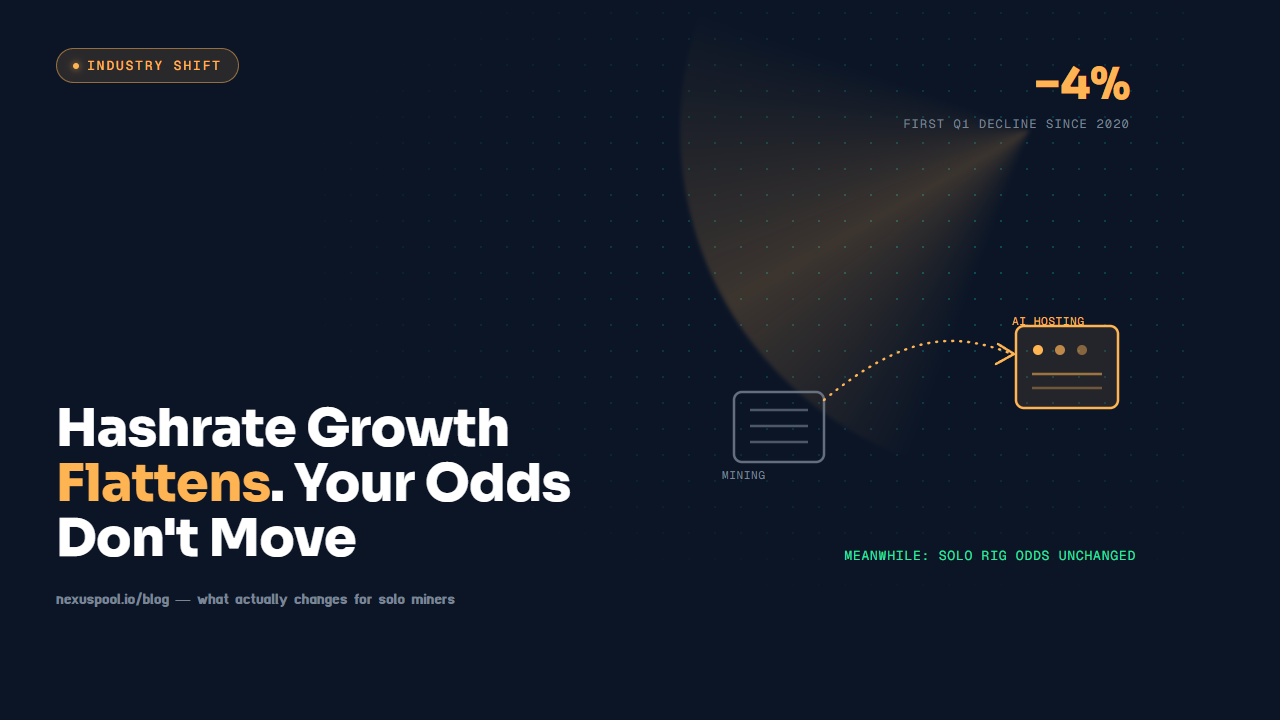
Fidelity's research team found that Bitcoin's 30-day average hashrate and difficulty each fell roughly 8 to 9 percent from earlier highs this year, before a partial rebound. Separately, the network posted its first first-quarter hashrate decline since 2020, down about 4 percent for the period, breaking five straight years of double-digit annual growth. The mechanism is economic, not political: with production costs for many operators running close to $90,000 per bitcoin against a lower spot price for much of the year, the math for a public miner with shareholders and quarterly targets increasingly points toward AI hosting instead. As Bitcoin Magazine reported, Fidelity frames this as a structural retooling of the industry, not a one-quarter blip.
What This Does Not Mean
It does not mean Bitcoin is less secure in any way a home miner needs to worry about; hashrate flattening from a five-year growth streak is not hashrate collapsing. It does not mean solo mining odds are improving, and nobody running this math should treat a slower-growing denominator as a promise of anything. The relationship between a solo miner's odds and the network never depended on who else was competing or why they showed up. It is, and remains, one miner's hashrate divided by the network's total, the same fraction for every participant on the chain, whether they run one Bitaxe in a closet or an entire warehouse. A public company deciding its power is worth more to an AI customer than to Bitcoin's SHA-256 puzzle does not rewrite that fraction. It just changes who else is standing in line.
Who Isn't Leaving
The miners this story is actually about, home and hobbyist operators running open-hardware devices, were never in that line for the same reasons a public company was. There are no shareholders asking a Bitaxe owner to redirect their device to an AI contract. Non-custodial solo mining was never a spreadsheet decision for most people running it; it is a stance about keeping the coinbase transaction paying directly to an address they control, with nothing held by a third party in between. That is the same design NexusPool runs on: no pool-held balance, a block reward that pays the miner's own address directly, and both Stratum V1 and Stratum V2 support so older and newer firmware connect on the same port without reconfiguration, detailed on NexusPool's about page. None of that changes anyone's odds either. It just means the reader who owns a solo rig isn't a character in the AI-pivot story at all, whichever way that story moves next quarter.
A Second-Order Effect Worth Naming
There is one place this story does touch the mining-protocol layer, even if it never touches the odds. As public miners consolidate into fewer, larger operators chasing AI-hosting margins, the concentration of who controls block template construction becomes a sharper question, not a softer one. That is part of why the industry's own push toward Stratum V2, which lets individual miners rather than pool operators choose which transactions go into the blocks they work on, has kept moving forward even as raw hashrate growth flattens. Fewer large players controlling more of the network's remaining hashrate makes protocol-level decentralization tools more relevant, not less, regardless of what any single participant's odds look like.
Back On That Mining Floor
The Antminers that got unplugged this month in West Texas are not coming back online because a headline says solo mining is having a moment, and they were never running for the person reading this anyway. What actually changes for someone with a Bitaxe or a NerdQAxe in a closet is not the plot of the AI-versus-Bitcoin story at all. It's whether they open a terminal, pull the current difficulty figure, and run their own hashrate against it, the same two numbers that mattered before this story started and the same two that will matter after it's over. Nothing here promises a slower-growing network improves anyone's actual odds of finding a block, and nothing about NexusPool's own non-custodial design changes that math either; anyone tracking uptime or wanting to see what changed recently can check NexusPool's live status page or NexusPool's changelog directly rather than take a claim on faith.
Trust nothing. Verify the network hashrate yourself before deciding what an AI headline means for your own odds.