Glass Ledger
Hardware Wallet Shipping Breaches: A Step-by-Step Response
Trezor and SafePal disclosed shipping and order data breaches in August 2026. A step-by-step walkthrough of what leaked and what to do about it.
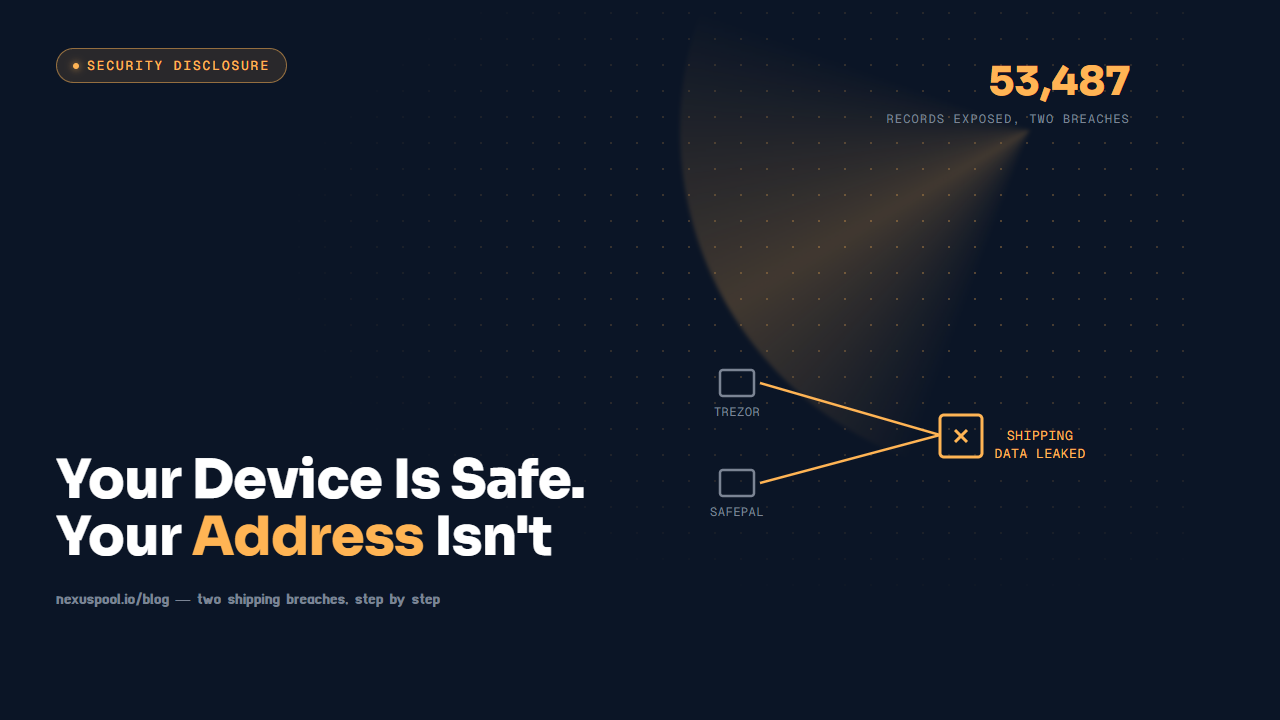
Two hardware wallet makers disclosed data breaches in August 2026, and neither one involved a device vulnerability. On August 13, Trezor disclosed that its fulfillment partner ShipMonk had been breached, after ShipMonk notified Trezor of unauthorized access on August 10. The breach exposed full details, name, email, phone number, and shipping address, for 11,742 customers, plus partial details for another 1,947, covering orders placed between May 10 and August 8, 2026, across the US, UK, Sweden, Colombia, Brazil, Italy, and Portugal. Days later, on August 16, SafePal disclosed a separate hardware wallet data breach of its own: a flaw in an order-tracking plugin let an attacker view other customers' order records simply by changing an order number, exposing names, emails, phone numbers, shipping addresses, and purchase details for 39,798 customers who had ordered between March 2025 and April 2026.
Both companies were clear that wallet devices, seed phrases, private keys, and funds were not touched. What leaked was the paper trail connecting a person's name and home address to the fact that they own a hardware wallet, which is exactly the information behind phishing attempts and, in a small but real number of cases, physical robberies sometimes called wrench attacks. Trezor confirmed attackers used the stolen data to send phishing messages attempting to trick recipients into revealing their 24-word recovery seeds.
Neither breach is unique in kind. Five hardware wallet companies, spanning Ledger, Trezor, and SafePal customer bases, have disclosed security incidents tied to third-party vendors since the start of 2026, and the pattern is consistent: the wallet itself stays secure while a shipping partner, a support vendor, or an order-tracking system becomes the weak point instead. That is a meaningfully different problem from a firmware bug that lets an attacker reconstruct a seed remotely, and it calls for a different response. Here is what to actually do about it, step by step.
Step 1: Check Whether the Hardware Wallet Data Breach Affects You
If you ordered a Trezor device with delivery between May 10 and August 8, 2026, or placed a SafePal order between March 2025 and April 2026, treat your name, shipping address, and phone number as exposed. Both companies notified affected customers directly; if you received that notice, this applies to you, and if you did not but your order falls in either window, contact the company's support channel directly, not a link from an email, to confirm your status.
Step 2: Never Enter Your Recovery Seed Anywhere Because of This
No legitimate follow-up to either breach requires you to type your 24-word recovery phrase into a website, an app, a chat window, or a form. That request is the phishing attempt, not a remediation step. Both companies confirmed the breaches did not touch seed phrases, private keys, or wallet passwords; anyone asking you to "verify" or "re-secure" your wallet by entering that phrase is impersonating the company, not helping you.
Step 3: Treat Unexpected Packages and Contacts With Suspicion
With your name and shipping address potentially exposed, be skeptical of anything referencing your hardware wallet purchase that you did not initiate yourself, an unexpected "replacement device" shipment, a support call about your order, or a message claiming to be from the company's security team. Verify independently through the company's official site before responding to any of it.
Step 4: Consider What Your Shipping Address Now Signals
A leaked shipping address tied to a hardware wallet purchase tells an attacker where a person who owns cryptocurrency lives. That is worth taking seriously regardless of how much you hold; physical safety, not just account security, is the actual stake here. Reporting on crypto-related home invasions has noted a rise in this kind of targeted physical robbery over the past couple of years, often built from exactly this sort of leaked purchase and delivery data rather than any on-chain information, since blockchain activity alone rarely reveals a person's home address. Basic precautions, not discussing your holdings publicly, varying delivery addresses for sensitive purchases going forward, and being alert to unusual attention from strangers, are reasonable responses to that kind of exposure.
Step 5: Separate the Custody Model From the Purchase Trail
A hardware wallet's job is protecting your keys once you have it; it says nothing about the retail and shipping trail that got it into your hands, which is precisely what leaked here. A mining setup that pays block rewards directly to an address you control sidesteps a different part of the same problem: there is no purchase record, shipping address, or customer database tying your identity to your holdings in the first place, because nothing was shipped to you and no company held a balance on your behalf. NexusPool's own approach to paying miners works exactly that way, with the coinbase transaction going straight to your own address. That is a different exposure than a hardware wallet's shipping trail, not a replacement for good hardware wallet practices, and this isn't a claim that either approach eliminates risk entirely; both still depend on you keeping your own keys and your own operational security sound.
Recap
Check whether your order falls in Trezor's May 10 to August 8, 2026 window or SafePal's March 2025 to April 2026 window. Never type a recovery seed anywhere in response to this. Treat unsolicited contact about your order as suspicious by default. Take your physical exposure seriously, not just your account security. And remember that a leaked shipping address and a compromised wallet are two different problems with two different fixes. None of this is investment advice, and self-custody, done well, still requires the same discipline it always has: verify independently, protect your seed phrase absolutely, and assume any unsolicited contact referencing your holdings is hostile until proven otherwise. Miners who want to see how NexusPool structures its own side of that trust model can read more on its about page, and its encrypted, authority-key-pinned Stratum V2 connection is built on the same principle of not trusting the network path by default.
Trust nothing. Verify who is actually contacting you before you respond to either breach.