Bitcoin Mining
Bitcoin Mining Pool Concentration: What It Means for You
Two mining pools now build nearly half of all Bitcoin blocks. Here is what that concentration changes for miners and solo miners, and what it never changes.
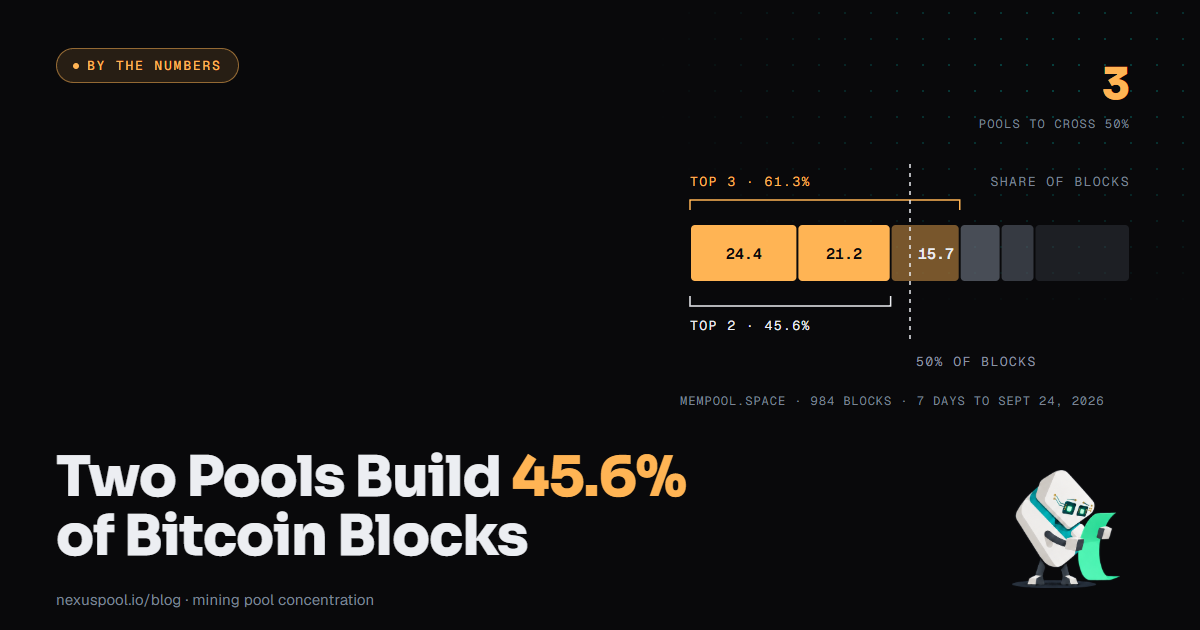
On September 11, 2026, two mining pools each produced a valid Bitcoin block at height 966,500 within seconds of each other. Only one could survive. The network kept whichever block the next one, 966,501, built on, and dropped the other along with its roughly 3.14 BTC reward. Nothing broke and no one's funds were at risk, but the event put a number back in front of Bitcoin miners that had stayed in the background: bitcoin mining pool concentration. The two largest pools on the network found 45.6% of all Bitcoin blocks in the seven days to September 24, according to the mempool.space pool ranking. Two more figures sit next to it, and none of the three touches your odds.
45.6%: Bitcoin Mining Pool Concentration at the Top
Pool operators do not create hashrate. They coordinate it. A pool collects proof-of-work shares from thousands of individual rigs, assembles the transactions those shares will confirm, and submits the winning block on the group's behalf once one of those shares clears the network's difficulty target. Over the past week the two largest pools did that job for 449 of the 984 blocks the network produced, or 45.6%. Block share over a week is the usual public estimate of hashrate share, and it carries some statistical noise. For a miner, the useful reading is how many block-building decisions sit with two organizations.
Where the Rest of the Hashrate Sits
| Rank by blocks found | Blocks, 7 days to Sept 24 | Share of 984 blocks |
|---|---|---|
| Largest pool | 240 | 24.4% |
| Second-largest pool | 209 | 21.2% |
| Third-largest pool | 154 | 15.7% |
| Fourth-largest pool | 92 | 9.3% |
| Fifth-largest pool | 76 | 7.7% |
| Combined, top two | 449 | 45.6% |
The gap between the top two rows and everything below them is wide enough that most of the hashrate-distribution discussion in mining circles centers on those two entries, not the long tail underneath. The same ranking over three days and over a month shows the same top three in the same order, so this is not a one-week blip.
3: How Few Pools It Takes to Cross Half the Network
Concentration research on Bitcoin often borrows a version of the Nakamoto coefficient: the smallest number of independent entities that together control more than half of a given resource. For Bitcoin's mining pools today, that number is 3. The top three pools found 61.3% of last week's blocks (24.4 plus 21.2 plus 15.7). If those three coordinated, they could outpace the rest of the network and decide, over time, which valid chain wins and which transactions it carries. That number describes censorship resistance at the block-production layer. It is smaller than most people expect from a network usually described as having thousands of participants, and it says nothing about anyone's odds of finding a block, which is a separate question covered further down.
75%: The Pools Trying to Change What Concentration Means
Pool concentration and decision concentration are not automatically the same thing, and a protocol standard aims to pry them apart. In May 2026, pools together representing close to three-quarters of Bitcoin's hashrate joined the working group behind Stratum V2, as CoinDesk reported at the time. Stratum V2 includes a sub-protocol called Job Declaration. Under the older Stratum V1 standard, the pool operator decides which transactions go into a block and hands miners a finished template to hash. Job Declaration lets an individual miner assemble their own candidate block and propose it to the pool instead, so a pool's hashrate share stops automatically translating into control over block contents. Joining a working group is a commitment. It does not tell you how many miners on those pools build their own templates today. NexusPool's technology page covers where Stratum V2 fits into NexusPool's own connection handling, including the same-port detection that lets Stratum V1 and Stratum V2 rigs connect without any configuration change.
What These Numbers Do Not Change
None of this changes the odds of any individual share finding a block. Bitcoin's network difficulty sets that probability, and it sets it the same way for every rig connected to every pool, NexusPool included. A smaller pool does not multiply your chances and a larger one does not either. Every hash faces the same odds, solo or pooled, and an average wait time is never a promise of when your next share clears the target. Concentration changes a different question: who decides what a block contains, and who you have to trust to pay you honestly once one is found. That second question is where a pool's custody model matters more than its hashrate share. A pool that never holds a balance to begin with, because the coinbase transaction pays the miner's own address directly, has nothing to redirect even if its share of the network were larger. NexusPool's Payout Preflight tool shows that exact coinbase for your address on the current block, before a block is ever found.
Where NexusPool Fits the Math
The block pays your address. There is no balance for us to hold. NexusPool charges a 0% pool fee, and Payout Preflight shows the exact coinbase before you find a block, regardless of what this post's numbers say about anyone else's share of the network. Each hour, NexusPool also signs a receipt for the work it counted from your rig: the shares, the difficulty they were served at, and the window they landed in, signed with BIP340 against a key NexusPool publishes. You can check a receipt in the browser on the NexusPool home page or with your own BIP340 code. NexusPool calls that receipt its Glass Ledger. The arithmetic behind the 45.6%, the 3 and the 75% stays the same. Those checks shrink what you have to take on faith while the numbers move.
This post makes no claim that joining any particular pool, NexusPool included, improves anyone's odds of finding a block, and nothing here is investment advice. Network difficulty sets the odds of every hash, the same at every pool, and NexusPool's core software is not open source today.
If you mine on a pool right now, skip its share of the network and check two things: whether that pool ever needs to hold your reward before you see it, and whether it gives you anything you can test against its own claims. The whole reward goes to your address. Check it before you mine.
Trust nothing. Verify who actually builds your block.