Solo Mining
The first five minutes of a found block
If your rig finds a block, the next minutes decide whether it reaches the chain. What NexusPool does from the winning share on, and how you check it.
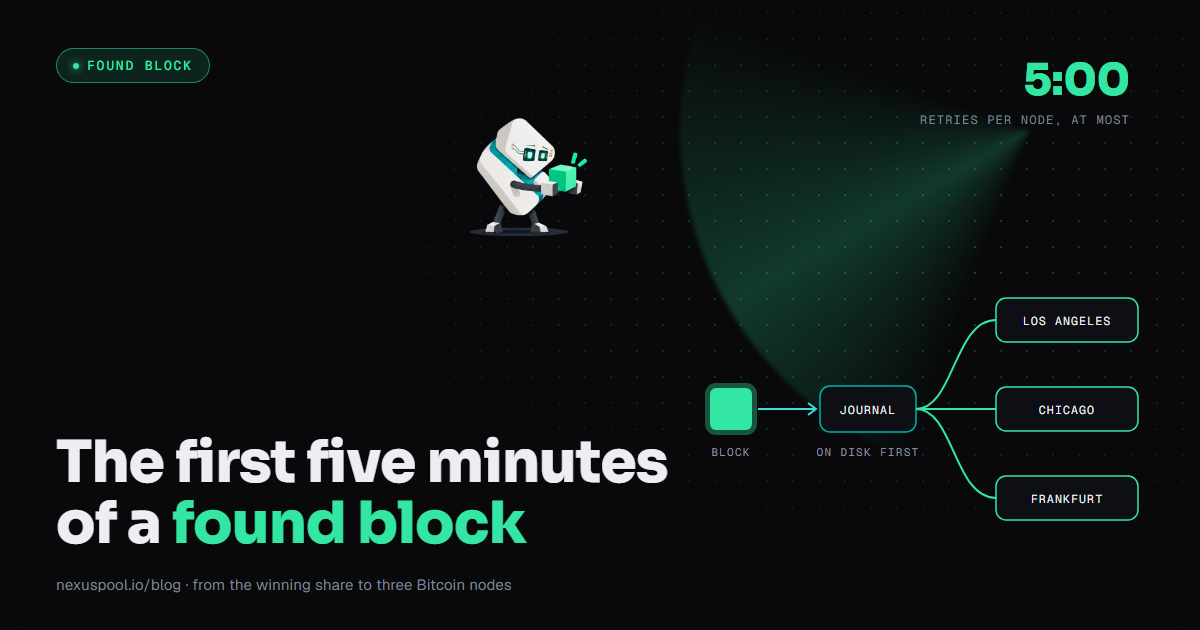
The next few minutes after a solo miner finds a block decide whether that block reaches the chain with the miner's address in its coinbase. Network difficulty set the odds of getting there before the find, and those odds are the same at every pool, this one included. A pool controls the window after the find. It has to read the winning share as a block and get that block to the network intact. At NexusPool that window has a fixed shape, and you can check most of it from your side.
What happens when a solo miner finds a block at NexusPool
A block starts life as a share. Your rig hashes against the share target the pool gave it, and on a rare occasion one of those shares meets the network target. Over Stratum V1, NexusPool tests each share against the network target before it applies its difficulty, credit and share-rate rules, so the pool submits the block of a rig that has gone over its share-rate limit. Three checks run before the block test: a flood ceiling on each connection, set above that limit, a lookup of the job the share belongs to and a duplicate check. Over Stratum V2 the pool follows the same order, except for a late share on a job the pool has retired.
The pool assembles the full block from three parts: the header your rig hashed, the coinbase that pays your address, and the transactions of the template your rig was mining. One detail depends on timing. NexusPool sends every rig a first job built from the header as soon as a new block appears on the network, so your rig moves off the stale parent before the pool's node finishes validating the new block. That first job carries no transactions. If your rig finds a block on it, the block pays the subsidy without fees. The next job carries the template with fees.
Before anything leaves the machine, the block goes to disk
The pool writes the block to a journal on disk before it sends it anywhere. A process can die between building a block and sending it, from a crash or a power cut, and a block held in memory dies with the process. With the block on disk first, a restart doesn't lose it. If the pool comes back before any node has accepted the block, it reads the journal on startup and resubmits the block.
We test that path against regtest nodes, including a restart between the find and the submission. Recovery code sits idle for months and has to work the one time it runs, so we don't trust it without that test.
Three Bitcoin Core nodes, in parallel
The pool submits the block as soon as the winning share arrives. It doesn't wait for the next job or the next template. From Los Angeles, Chicago and Frankfurt, the pool sends the block to three Bitcoin Core nodes in three regions: the region's own node and two more over a private network. The three submissions go out in parallel, so a slow or unreachable node doesn't hold up the other two. Our Singapore region submits to one node, its own, and we list that as an open gap.
Each node that accepts your block validates it and relays it to its own peers, and that relay is how a block spreads across the Bitcoin network. Three nodes in three regions give your block three starting points on the network instead of one.
The pool signs a receipt for the block itself. It records the block going out to the nodes the pool reached and names the coinbase transaction that pays you, so you can look that transaction up on any block explorer.
Up to five minutes of retries
A node can refuse a submission for reasons that have nothing to do with your block. It might be restarting or busy with the previous block. The pool doesn't treat one failed attempt as the end: it retries each node for up to five minutes, and a hiccup on one node costs nothing while another node has taken the block.
The five minutes are the retry window, and a healthy node takes a valid block on the first attempt, so the window does not measure how long a block takes to reach the network.
Where the reward goes when a solo miner finds a block
The coinbase of your block pays the full subsidy plus that template's fees to your address, inside the block itself. NexusPool charges a 0% pool fee in solo mode, so the only coinbase output that carries value is yours; the other outputs carry data such as the witness commitment. We hold no balance for you, and you have nothing to withdraw and no payout threshold to reach. If the block makes it into the chain, the reward sits at your address.
Bitcoin's consensus rules add one wait that applies to every coinbase at every pool: your wallet cannot spend the output until miners build 100 more blocks on top of yours, about 17 hours at the network's average pace. The Bitcoin developer documentation states the rule in its guide to the block chain.
Over Stratum V1, the pool checks your address when your rig connects and refuses one it can't pay. A typo fails at connect time, on a day when nothing depends on it, instead of inside a block.
Check your NexusPool payout before your rig finds anything
You can verify the part of this path that depends on you today. Payout Preflight takes your address and rebuilds the exact coinbase the pool would pay you on the current block, byte for byte, with the amount and the raw transaction. Decode that transaction with your own software and read the output script. If it pays the address you meant, your side of the path is set.
After a find, a block explorer settles the rest. Any block the pool submits is public, and its coinbase shows the output paying the finder's address. The parts of the path the pool controls are on our technology page. On the Glass Ledger, the pool signs a receipt each hour for the shares it counted from your rig.
On 26 September 2026, a NexusPool test instance ran this path end to end on Bitcoin's test network. Mining with rented hashrate, it found testnet4 block 154008, wrote the block to its journal on disk and submitted it to one Bitcoin Core node, which accepted it. The coinbase carries the tag /NexusPool-M9-tn4/ and pays the whole reward to the mining address. Test coins have no market value. Read testnet4 block 154008 on mempool.space.
What NexusPool can't do in those five minutes
Nothing in this window changes your odds. Network difficulty sets the chance that any one hash finds a block, and that chance is the same at every pool.
A pool can't pick which of two competing blocks the network builds on. If another miner finds a block at the same height around the same time, the next block the network finds settles it, and the block that loses pays nobody. Submitting to several nodes at once shortens the time before the network hears your block. It doesn't decide the race.
Three gaps are open as of 23 September 2026. Singapore submits to one node instead of three. Over Stratum V2, the pool rejects a share that arrives on a retired job as stale before testing it for a block. After a Stratum V1 reconnect, the pool forgets the jobs of the old connection, so it can't test a late share from before the reconnect. We have built fixes for the last two and have not deployed them.
Check your payout address today, while nothing depends on it. Trust nothing. Verify the coinbase.