Glass Ledger
Is a 0% Fee Bitcoin Mining Pool Actually Free?
SpiderPool mined a Bitcoin block with zero transactions in it this year. Here is what that reveals about what pool fees actually pay for.
Wait, Don't Bitcoin Mining Pool Fees Already Cover This?
A pool's headline fee, whether that is 0%, 1%, or 2%, describes what the pool takes off the top of a block reward before paying it out. It says nothing about how that pool builds the block in the first place, or what it does in the seconds after a new block is found while it is racing to build the next template. Bitcoin mining pool fees are the number everyone compares. They are not the only number that determines what a miner actually walks away with.
What Does an Empty Block Have to Do With Any of This?
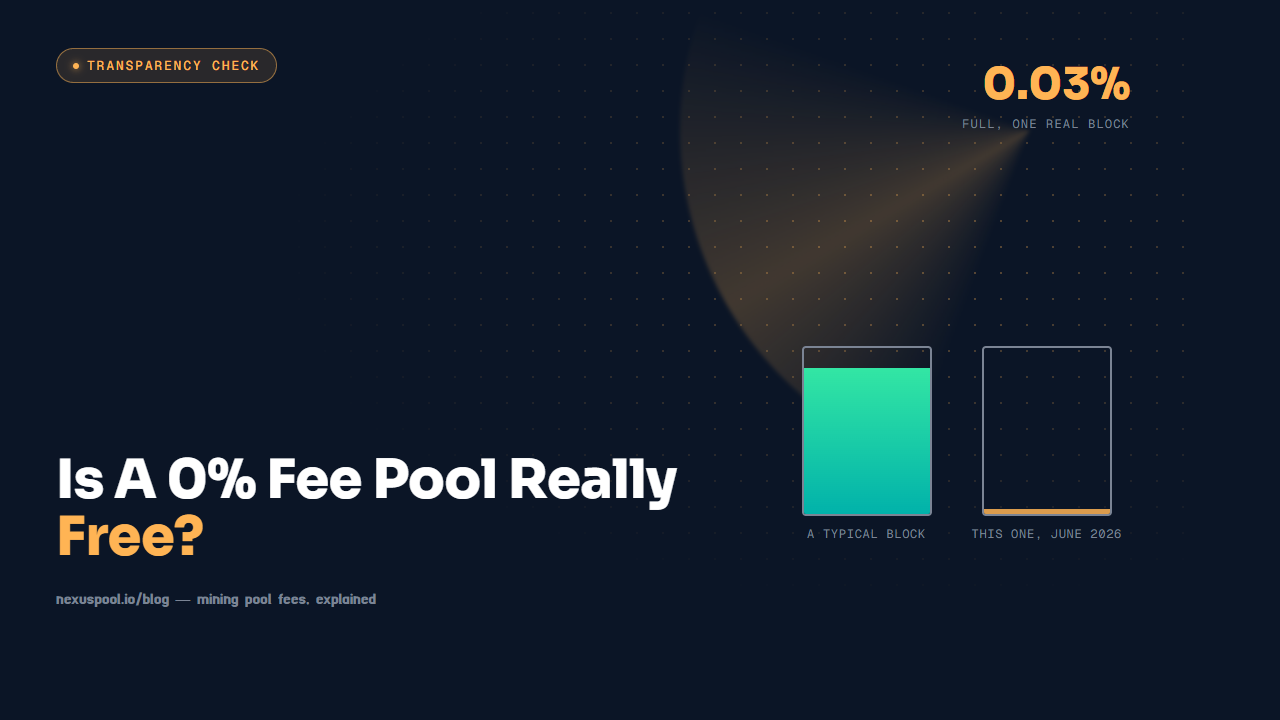
On June 19, 2026, at block height 954,352, SpiderPool published a Bitcoin block containing nothing but the mandatory coinbase transaction. No user transactions, no fees collected beyond the fixed subsidy. The block was about 0.03% full. Data from Mempool Research cited in the coverage put SpiderPool's empty block rate at above 5%, a noticeably higher share than its portion of network hashrate would predict, as reported by Cryptobriefing.
This is not necessarily foul play. When a new block lands, a pool has to validate the transactions in its queue and build a fresh template, and that takes a few seconds. A pool can wait for a complete template or start hashing immediately on a bare-bones one. The block in question followed a previous block by just 62 seconds, which explains the temptation to skip the wait. But an empty block still collects the full block subsidy while contributing nothing to the transaction backlog every other Bitcoin user is paying fees to clear. Repeated across a pool's whole operation, that pattern shapes what miners on that pool actually earn in fees, in ways the advertised percentage fee never mentions.
So How Would a Miner Even Notice This Was Happening?
That is the real problem. A miner pointing hashing power at a custodial pool generally sees a dashboard number and a payout. They do not see the block templates their own hashing power was assigned to hash against, whether those templates were full of fee-paying transactions or nearly empty, or how the pool's internal accounting translated total pool earnings into an individual payout. The headline fee is the only number that gets marketed. The block-construction decisions sitting upstream of that fee are not.
Does a Lower Advertised Fee Even Mean Lower Real Cost?
Not necessarily, and that is the myth this whole story quietly undercuts. A pool that produces more empty blocks than its hashrate share should predict is capturing subsidy income without doing the work of clearing the transaction queue, work that fee-paying users are counting on someone to do. None of this requires assuming bad intent. It does mean that a 0% or 1% headline fee is a partial picture, not a complete one, and it is worth asking what sits behind it before assuming the lowest advertised number is automatically the cheapest pool.
What Does Non-Custodial Actually Change Here?
A non-custodial structure does not stop a pool from building near-empty templates. What it changes is who holds the reward once a block is found. On a non-custodial pool, the coinbase transaction pays the block reward directly to the miner's own address the moment a block is solved. There is no pool-held balance sitting between a win and a payout, and nothing for a miner to withdraw or wait on. NexusPool's about page lays out that structure in plain terms, and the pool's signed, offline-checkable Glass Ledger work receipts exist so a miner can check what work was actually credited to their address rather than taking a dashboard number on faith. None of this is a claim that NexusPool improves anyone's odds of finding a block in the first place. Difficulty divided by hashrate sets those odds, identically for every miner mining a given chain, and no pool, custodial or not, changes that math.
Does Stratum V2 Change Any of This?
Stratum V2 lets the miner, not just the pool, see and select the transaction template a device is hashing against, instead of trusting a black box handed down from the pool operator. That does not stop a pool from choosing to publish a near-empty template if it decides the seconds saved are worth more than the fees skipped. What it does is make the choice visible instead of invisible. NexusPool runs Stratum V2 natively, encrypted and authority-key-pinned, on the same port as Stratum V1 so older firmware keeps connecting without any settings changes. Visibility is not the same thing as a guarantee, and it does not change a pool's incentives by itself. It does mean a miner has something to check instead of only a marketing page to take at face value.
Is This Something Every Miner Needs to Worry About?
Realistically, most solo and small-scale miners are not going to move enough hashing power to make a pool's empty-block habits matter much to their own expected payout in any given week. But it matters as a category. It is the same category as the fee itself: something a miner should be able to see and check, not something they have to take on trust because the dashboard only shows one number. NexusPool's status page publishes the pool's own operational data for exactly that reason, so the claim of transparency has somewhere to be checked rather than just asserted.
This is not an accusation that any specific pool is defrauding its miners, and it is not investment or earnings advice. It is a description of what the advertised fee number does and does not tell you, based on a documented event.
So, is a 0% fee pool actually free? The fee might be zero, but free of what a pool does with its block templates is a separate question, and it is worth answering before pointing hashing power anywhere.
Trust nothing. Verify what your pool is actually putting in the blocks it builds.