Pool Transparency
Pool Transparency Review for Bitcoin Miners
Use this pool transparency review to check custody, payout construction, work accounting, connection security, and public operational proof before mining.
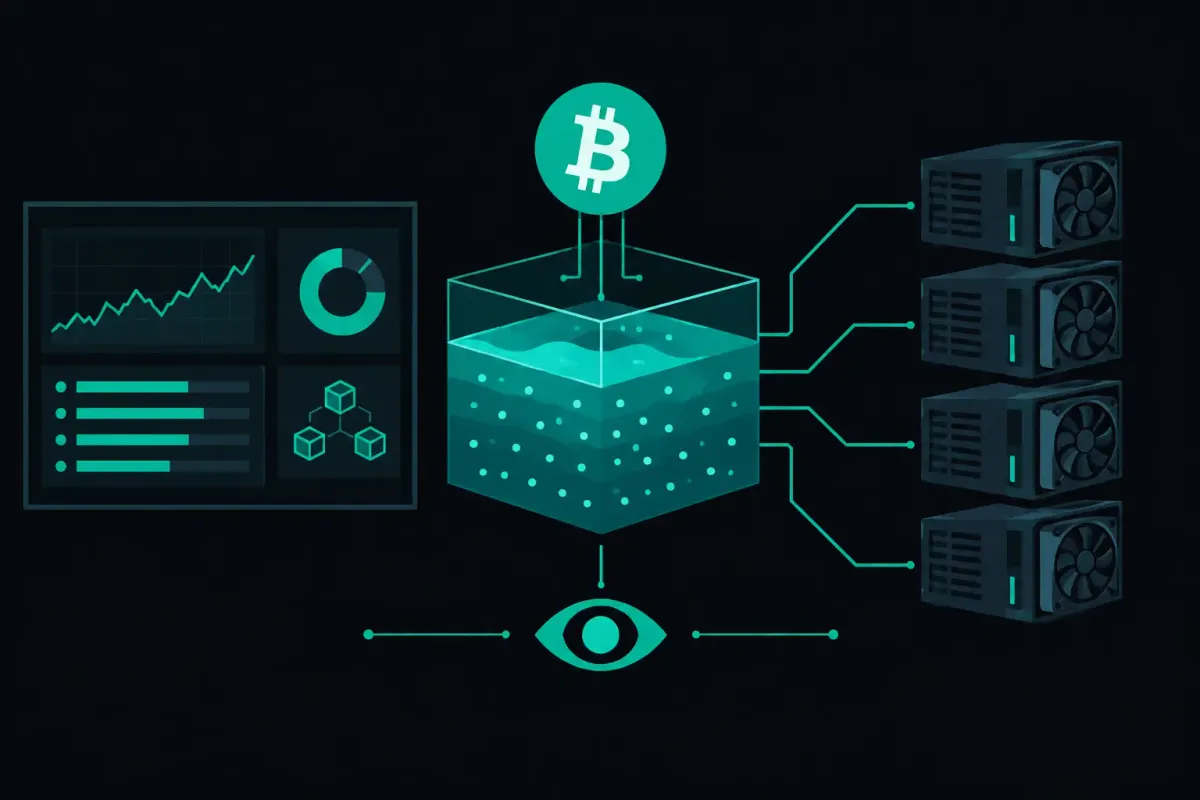
A pool transparency review should begin before your miner submits its first share. The question is not whether a pool dashboard looks polished or whether an operator sounds credible. The question is what the pool can technically do with your work, your payout, and your connection - and what evidence lets you check those limits yourself.
For a solo or lottery miner, the distinction is direct. You are accepting high variance. A valid block may arrive tomorrow, years from now, or never. No pool changes that. What the pool can control is whether it receives your work, what template you are mining, where a solved block pays, and whether its public claims can be tested without access to its internal systems.
What a Pool Transparency Review Should Test
Transparency is not a badge. It is a set of claims with different proof standards. Some claims can be checked from the Bitcoin blockchain. Some can be tested from your miner. Others require signed records, protocol documentation, or a frank statement that a claim cannot yet be independently audited.
Start with custody. If a pool receives block rewards into an address it controls, then calculates your balance later, it is in the payment path. That may be a model a miner accepts, but it is not self-custody. The operator controls the funds until payment occurs. A displayed balance is an accounting claim, not Bitcoin in your wallet.
Direct payout changes the structure. When the coinbase transaction pays the full block subsidy and transaction fees to the Bitcoin address you specified, the pool does not first hold the reward for you. The proof is the confirmed block itself. You can inspect the coinbase output, confirm the destination address, and calculate the amount without trusting a balance page.
That does not make every other question disappear. You still need to know whether your miner received valid work and whether the payout address was attached to the job before a rare winning share mattered. A serious review examines both the payment result and the path that produced it.
Check the Payout Before Luck Is Involved
A pool should make payout construction understandable before anyone finds a block. Waiting for a once-in-a-lifetime event to discover a configuration error is not a verification strategy.
Look for a preflight process that shows the payout address, expected coinbase destination, and the details needed to validate the eventual transaction. The useful question is not whether the pool says it pays 100 percent. Ask how you would prove it if your device solved the next block.
The math needs careful language. One hundred percent of a block reward means the miner receives the block subsidy plus the transaction fees included in that solved block, subject to Bitcoin's consensus rules and the actual block template. It does not promise a block. It does not make a small miner's odds better. It defines what happens if the improbable event occurs.
NexusPool uses direct on-chain payment to the miner's own Bitcoin address and provides Payout Preflight verification. That gives a miner a concrete object to inspect before pointing hash rate at the pool. The final proof remains public: the coinbase transaction in a valid block.
Work Accounting Needs More Than a Number
Shares are not Bitcoin. They are evidence that your miner performed work at an assigned difficulty. Pools use them to measure contribution, monitor connections, and, in shared-reward systems, calculate payments. For solo mining, share statistics still matter because they are your best operational signal that the pool is receiving useful work from your hardware.
A reported hash rate is an estimate. It can vary because of sample size, assigned difficulty, rejected shares, network conditions, and the miner's own instability. A ten-minute chart is not a performance guarantee. It is a measurement with noise.
Review how the pool exposes that measurement. Can you see accepted and rejected shares? Does it use per-rig difficulty that fits a low-hashrate Bitaxe as well as a conventional ASIC? Can you compare your miner's local logs with pool-side observations? Are fleet statistics live enough to identify an outage instead of leaving miners to guess?
Dynamic difficulty is useful when it reduces meaningless chatter while preserving a workable signal from small rigs. But it should not become an opaque number that conceals what a share means. A miner should be able to understand the assigned target, observe accepted work, and spot an unexpected rise in rejects.
The strongest accounting design also recognizes a limit: no public dashboard can prove every internal event by itself. If the operator publishes a cryptographically signed ledger, verify the signature and understand exactly what it establishes. A valid signature proves that the holder of the signing key issued the record. It does not magically prove that every underlying measurement is true. Cross-check signed records against your miner logs, observed jobs, and public chain data where possible.
Connection Security Is Part of Transparency
Mining is a live protocol relationship. If work can be modified in transit or if a miner connects to an endpoint it did not intend to use, a correct payout policy on paper is not enough.
Stratum V1 remains necessary for much of the hardware in home mining. Many standard ASICs and small open-source rigs speak it today. Its broad support is useful, but miners should understand the security properties of the exact connection they are using rather than assuming a port number provides confidentiality.
Native Stratum V2 provides a different model. Noise encryption protects the connection, and authority-key pinning lets the miner identify the expected pool authority rather than accepting any server that answers first. This is meaningful only when the miner or firmware actually supports V2 natively. Bitaxe AxeOS and BraiinsOS+ are examples. Many other devices require a translator to reach a V2-only pool.
For that audience, a pool that accepts V1 and native encrypted V2 on one connection point removes a separate moving part. It does not turn V1 into V2. It gives miners a path to use the protocol their hardware supports now, while allowing native V2-capable firmware to use its security model directly.
Latency belongs in the same review. A stale share is work submitted too late to matter. Test your actual route from your location and compare it with the pool's latency tools. Server geography can affect results, but it is not the whole story. ISP routing, Wi-Fi problems, overloaded routers, and a struggling controller can all look like a pool problem from a distance.
Public Operations Matter When Things Break
Every mining service eventually has maintenance, deployment errors, rejected connections, or upstream network trouble. The useful transparency test is not whether an operator promises perfection. It is whether miners can establish what changed, when it changed, and what evidence supports the explanation.
A public changelog creates a timeline. It lets miners connect a change in observed behavior to a documented release or configuration update. Signed operational records can add integrity when the verification key and signature format are published. Version information helps, too, but do not confuse an MIT license with publicly auditable source code. A license can be real while the relevant implementation is not yet available for public inspection.
That distinction is not pedantry. It is the difference between verifying a deployed behavior from external evidence and reviewing the code that may produce it. Both have value. Neither should be claimed as the other.
A Practical Standard for Miners
A pool does not need to expose every internal detail to earn scrutiny. It does need to make its consequential behavior testable. Can you validate the payout address before mining? Can you observe that your rig's shares arrive? Can you verify the security mode your hardware negotiated? Can you inspect a signed record rather than merely read a status message? Can you confirm a winning payout on-chain without asking support to release it?
If the answer is no, the remaining question is whether you are comfortable replacing proof with trust. Some miners may be. But self-custody is not just about holding private keys after a payout. It is about minimizing the number of moments when someone else can decide what happened to value created by your hardware.
Run the checks while nothing is at stake. A block found under pressure is a bad time to learn which claims were only words.
Trust nothing. Verify the payout transaction.