Non-Custodial Mining
Bitcoin Mining Tax Bill: A Solo Miner's Checklist
Congress marks up a bill on September 16 that could change when miners owe tax on block rewards. Here is a self-check before that vote, not tax advice.
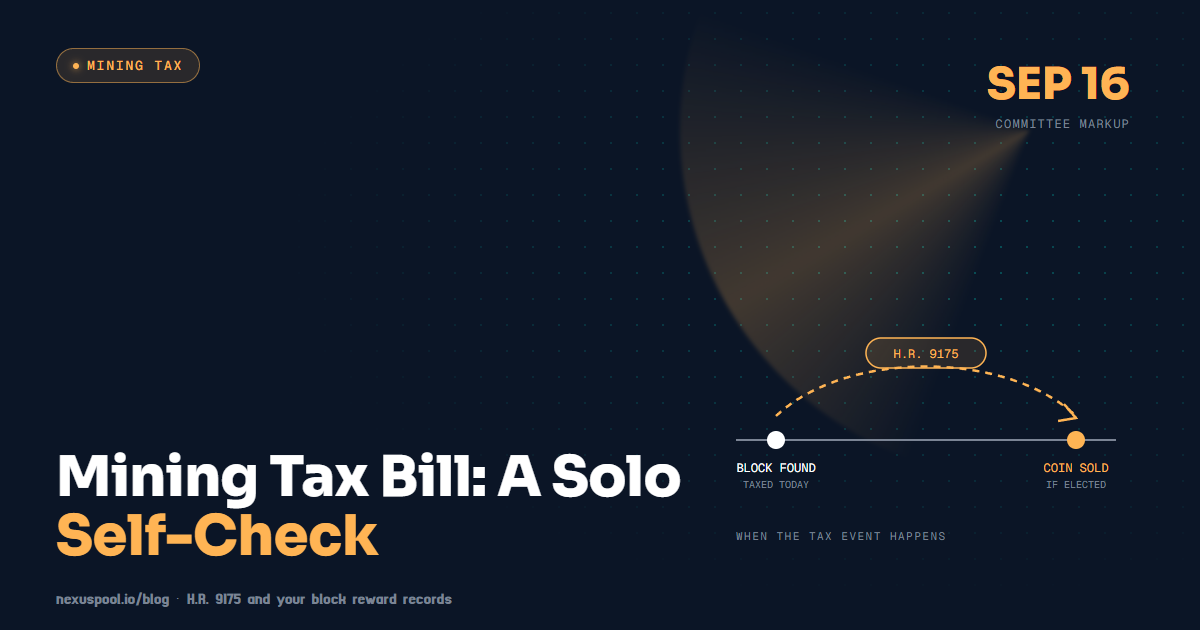
The House Ways and Means Committee is set to mark up a package of crypto tax bills on September 16, 2026, according to a Bloomberg report carried by CryptoBriefing, Asianet Newsable and others (as of September 12 the committee had not yet posted a formal markup notice). The bill in that package that matters most to miners is H.R. 9175, the Tax Clarity for Mining and Staking Act, a Bitcoin mining tax bill built around one question: when does a miner owe income tax on a block reward? Under IRS Notice 2014-21, the fair market value of mined coins counts as ordinary income on the day you receive them, whether or not you ever sell. H.R. 9175 would let miners and stakers elect to push that moment back to when they dispose of the coins.
If you solo mine, this rule hits you more directly than almost anyone else in Bitcoin. No exchange withholds anything and no custodian files a form for you. With a non-custodial pool, the entire reward lands in your own wallet the moment the coinbase transaction confirms. That directness is why people solo mine, and it also puts the whole recordkeeping job on you. Run the self-check below against your own setup before September 16, whichever way the vote goes.
What the Bitcoin mining tax bill actually says
Representative Mike Carey (R-OH) introduced H.R. 9175 on June 8, 2026, and Congress.gov lists it as referred to Ways and Means. The committee published the draft text ahead of a June 9 hearing on digital asset taxation. Reading that text, rather than the headlines about it, turns up four details that the short summaries leave out.
First, the default stays the same. The bill writes today's treatment into the tax code: newly minted coins count as ordinary income at fair market value when you acquire them, and that amount becomes your basis.
Second, deferral is an election, not automatic. If you make it, rewards from that tax year stay out of your income until you dispose of them. The election also carries forward to every later year unless the Treasury consents to revoking it.
Third, deferral changes the timing of the tax, not its character. When you eventually sell an elected coin, the bill treats your gain as gain from property that is not a capital asset, which means ordinary income rather than long-term capital gains.
Fourth, electing changes how your costs work. Your mining costs for that year (the bill calls them specified acquisition costs) get capitalized into the coins instead of deducted in the year you pay them. A miner who elects gives up the current-year deduction for those costs.
One amendment is also in play. Representative Steven Horsford (D-NV) filed an amendment in June that would end the deferral after the fourth taxable year following the year you mined the coin, taxing any unsold coin as if you sold it at fair market value on that year's last business day. Nobody knows yet whether that amendment will be adopted at the markup.
Your Bitcoin mining tax self-check before September 16
- Current rule. I know that today's rule, not the proposed one, applies to every reward I have already received: ordinary income at fair market value on the day it arrived, regardless of what happens to H.R. 9175.
- Timestamps. I have a record of every block reward I received this year, with the date, time, block height and BTC amount.
- Valuation. I have the USD (or local currency) value of Bitcoin at the time each reward arrived, not a rough monthly average, because valuation method matters if anyone ever reviews a return.
- Payout address. I know which address my rewards land in and I control its keys. NexusPool's payout preflight shows you the exact coinbase transaction the pool would build for your address on the live block, so you can confirm where a reward would go before you ever win one.
- Custody and timing. I understand that a non-custodial payout, such as a reward paid straight to my own address through NexusPool, does not change when the tax event happens. It changes who holds the coin in between, which is nobody but me.
- Costs. I track my electricity, hosting and hardware costs separately, because under the current rule they are deductions and under an H.R. 9175 election they would become part of each coin's basis.
- Basis. I keep cost basis per reward, since that figure decides gain or loss whenever I sell or spend it.
- No speculation. I am not treating a possible change in tax timing as a reason to mine harder or to expect a specific financial result. Mining is not an investment product, and no bill changes the odds of finding a block, which depend on network difficulty relative to hashrate and nothing else.
- A professional. I have talked to an accountant or tax preparer about my situation instead of filing off a blog post, this one included.
- Status. I know where to check the bill's real status after the markup, and I will not read a committee vote as a law.
What to do depending on how the checklist lands
If you checked every item, your records already hold up whatever happens on September 16. A committee vote does not change how rewards you already received get taxed, so keep logging each reward's timestamp and value on the day it lands.
If you could not check the timestamps or valuation items, fix those first, before you think about the legislation. Start logging block rewards going forward with a timestamp and a price snapshot at receipt. A signed, offline-checkable record of the work you submitted, the kind NexusPool's Glass Ledger provides, gives you evidence of what happened no matter which tax regime ends up applying. It documents the work. It does not tell you what you owe, and it does not replace a tax professional reviewing your return.
If the bill clears committee and eventually becomes law, you would face a choice rather than an automatic change. Electing deferral would move the tax on rewards you hold from the year you mine them to the year you sell, taxed as ordinary income then, with your mining costs capitalized instead of deducted along the way. If the Horsford amendment is adopted, that deferral would end after about five years. If the bill stalls, which happens to plenty of bills after a first markup, the receipt-based rule keeps applying and your current recordkeeping stays exactly what you need. The technical side of how NexusPool pays rewards to your address is on the technology page if you want to match your records against it.
This post describes a pending bill and current tax treatment, drawn from the bill's published text and public reporting on the committee schedule. It is not tax advice, not a prediction that H.R. 9175 will pass, and not a promise about what any miner will owe. It is not investment guidance either. Solo mining remains a lottery whose odds depend on difficulty and hashrate alone, identical for every miner on the chain, and no tax law changes that math.
Trust nothing. Verify your reward records against what actually confirmed on chain, and verify the bill's text against what the headlines say it does.