Glass Ledger
Bitcoin's Reorg Explained: What Solo Miners Should Know
Bitcoin had its third one-block reorg in a month on September 11. Here is what actually happened, why it isn't an attack, and what it means if you solo mine.
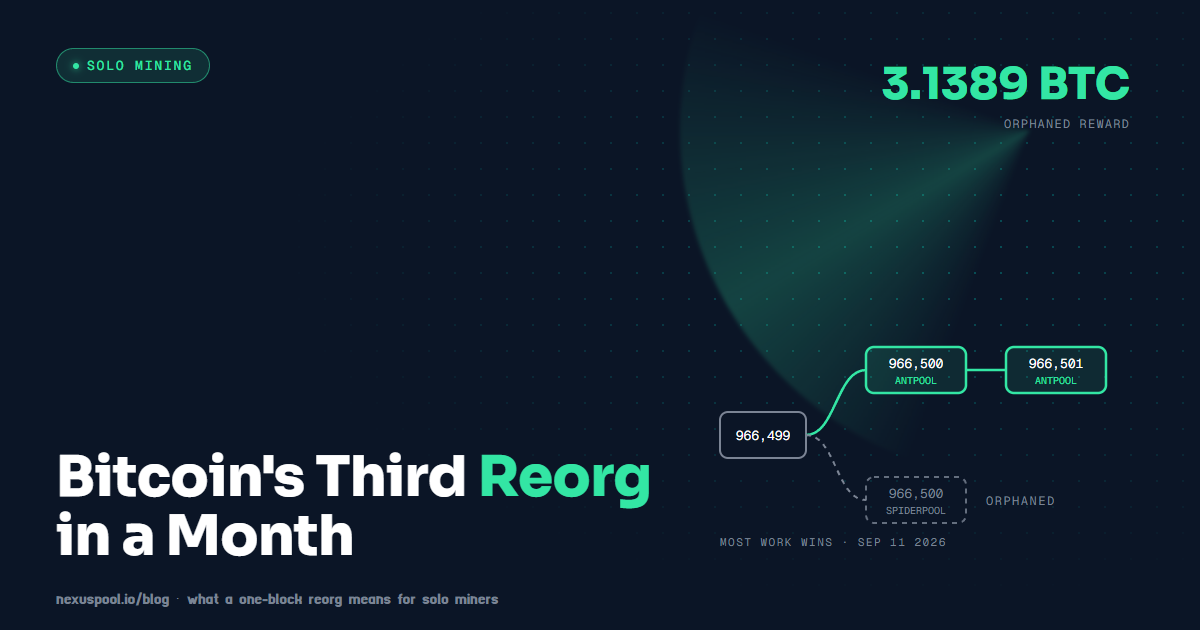
On September 11, 2026, Bitcoin's blockchain briefly split into two competing versions of the truth. AntPool and SpiderPool each found a valid block at height 966,500, both built on the same parent block. For about a quarter of an hour, nodes disagreed about which block was the tip of the chain. Then the network settled on one, and the other block, along with its 3.1389 BTC reward, was left behind. As Bitcoin.com News reported, Galaxy Research counted this as the third one-block reorg in four weeks, after similar events at heights 962,722 on August 16 and 963,853 on August 24. A Bitcoin blockchain reorg sounds alarming in a headline. You get more out of walking through what happened block by block, and what it means if you run your own hardware.
What actually happened in the September 11 Bitcoin reorg?
Galaxy Research's node saw SpiderPool's block 966,500 first and treated it as the chain tip. AntPool had found its own valid block 966,500 at nearly the same moment, and Galaxy's node did not even know that second block existed yet. Other nodes and miners saw AntPool's version first. Two branches, both valid, each followed by part of the network.
The tie broke the way Bitcoin always breaks ties: nodes follow the valid chain with the most accumulated proof of work. AntPool found block 966,501 on top of its own 966,500. According to the block data on mempool.space, AntPool's 966,500 carries a timestamp of 11:30:30 UTC and its 966,501 a timestamp of 11:47:00 UTC (miners set these timestamps, so treat the 16-minute gap as approximate). The moment 966,501 arrived, AntPool's branch had more work behind it. Galaxy's node dropped SpiderPool's block and switched over, and so did every other node still following SpiderPool's branch.
Was this an attack, or a bug in Bitcoin?
Neither. Galaxy Research itself called the event common. Nobody double-spent anything, no invalid transaction slipped through, and nobody exploited a flaw. Two honest miners found valid blocks close enough in time that the network needed one more block to decide between them, and Bitcoin's longest-chain rule resolved it within that one block without anyone intervening. Compare that to Cronos, which rolled back roughly two hours of its chain in early September to reverse an exploit: that was a coordinated decision by the chain's operators. The Bitcoin reorg involved no decision at all, only the same rule every node already runs.
What happens to the block that gets left behind?
SpiderPool's block stopped counting. Any of its transactions that AntPool's block had not also included went back into the mempool, and a later block could confirm them. The coinbase reward on the orphaned block, the newly minted BTC plus fees, never paid anyone, because the chain the network settled on never contained it. AntPool's winning 966,500 paid out 3.14112795 BTC. SpiderPool's losing version would have paid roughly 3.1389 BTC, and it became worthless the moment the network moved on.
If a solo miner found that orphaned block, would they lose the reward?
Yes. This applies to every pool, NexusPool included, because it follows from how Bitcoin works rather than from how any pool runs. If your block ends up on the losing side of a reorg, your reward disappears with it, whether one ASIC on your desk found that block or a pool with a large share of the network did.
A non-custodial pool changes one thing here: nothing sits in between. On NexusPool, the coinbase transaction pays your own address directly with a 0% fee, so an orphaned block leaves no pool balance to argue about and no IOU to chase. The reward exists on the winning chain or it does not exist. If you want a signed record of the work you submitted, separate from whether a particular block survived, that is what NexusPool's Glass Ledger receipt system provides.
Why do Bitcoin reorgs happen at all?
A fork like this needs a second block found during the short window before the first one reaches the miners competing with it. Blocks arrive every 600 seconds on average. The chance that someone finds a competing block within any single second after a block is about 1 in 600 (1 minus e to the power of minus 1/600, or 0.17%). Faster relay between pools shrinks that window, and slower relay widens it.
Four weeks hold about 4,032 blocks (28 days times 144 blocks a day). Three one-block reorgs in 4,032 blocks is 1 in 1,344. If those three were the only forks in the period, that rate matches an effective window of about 0.45 seconds, which fits how fast well-connected pools relay blocks to each other today. Galaxy's note that its node "never saw the Antpool block until it confirmed" shows the other side of the same fact: some nodes learn about a block late, and that delay is exactly where forks come from. Three reorgs in a month do not show Bitcoin's consensus weakening.
Does pool size change who wins a reorg race?
Here the answer splits in two, and both halves matter.
Pool size does not change your odds of finding a block. The chance that any unit of hashrate finds the next block depends on network difficulty and nothing else, and it is identical for every miner on the chain, solo or pooled, small or large. No pool, protocol version, or fee structure moves it.
Pool size does change who wins a tie. Each miner builds on the block it saw first, and a pool keeps mining on its own block. When two blocks tie, the branch whose supporters find the next block wins, so a pool with a large share of the network has a better chance of extending its own branch. AntPool did exactly that on September 11: it found 966,501 itself.
A solo miner with a tiny slice of the network cannot win a tie that way. If you ever find a block, your protection is speed: the pool you mine through has to get your block to the rest of the network before a competing block spreads. You can read how NexusPool builds block templates and submits found blocks on its technology page, and check the live state of each region on the NexusPool status page, instead of taking any of this on faith. None of that changes your odds of finding a block. It only affects how quickly a block you already found reaches everyone else.
Nothing here guarantees a reward once a block is found, and none of it is investment advice. Mining does not guarantee income.
So should the September 11 reorg worry you if you solo mine? Only if you were the miner whose valid block got orphaned in that one-block window, and then you lost it the same way SpiderPool did, under the same rules that apply to everyone. Trust nothing. Verify that your found block made it into the chain the network kept.